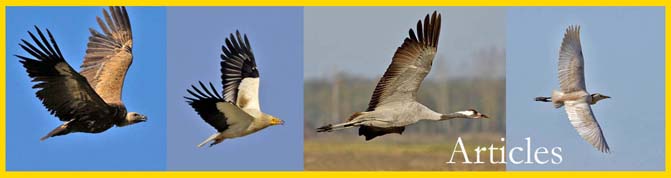
You will find here some articles about several birds’ species.
I can see the most part of these birds in my region. They breed or winter here and I observe them in their natural environment.
Others are seen in captivity, but their story is interesting and I am glad to share it with you.
Basic articles
Description of the bird and its plumage
The bird and its nest, where everything starts… See the Summary of this study
The bird and its nest: the passerines... See the Summary of this study (in progress)
Birds' legs and feet: different shapes
From observation to photography… or the contrary?
Introductions or descriptions
Orders and/or Families
Family Accipitridae - Description
Family Accipitridae - List groups
1- Kites, Cuckoo-hawks, Honey-buzzards
2- Fish-eagles - Feeding behaviour
4- Snake-Eagles, Serpent-Eagles and Bateleur
5- Harrier-hawks - Harriers - Crane Hawk
6- Goshawks, Sparrowhawks, Hawks
7- Buzzards – Hawks – Buzzard-Eagle – Solitary Eagles
10- Booted eagles
Birds of Prey (Accipitridae, Cathartidae, Sagittariidae, Pandionidae, Falconidae)
Order Bucerotiformes (Hornbills, ground-hornbills, wood hoopoes, scimitarbills and hoopoes)
Pheasants (Pheasants, peafowls)
Order Anseriformes (Ducks, geese, swans)
Order Passeriformes (Passerines of the world)
Order Psittaciformes (Parrots and cuckatoos)
Family Acanthisittidae (New Zealand wrens)
Family Aegothelidae (Owlet-nightjars)
Family Alcidae (Auks, auklets, guillemots, murrelets, murres, puffins and Razorbill)
Family Anhimidae (Screamers)
Family Anhingidae (Darters and Anhinga)
Family Apterygidae (New Zealand kiwis)
Family Ardeidae (Herons, egrets, night-herons)
Family Bernieridae (Malagasy warblers)
Family Bombycillidae (Waxwings)
Family Brachypteraciidae (Ground-rollers)
Family Callaeidae (Saddleback, Kokako and Huia)
Family Caprimulgidae (Nightjars and Nighthawks)
Family Cathartidae (New World Vultures)
Family Chionidae (Sheathbills)
Family Ciconiidae (Wood Storks, Openbills, Storks)
Family Cinclidae (Dippers of genus Cinclus)
Family Columbidae (Pigeons and Doves)
Family Corvidae (Nutcrackers, jackdaws, ravens, crows, jays, magpies, ground jays, treepies)
Family Cuculidae (Cuckoos, malkohas, couas, coucals, roadrunners...)
Family Diomedeidae (Albatrosses)
Family Emberizidae (Old World Buntings)
Family Falconidae (Falcons, caracaras)
Family Fregatidae (Frigatebirds)
Family Fringillidae (Chaffinches, Crossbills, bullfinches, goldfinches, grosbeaks, linnets, euphonias, rosefinches, canaries, siskins, greenfinches)
Family Gaviidae (Divers or Loons)
Family Gruidae (Cranes)
Family Icteridae (Blackbirds, caciques, oropendolas, orioles, troupials, grackles, meadowlarks, cowbirds, Bobolink)
Family Laridae (Gulls, terns, noddies and skimmers)
Family Mesitornithidae (Mesites)
Family Mimidae (Mockingbirds, Thrashers, Tremblers, Catbirds)
Family Mohouidae (Whitehead, Yellowhead and Pipipi)
Family Muscicapidae (Scrub Robins, Robin Chats, Forktails, Flycatchers, Bluethroats, Rock Thrushes, Robins, Redstarts, Magpie-Robins, Bush Chats, Stonechats, Wheatears)
Family Nyctibiidae (Potoos)
Family Opisthocomidae (Hoatzin)
Family Otididae (Bustards, Floricans and Korhaans)
Family Paradisaeidae (Birds-of-paradise, Standardwing, Riflebird, Manucode, Parotia, Paradigalla, Paradise-crow, Crow, Lophorina, Sicklebill and Astrapia)
Family Paridae (Tits, Chickadees, Titmice)
Family Parulidae (New World warblers)
Family Phaethontidae (Tropicbirds)
Family Phalacrocoracidae (Cormorants and Shag)
Family Philepittidae (Asities)
Family Phoenicopteridae (Flamingos)
Family Picidae (Woodpeckers, Piculets, Wrynecks)
Family Ploceidae (Weavers and allies)
Family Podargidae (Frogmouths)
Family Podicipedidae (Grebes)
Family Procellariidae (Petrels, Prions, Fulmars, Shearwaters)
Family Ptilonorhynchidae (Catbirds and Bowerbirds)
Family Rallidae (Coots, Moorhens, Crakes, Rails, Swamphens)
Family Rheidae (Rheas)
Family Rhynochetidae (Kagu)
Family Scolopacidae (Snipes, woodcocks, dowitchers, turnstones, sandpipers, ruffs, phalaropes, godwits, curlews, shanks)
Family Spheniscidae (Penguins)
Family Stercorariidae (Skuas and Jaegers)
Family Strigidae (Owls)
Family Strigopidae (Kea, New Zealand Kaka, Kakapo)
Family Sulidae (Boobies and Gannets)
Family Tetraonidae (Grouses)
Family Thinocoridae (Seedsnipes)
Family Trochilidae (Hummingbirds)
Family Troglodytidae (Wrens, Donacobius)
Family Turdidae (Thrushes)
Family Tyrannidae (Tyrants, Flycatchers)
Family Tytonidae (Owls genus Tyto)
Family Upupidae (Hoopoes)
Family Vangidae (Vangas, Newtonias and Ward’s Flycatcher)
Description of one species:
Behaviour, displays, diet, other studies...
Eiders... four really strange ducks
Eurasian Griffon Vulture's reproduction
Loro Parque Foundation and Parrots
The Northern Gannet, an acrobat in the sky
Parrots and clay… an old story !
Parakeets, the little green invaders!
White-throated Dipper, the bird flying underwater!
Island's birds - Endemic species
Island's birds - Endemic species (Main page)
Endemic bird’s species - Puerto Rico
Endemic bird's species - Jamaica
Endemic bird’s species - Trinidad and Tobago
Endemic bird’s species - Cocos Island (Costa Rica)
Avian Species of Clipperton Island
Avian Species of Desventuradas Islands
Endemic bird species of Juan Fernández Islands
Salas y Gomez Island Bird Species
Endemic bird’s species - Galapagos Islands
Endemic bird's species - Cyprus
Endemic bird's species - Seychelles
Endemic bird's species - Mayotte
Endemic bird's species - Madagascar
Endemic bird's species - La Reunion
Endemic bird's species - Mauritius
Tromelin Island avian bird species
Sri Lanka endemic bird species
Mauritius and Rodrigues Islands extinct endemic bird species
Endemic bird’s species - Canary Islands
Endemic bird's species - UK Sub Antarctic Islands
Avian species of South Shetland Islands
Endemic bird's species - French Subantarctic Islands
Avian species of Norwegian Sub Antarctic Islands
Avian species of South African Sub Antarctic Islands
Endemic bird’s species - Australian Sub Antarctic Islands
Endemic bird's species - New Zealand Sub Antarctic Islands
Endemic bird's species - Chatham Islands
Endemic bird's species - New Zealand
New Zealand extinct endemic bird species
Endemic bird species - Vanuatu
Endemic bird's species - Falkland Islands
Diego Ramírez Islands bird species
Franz Josef Land - Russian Arctic National Park
Novaya Zemlya - Arctic Ocean in northern Russia
Severnaya Zemlya (Russian high Arctic)
New Siberian Islands (Russian archipelago in the Arctic Ocean)
Wrangel Island - Arctic Ocean
Svalbard and Jan Mayen Islands (Norway territories in the Arctic Ocean)
The bird, this flying marvel so envied by humans, could have the Archaeopteryx as ancestor, known like the earliest bird up to now. However, without being their direct forefather, it is regarded as the most ancient bird, closely related to dinosaurs.
The bird, as we know it today, is living with us every day. Whether on the tree outside the window, under the house’s porch, in the garden, in town, in the countryside, at sea or in mountains, it is living everywhere.
Some species adapt easily to humans, whereas others, more unobtrusive, remain hidden in the forests. The seabirds fly over the waves off the crowded beaches in summer. The mountain birds share more peaceful habitat, but requiring specific qualities to survive in spite of harsh winters.
Each of them moves into a habitat suited to their needs. A bird, whatever it is, must find food, water, and nest-sites for breeding. When it does not find these things that are essential to its survival and that of its species, it goes elsewhere. It migrates, sometimes thousands of kilometers away, to find that it lacks here.
The problem of our modern world is that man occupies more and more space on earth, to the detriment of Nature and its inhabitants. Thus some species are declining, due to habitat loss. Fragmentation and clearing of forests, drainage of wetlands, construction of roads, pollution, are causing severe degradation to numerous habitat types. Thus, the bird has no more trees to nest near its feeding area or water, egg shells are weakened by the ingestion of toxic substances related to agriculture, their favorite preys become scarce. Species already begins to suffer ...
However, the most opportunistic are able to benefit from these changes, adapt and survive, showing how a healthy Nature is necessary for their survival.
Each species has adapted to an environment where balance is shaky. We must to preserve it!
The species' names can be found here: Avibase (Lepage Denis)