Photographers:
John Anderson
John Anderson Photo Galleries
Aurélien Audevard
OUESSANT DIGISCOPING
Didier Buysse
Vision d’Oiseaux
Steve Garvie
RAINBIRDER Photo galleries & Flickr Rainbirder
Otto Plantema
Trips around the world
William Price
PBase-tereksandpiper & Flickr William Price
Nicole Bouglouan
PHOTOGRAPHIC RAMBLE
Text by Nicole Bouglouan
Sources:
HANDBOOK OF THE BIRDS OF THE WORLD Vol 16 by Josep del Hoyo- Andrew Elliot-David Christie – Lynx Edicions – ISBN: 9788496553781
THE HANDBOOK OF BIRD IDENTIFICATION FOR EUROPE AND THE WESTERN PALEARCTIC by Mark Beaman, Steve Madge - C.Helm - ISBN: 0713639601
L’ENCYCLOPEDIE MONDIALE DES OISEAUX - Dr Christopher M. Perrins - BORDAS - ISBN: 2040185607
SPARROWS AND BUNTINGS – Clive Byers - Houghton Mifflin Company - ISBN: 03957387
Wikipedia (Wikipedia, The Free Encyclopedia)
CREAGUS@Monterey Bay (Don Roberson)
FAMILY EMBERIZIDAE
Old World Buntings
The Family Emberizidae belongs to the huge Order Passeriformes.
The origin of these birds is in South America. Little by little, they moved northwards, first to Central America, then into North America, before to continue to the West, reaching Eurasia through the Bering Strait. Asia gathers a great diversity of species, but these birds are rarer in West Europe and Africa.
Today, the family Emberizidae includes only the species of genus Emberiza. There are about 44 species in the Old World.
They usually are seed-eaters, often seen on the ground. Their strong legs allow them to forage under bushes and among low vegetation.
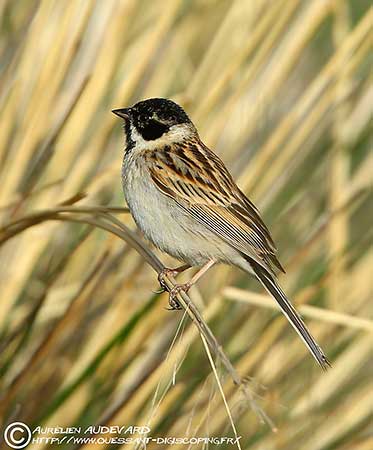
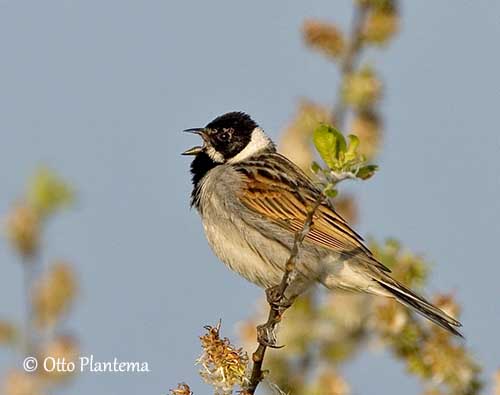
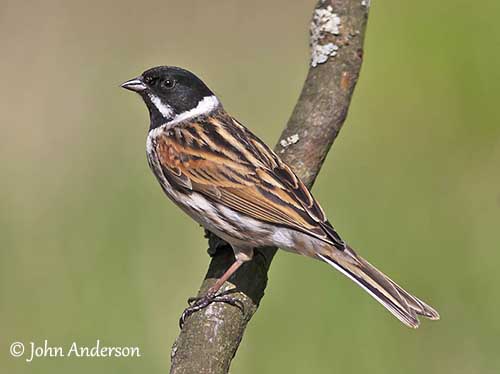
The Old World’s buntings can be separated in two groups, one with relatively dull, fairly uniform plumage with brown, chestnut, buff and grey colours, and the other with brighter colours, often yellow on the underparts, with bright chestnut breast or collar. They often have a contrasted head-pattern, with black and white stripes, more or less conspicuous. Some species such as the Common Reed Bunting have black head with contrasting white markings.
The conical bill is well-adapted to their diet and allows them to consume all kinds of seeds. However, during the nesting period, the young are fed first with insects.
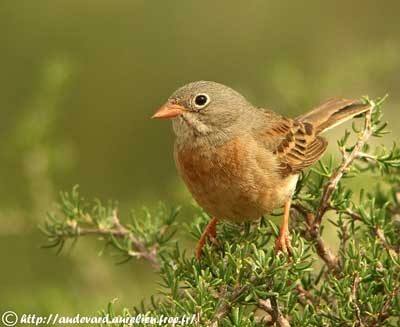
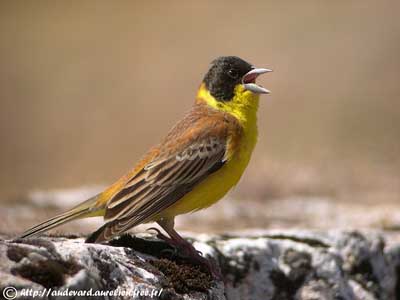
Grey-necked Bunting
Emberiza buchanani
Black-headed Bunting
Emberiza melanocephala
Male and female have different appearance. The female is usually duller. The juvenile resembles female with in addition, a heavily streaked plumage until the next spring.
In winter plumage, both sexes are very similar.
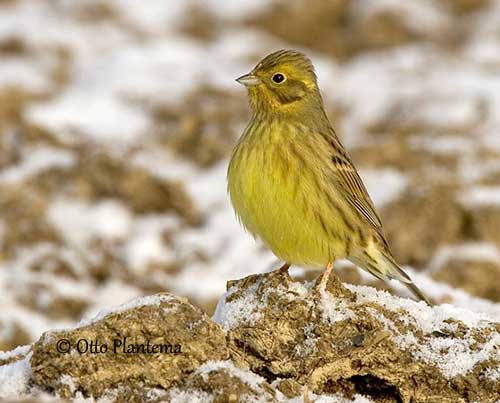
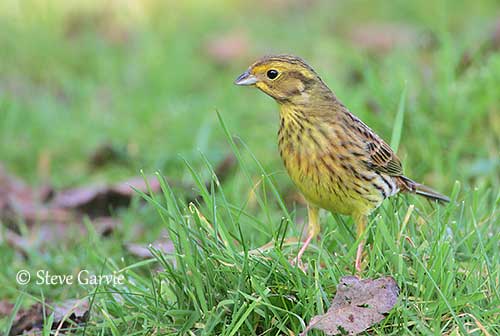
They nest fairly low among the vegetation, and even sometimes on the ground. Several types of breeding habitats are used, such as brushy, rocky areas adjacent to forest, also deciduous woods in foothills, grasslands and short scrub.
They may live in reedbeds and tundra. But they are mainly seen in scrub, or along cultivated areas, in woodlands, marshes or lands with scattered trees and bushes. Other species frequent open areas in most part of the range.
These birds often form small groups outside the breeding season.
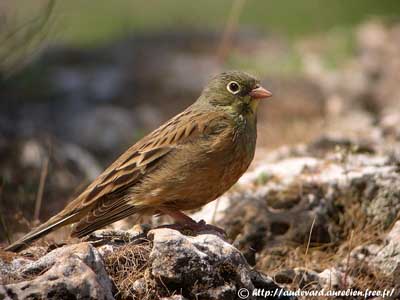
Ortolan Bunting
Emberiza hortulana
The songs are variable, but the most usual are scratchy and rattling.
The songs are part of courtship displays and are used to attract the females and to establish the territory.
The displays by males vary and often occur on the ground or in low branch. The male displays in front of the female with dropped wings and raised tail. Some mates may rub their bills, or the male performs aerial chases of female, or brings her nest materials. We also observe courtship feeding by male to female.
These species nest on the ground or fairly low, well-hidden among the vegetation or protected by overhanging rock, clump of grass or bush. The nest is an open cup, often built by the female with twigs, rootlets and other plant materials.
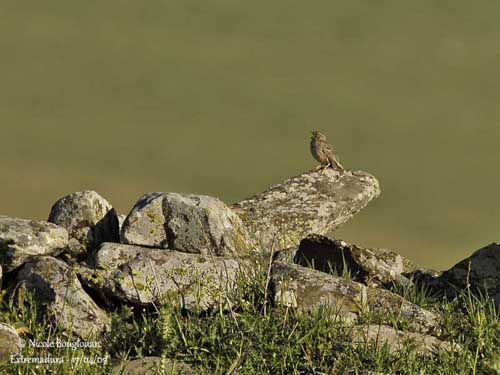
She usually lays 4-6 pale eggs, whitish, brownish or pale blue, with darker markings. The incubation lasts about 10 to 14 days, mainly by the female, but sometimes, the male brood the eggs for short moments. The young are reared by both parents, and leave the nest about 10 to 15 days later.
During the nesting period, the male defends the territory and protects both young and female. One to three broods per season are usual.
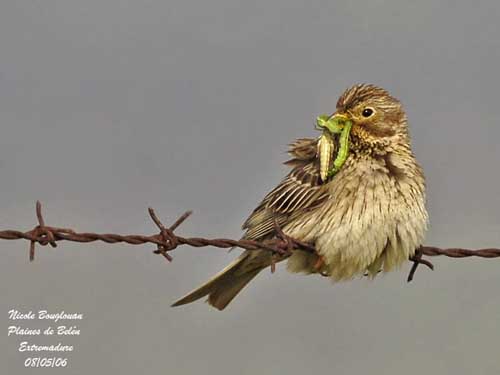
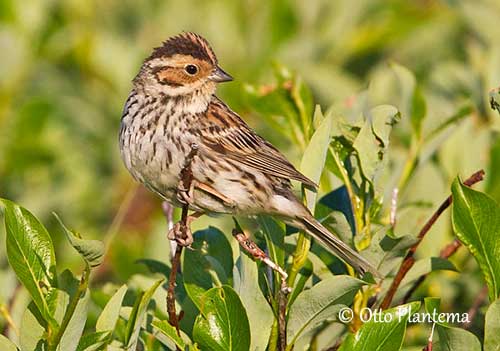
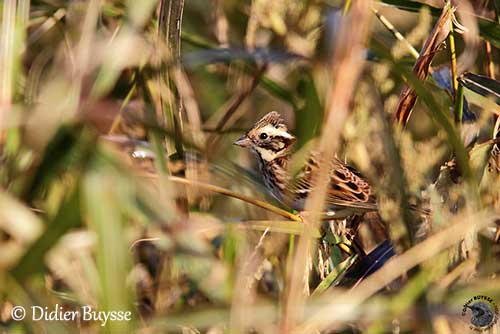
The European buntings are often sedentary in their range, except for the northernmost populations which migrate to more temperate regions in winter. Several eastern bunting species have been recorded in W Europe. Some others, such as the Little Bunting (E. pusilla), the Rustic Bunting (E. rustica) the Common Reed Bunting (E. shoeniclus) and the Pallas’s Reed Bunting (E. pallasi) have reached W North America, with two in California and the two others in Alaska.
The Emberizidae have relatively stable numbers. However, they are threatened by changes in several types of habitat, such as heavy deforestation and drainage of wetlands, but also by pesticides, and predation by Birds of Prey taking young at nest, and even adults. Others are killed by domestic cats.
We enjoy the presence of these pretty songbirds with beautiful plumage during our rambles. It is always pleasant to admire their colourful feathers crossing the track above our heads.
We hope to see them for a long time in Nature!
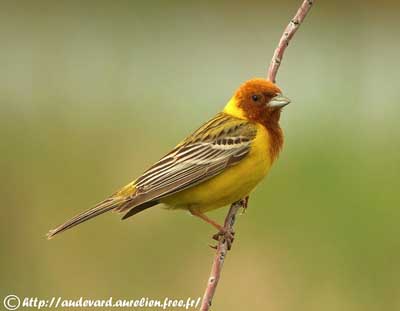
Red-headed Bunting
Emberiza bruniceps