PROTECTION / THREATS / STATUS:
The Philippine Eagle is threatened by habitat loss caused by deforestation and logging in lowland forest. Mining is also another problem for this species. An infrequent breeding cycle and the low survival rates among juveniles and immatures involve a negative impact on the species.
The population is roughly estimated at 128-924 mature individuals (2025), with the majority of the population on the island of Mindanao, with about 82-233 breeding pairs, giving around 180-500 individuals over a surface of 146,000 km².
Conservation measures including captive breeding and reintroduction, prohibition of persecution and protection of the nests are in progress.
The Philippine Eagle is one of the most endangered raptor in the world. The species is currently listed as Critically Endangered.
Fr: Pithécophage des Philippines - Aigle des singes
Ang: Philippine Eagle - Great Philippine Eagle - Monkey-eating Eagle
All: Affenadler
Esp: Águila Monera
Ita: Aquila delle Filippine
Nd: Apenarend
Sd: apörn
Photographer:
Dubi Shapiro
Dubi Shapiro Photo Galleries
Illustrators:
John Gerrard Keulemans: 1842-1912
Henrik Grönvold: 1858-1940
Text by Nicole Bouglouan
Sources:
HANDBOOK OF THE BIRDS OF THE WORLD Vol 2 by Josep del Hoyo-Andrew Elliot-Jordi Sargatal - Lynx Edicions - ISBN: 8487334156
A photographic guide to Birds of the Philippines by Tim Fisher and Nigel Hicks. New Holland Publishers. ISBN: 9781847738301
Le Livre des Oiseaux Rares – Auteur : Dominic Couzens – Editions Delachaux et Niestlé SA – ISBN: 978-2-603-01671-8
Department of Environment and Natural Resources
One earth - Giant Philippine eagle: the world's largest eagle known as the 'monkey eater'
Mandai Nature - Protecting the Iconic Philippine Eagle
National Bird: Philippine Eagle
EDGE - The Philippine Eagle is one of the world’s largest, most powerful birds of prey.
Scotty's Action Sports Network
Ecology and conservation of Philippine Eagles
Wikipedia, the free encyclopaedia
Philippine Eagle
Pithecophaga jefferyi
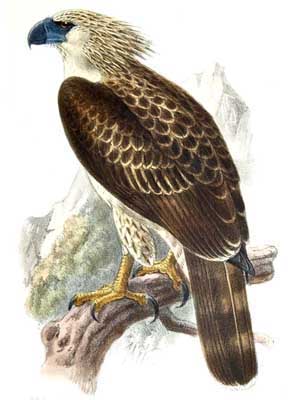
John Gerrard Keulemans
Philippine Eagle
Pithecophaga jefferyi
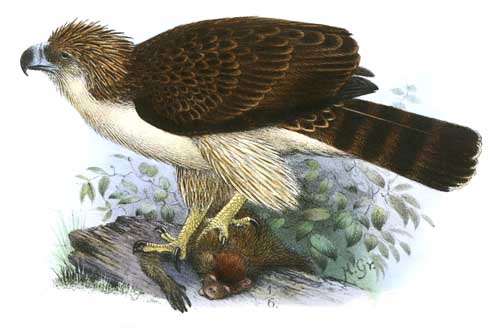
Henrik Grönvold
Philippine Eagle
Pithecophaga jefferyi
Accipitriformes Order – Accipitridae Family
INTRODUCTION:
The Philippine Eagle is a huge raptor, one of the largest and rarest birds of prey in the world. It occurs in the Philippines, especially on Luzon, Samar, Leyte and Mindanao.
It frequents forested mountain valleys, and can be seen flying and gliding from tree to tree while searching for prey. It feeds primarily on flying squirrels, fruit bats, rats, snakes, owls and occasionally monkeys.
The Philippine Eagle is monogamous and mates for life. Aerial chases between male and female are usual during the courtship displays. The nest is built high up in large trees. The female lays one egg every two years. Both adults share all the nesting duties.
The Philippine Eagle was declared the National Bird of the Philippines in 1995. It is a national symbol of the rich Philippine heritage, soaring high up in the sky despite all difficulties. It represents the strength, uniqueness, a love for freedom and power of the Filipino people.
The species was discovered by the English explorer and naturalist John Whitehead (1860-1899) in 1896 in Paranas, on Samar Island.
This large raptor is threatened by deforestation and habitat loss, and the population is decreasing. Conservation actions to protect and conserve its habitat are in progress.
The Philippine Eagle is currently listed as Critically Endangered.
DESCRIPTION OF THE BIRD:
Biometrics:
Length: 86-102 cm
Wingspan: 184-202 cm
Weight: 4700-8000 gr
The Philippine Eagle has warm brown upperparts with pale margins to feathers. On the rounded wings, the brown wing-coverts show white edges, forming a conspicuous scaled pattern on the upper back.
The flight-feathers appear darker brown, and are also bordered with white. The primary flight-feathers are black.
The long, squared tail is brown with a blackish subterminal band and narrow white tips to rectrices.
On the white underparts, we can see rufous streaks along the thighs. The underwing is white on axillaries and wing-coverts. The primary flight-feathers are barred blackish. The narrow leading edge is black, while the trailing edge shows broader black band and narrow white tips to feathers.
The undertail is grey with darker terminal band.
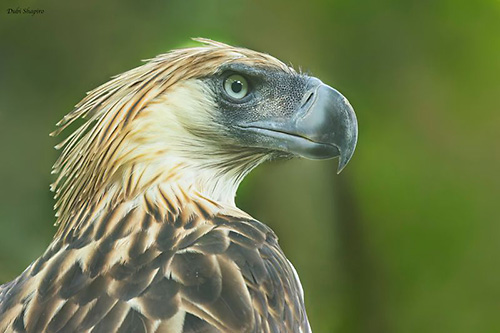
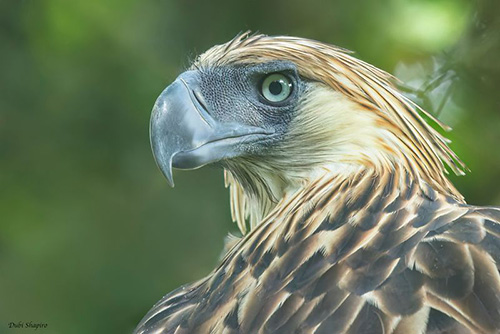
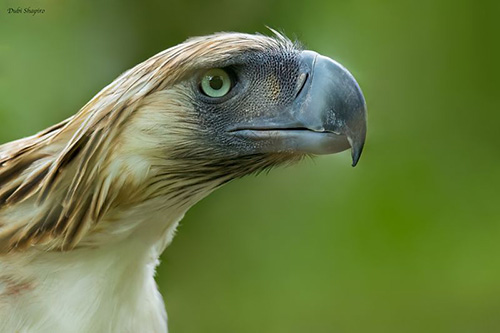
On the head, crown, crest and nape are pale buff with a rufous-blackish streak in the middle of each feather. The nape is adorned with long chocolate-brown feathers forming a loose, shaggy crest. These feathers may form a “crown” around the head of the eagle when lifted by the wind.
The rear of the cheeks, chin and upper throat show short, narrow, blackish feathers, contrasting with the white underparts.
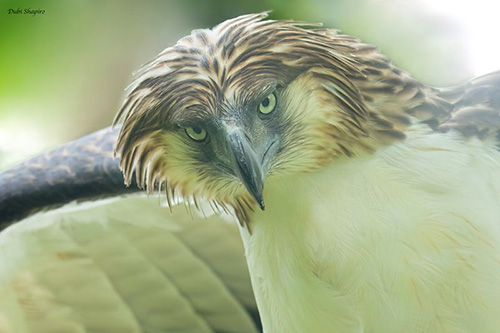
The naked skin of the face and the cere are bluish-grey.
The large, bluish-grey bill is strongly hooked. The tip of the bill is darker, mostly bluish-black.
The eyes are pale bluish-grey. This eagle has a very good vision, very useful when hunting.
The strong legs and feet are yellow, with black, sharp, powerful talons.
Male and female have similar appearance. The female is sexually mature after five years, and the male after seven years.
The chick has white down and bluish bill.
The juvenile resembles adults.
RANGE:
The Philippine Eagle is endemic to the Philippines. It is found on Luzon, Samar, Leyte and Mindanao, the larger islands of N and E Philippines.
HABITAT:
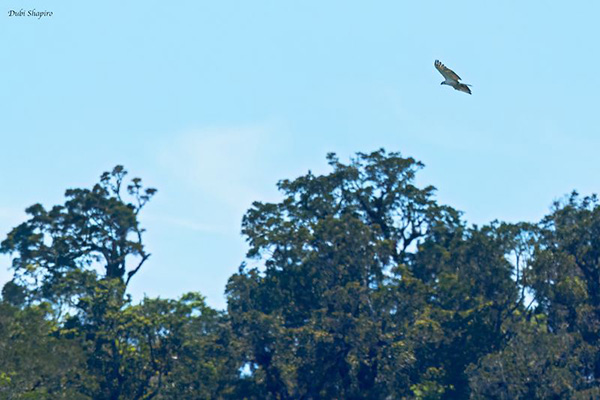
The Philippine Eagle is a forest raptor. It frequents primary forests with resinous trees, forest edges, gallery forests and logged forests. It is mainly found along the mountainsides, especially in steep and rugged areas. It is less common in patches of forest rounded by cleared areas.
The species occurs from lowlands up to 2,000 metres of elevation, sometimes up to 3,200 metres or more.
CALLS AND SONGS: SOUNDS BY XENO-CANTO
The most common call of the Philippine Eagle is a repeated high-pitched, mellow whistle described as “wheeeeuw”.
This call appears rather weak, compared to the size of the eagle.
This species also produces a loud, high-pitched sound, suggesting its territorial habits. During the aerial courtship displays, a loud calling is also reported.
The juveniles beg for food by a series of high-pitched notes.
BEHAVIOUR IN THE WILD:
The Philippine Eagle feeds on various prey species such as bats, snakes, rodents, pigs, monitor lizards and flying lemurs. It also takes birds such as hawks, owls and hornbills.
Although named “Monkey-eating Eagle” it does not eat monkeys, or only very occasionally. Recent studies have proven this belief to be incorrect.
The diet varies, depending on the location.
The Philippine Eagle hunts within the forest, while perched in the canopy. It moves downhill by flying from perch to perch, and when at the bottom, it comes back to top before performing again the same behaviour.
The pair may sometimes hunt co-operatively. One bird distracts a group of potential prey whereas the other catches one from behind.
The Philippine Eagle is the dominant hunter of the Philippine forests.
This species is territorial and monogamous. Once paired, they mate for life.
They perform beautiful aerial displays including circling, chases and claw-grappling. The male chases the female in flight, and then, it presents its talons to the female. If the female is receptive, she turns around while flying and also reveals her talons to the male.
Once mutually approved, both new mates begin to build the nest. When the structure is complete, copulation can begin.
Because the young bird depends on its parents during at least 17 months, only one egg every two years is laid. Both adults share all the nesting duties.
The Philippine Eagle is sedentary within its range.
The flight is fast and agile, more like that of a small hawk than that of large birds of prey. This eagle is able to reach up to 80 km per hour in flight.
REPRODUCTION OF THIS SPECIES:
The breeding season takes place in September, with the laying in October/December.
Both adults build the stick-nest in tree-fork, up to 27-50 metres above the ground. The huge structure is about 120 cm across and 270 cm deep. It is usually reused in several following years.
The copulation begins once the nest is complete.
The female lays a single white egg every two years. Prior to the laying, the female exhibits “egg-lethargy” and refuses food during 8-10 days. This behaviour ends when the egg is laid and the incubation begins.
Both parents share the incubation during 58-68 days, but the female does more while the male is hunting.
At hatching, the chick has white down overall and pale bluish bill. It is fed by both parents, but more by the male during the first 40 days, while the female remains at nest with the young.
The young fledges 4-5 months after hatching, but it will depend on adults for 17 months. For this reason, the Philippine Eagle breeds once every two years.