PROTECTION / THREATS / STATUS:
The Malaysian Rail-babbler is threatened by habitat loss and degradation caused by illegal logging and land conversion, even within protected areas. In addition, the biodiversity of these areas has been damaged by forest fires, and probably again in the future.
However, the species is described as scarce to locally common in some areas, and locally numerous. But this shy bird is difficult to find.
Despite some tolerance of habitat degradation, the population is declining.
The Malaysian Rail-babbler is currently listed as Near Threatened.
Fr: Eupète à longue queue
Ang: Malaysian Rail-babbler - Rail-babbler
All: Rallenflöter
Esp: Zordala Colilarga
Ita: Garrulo rallo
Nd: Ralbabbelaar
Sd: ralltrast
Photographers:
William Price
PBase-tereksandpiper & Flickr William Price
Dubi Shapiro
Dubi Shapiro Photo Galleries
Text by Nicole Bouglouan
Sources:
HANDBOOK OF THE BIRDS OF THE WORLD Vol 12 by Josep del Hoyo-Andrew Elliott-David Christie - Lynx Edicions - ISBN: 8496553423
A Field Guide to the Birds of South-East Asia by Craig Robson. New Holland Publishers. ISBN: 9781780090498
Fatbirder - The World’s Richest Information Resource about Birds for Birders
CREAGUS@Monterey Bay (Don Roberson)
Bird Guides - Quest for the elusive Rail-babbler
Birding Ecotours - Know your birds – Rail-babbler
A blog dedicated to the thousands of bird species that fly, swim or walk on our planet
Zul Ya - Birds of Peninsular Malaysia
Wikipedia, the free encyclopaedia
Home page
Page Passeriforme Order
Malaysian Rail-babbler or Rail-babbler
Eupetes macrocerus
Passeriformes Order – Eupetidae Family
INTRODUCTION:
Today the sole member of the Eupetidae family, the Malaysian Rail-babbler or Rail-babbler was formerly surrounded by several other species which are now classified in different genera and families.
The relationships between these species were long debated, but DNA sequencing has recently shown that it grants them full family status.
During your first encounter with the Malaysian Rail-babbler or Rail-babbler, you might think you are seeing a rail (Family Rallidae), because of the way it moves across the forest floor of the Malay Peninsula, Sumatra and Borneo where it is found.
It favours tall, lowland, broadleaved forests with dense canopy and well-vegetated floor, but it also frequents swamps and moist tropical forests. It feeds mainly on beetles, spiders and worms, caught by dashing over ground or fallen logs while pursuing prey items.
It is a shy, secretive, medium-sized, ground-dwelling species living on the forest floor where it is often seen walking like a rail. When disturbed, it prefers to run to the dense vegetal cover rather than fly.
The breeding behaviour of the Malaysian Rail-babbler or Rail-babbler is poorly known. However, some displays are observed while the bird is calling from a vantage point. The nest of this species is described as a shallow, loose cup-shaped structure usually placed near the ground, often on a pile of dead leaves among the stalks of a plant.
The Malaysian Rail-babbler or Rail-babbler is threatened by heavy deforestation involving decline of the population. It is described as scarce to fairly common, depending on the range. The species is currently listed as Near Threatened.
DESCRIPTION OF THE BIRD:
Biometrics:
Length: 28 - 30 cm
Weight: 66 - 72 g
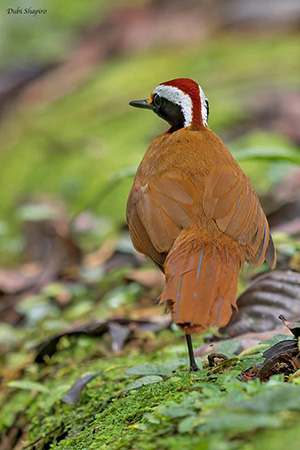
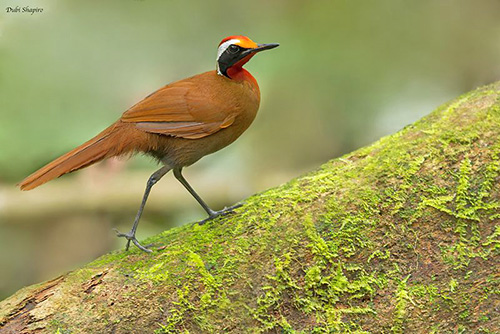
The Malaysian Rail-babbler has slender body, long neck, legs and tail, rounded wings and a long black bill. The rounded wings and the well-developed legs are associated with the preference of thick vegetation and largely terrestrial lifestyle.
The male of nominate race has mainly brown plumage on the upperparts, with the uppertail-coverts showing more intense colour. On the upperwing, the flight-feathers are dusky brown, with golden-brown edges on the outer webs. The upperwing-coverts are mainly ochraceous-buff with golden-brown edges. The long, fan-shaped tail is reddish-brown, with more ochraceous edges on rectrices. It is longer than the wings.
On the underparts, chin, throat and foreneck are chestnut. The underparts are ochraceous-brown, but the breast is reddish-rufous whereas the belly is washed grey. On the underwing, the coverts are reddish-brown.
On the head, crown, nape and hindneck are chestnut-red. The forehead shows a rich ochraceous-buff colour.
A conspicuous white supercilium extends from the front of the eye down to the neck side. It is bordered below by a broad, black patch extending from bill base and lores, through and below the eye, and along the neck side.
Below this black part, a thin patch of blue bare skin is running along the neck side. It becomes more conspicuous when the bird is calling or displaying.
The long bill is black.
The eyes are brown.
Long legs and feet are black.
Male and female are similar.
The juvenile resembles adult but crown and hindneck are dull chestnut, the upperparts are warmer, the head-neck stripes are duller, foreneck and breast are orange-rufous, the throat is whitish and the lower belly is greyer.
SUBSPECIES AND RANGE:
The Malaysian Rail-babbler has two subspecies.
E.m. macrocerus (described above) is found in S Thailand, Peninsular Malaysia, Sumatra and N Natuna Islands.
E.m. borneensis is found in Borneo.
It differs from nominate race by richer brown head. The upperparts are mush redder, especially on the tail. The underparts are more extensively rufous.
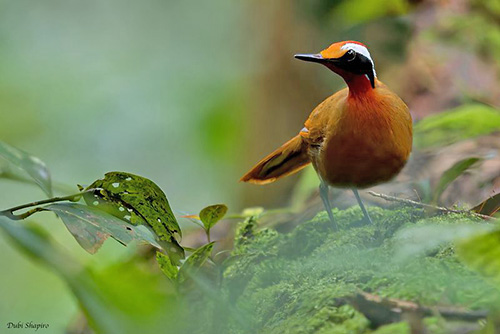
E.m. borneensis
We can see the thin, white patch of bare skin on the neck side.
HABITAT:
The Malaysian Rail-babbler frequents tall primary forest and broadleaved forests with dense canopy and well-vegetated floor. It is locally common in logged forest or on hill-forest on slopes. It may also occur in swamps and heath forest.
The species is visible up to 1,060 metres of elevation in Peninsular Malaysia, and up to 900 metres in Sumatra and Borneo.
CALLS AND SONGS: SOUNDS BY XENO-CANTO
The Malaysian Rail-babbler gives a haunting, long, thin, drawn-out, monotone whistle-call that makes it even more mysterious. This call starts with 2-3 soft, barely audible clucks, followed by “oo…ooo…oooooo…ooo…ooo” first increasing and then falling in volume. It lasts 1,5-2 seconds. While vocalizing, the bird adopts unusual posturing while it inflates the blue, bare shin on the neck side.
When the bird is excited or agitated, it gives a series of popping frog-like notes “going” possibly used as alarm call.
The presumed contact call is described as “tok”.
The monotonous whistling call contrasts with the frog-like notes.
BEHAVIOUR IN THE WILD:
The Malaysian Rail-babbler forages and feeds on the ground, by walking on the forest floor. It feeds mainly on insects such as cicadas and beetles, but it also takes spiders and worms. While foraging, it dashes with great speed over the ground or fallen logs while pursuing prey items.
It is a social species, often encountered in pairs or small family groups in their territory throughout the year.
The Malaysian Rail-babbler is a shy and secretive species living on the forest floor.
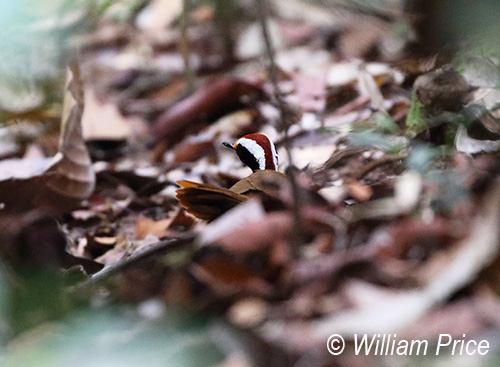
E.m. macrocerus
Foraging on the forest floor
The breeding habits of this species are poorly known. The male can be observed performing unusual movements and postures while singing. It is perched on exposed point on fallen log, and while vocalizing, it bends its long legs and lowers the body until the breast almost touches the ground. Both head and neck are stretched forwards, whereas the tail is raised and bobbed up and down. Sometimes, both wings and tail are raised and slightly spread out.
While the bird is singing, it inflates the blue, bare skin patch visible on the side of the neck.
We can also suggest that some displays enhance the bright coloured pattern of the head.
This species builds a loose, cup-shaped nest about 30 cm from the ground. Both parents feed the chicks. They are monogamous.
The Malaysian Rail-babbler is resident within its range throughout the year.
This species shows a great reluctance to fly. If disturbed or alarmed, it prefers to run to the vegetal cover where it can hide, rather than fly. If necessary, it flies weakly and low above the ground.
REPRODUCTION OF THIS SPECIES:
The breeding season takes place from January to July, with the laying around January and February, and the fledglings can be seen in June.
The Malaysian Rail-babbler builds a loose, cup-shaped structure with plant fibres. The nest is placed about 30 cm from the ground, often on a pile of dead leaves among the stalks of a plant or bush.
The female lays two eggs with dark markings against a paler background (for some authors, the eggs are white, that is not correct for a species that nests almost on the ground). The duration of the incubation is unknown, but the male feeds the female during this period. Both parents feed the chicks and the fledglings.
No more information.