Fr: Bihoreau malais
Ang: Malayan Night-Heron
All: Wellenreiher
Esp: Martinete Malayo
Nd: Indische Kwak
Sd: malajnatthäger
Photographers:
Jean Michel Fenerole
Photos d’Oiseaux du monde
Ken Havard
My Bird Gallery & Flickr gallery 1 & Flickr gallery 2
William Price
PBase-tereksandpiper & Flickr William Price
Ingo Waschkies
Bird Photography
Text by Nicole Bouglouan
Sources:
HANDBOOK OF THE BIRDS OF THE WORLD vol 1 by Josep del Hoyo-Andrew Elliot-Jordi Sargatal - Lynx Edicions - ISBN: 8487334105
Key Facts About the Malayan Night Heron for UPSC Aspirants
Wikipedia, the free encyclopaedia
Malayan Night Heron
Gorsachius melanolophus
Pelecaniformes Order – Ardeidae Family
INTRODUCTION:
The Malayan Night Heron occurs from the Indian subcontinent to Southeast Asia, in the Philippines and the East Indies.
It usually frequents mature moist forests, from low wetlands to moderate elevation.
It feeds mainly on earthworms, insects and small amphibians, molluscs and small fish, using its sharp bill to catch them.
During the breeding season, the Malayan Night Heron performs ritual displays accompanied by vocalizations to attract females. The nest is built in tree or shrub with twigs, leaves and mud, usually near or over water.
It is a solitary nester, but sometimes, small colonies of about 20 pairs are reported. The species is monogamous and both parents share the nesting duties.
The Malayan Night Heron is closely related to the Japanese Night Heron, and both species belong to the same genus Gorsachius.
The population is currently stable, although habitat loss caused by deforestation is a significant problem. But the species is relatively common and not globally threatened at the moment.
DESCRIPTION OF THE BIRD:
Biometrics:
Length: 45-51 cm
Wingspan: 86-87 cm
Weight: 377-451 g
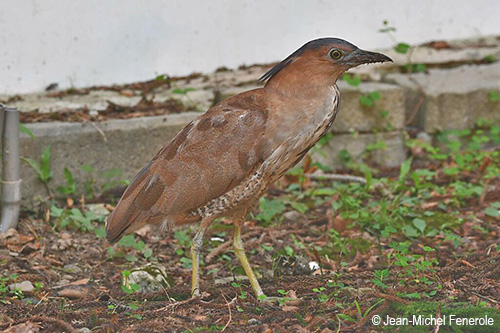
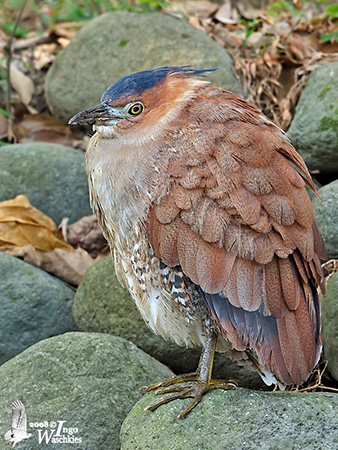
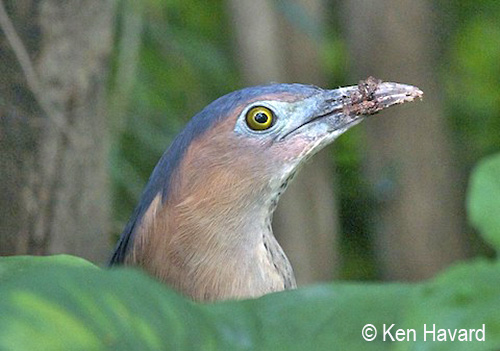
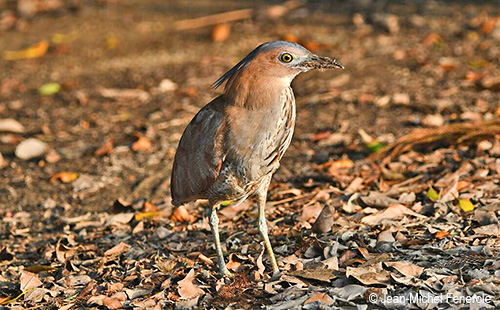
The Malayan Night Heron shows a high degree of individual variability of plumage. It is a medium-sized Ardeidae showing a striking plumage, a stocky body and a short, robust beak, well adapted to its foraging behaviour.
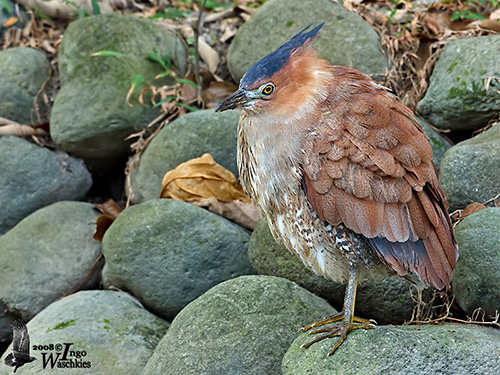
The upperparts are chestnut-brown and intricately vermiculated. The upperwing shows a beautiful combination of black speckles. The flight-feathers are black, with subterminal chestnut-black stripe and white tips. The wing-coverts are chestnut-brown with narrow white tips. The tail is black.
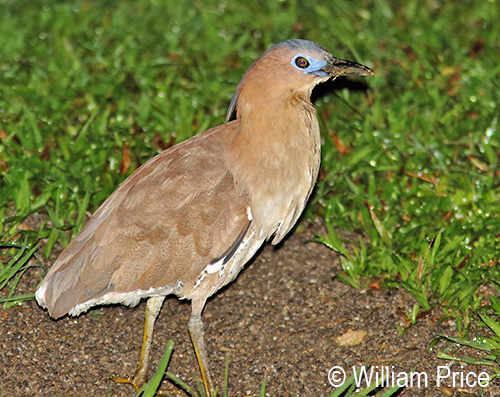
The underparts are brown, finely speckled with black, but neck and breast appear mostly rufous, with black streaks going down the centre until forming a black, vertical irregular stripe. Flanks and undertail-coverts show brown and white mottling.
On the head, crown and crest are black, the latter with longer black feathers. The crest may become more conspicuous during the breeding season. Chin and throat are white with scattered black spots. Rest of the head is chestnut-brown like the upperparts.
Deeper blue lores are developed 1-2 months before the nesting period.
The short, robust beak is black with bluish gape.
The eyes are yellow, surrounded by blue-green or blue eyering, depending on the season.
Legs and feet are olive-green to olive-brown.
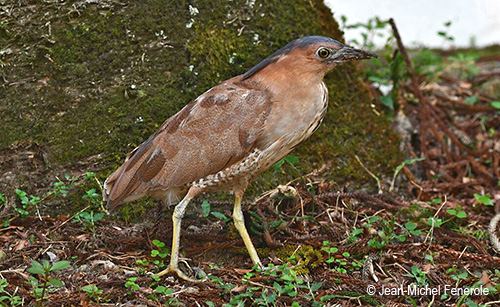
The female shows similar appearance, but she has heavier neck striping and less conspicuous vermiculations on the upperparts.
On the head, the lores are duller blue than in male during the breeding season. They become blue-green, green or grey-green after breeding. The crest is usually shorter.
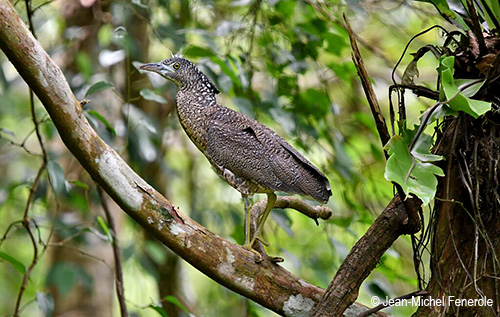
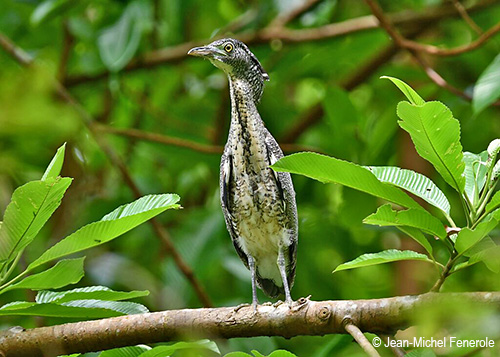
The juvenile plumage is densely spotted and barred dark brown and whitish, making the bird more camouflaged among the vegetation.
The pale facial markings of adults are lacking. The blackish crown is barred and spotted white. The facial skin is bluish-green, duller than in adults.
The bill is horn-coloured.
The eyes are yellowish.
Legs and feet are dull grey to yellowish.
RANGE:
The Malayan Night Heron is found from the Indian Subcontinent to Southeast Asia. Sightings are reported in several countries such as India, Sri Lanka, Brunei, Nepal, Bangladesh, Myanmar, Cambodia, Laos, Vietnam, Thailand, Malaysia, Singapore, China, Indonesia, the Philippines, Taiwan, and Japan.
It winters in Sri Lanka, Thai-Malay Peninsula, Greater Sundas (E to Bali), Halmahera and Talaud, and N to Ryukyu Islands in Japan. It is vagrant in Christmas Island and Palau.
HABITAT:
The Malayan Night Heron frequents primarily lowland wet evergreen forests, swamp forests and mangroves near streams, marshes and rice paddles.
It roosts in undisturbed forests where it selects dense tree canopies and bamboo thickets. But it also may occur near human settlements and adjacent urban parks where it can find food resources.
The species is visible from 800 metres to 2,300 metres of elevation, depending on the range.
CALLS AND SONGS: SOUNDS BY XENO-CANTO
The Malayan Night Heron utters deep “oo” notes, hoarse croaks and repetitive “arh” in territorial behaviour.
During the courtship period, it produces deep booming sounds.
In flight, it gives some “arh, arh, arh”.
The song is described as a deep, hollow, mournful series of “wu,wu,wu” and “thuk, thuk, thuk, thuk…” given in series of 5-12 notes. This song can be heard at dusk and dawn, also at night, and occasionally during the day, while the bird erects the crest feathers.
BEHAVIOUR IN THE WILD:
The Malayan Night Heron feeds mainly on insects (beetles, cockroaches and grasshoppers), molluscs, earthworms (mainly large ones) frogs, lizards, snakes, freshwater crabs, and probably small fish.
It forages on the forest floor, often near streams or along field edges. It moves slowly, using a “stand-and-wait” posture or walking slowly and probing soil and leaf litter with its short, stout bill.
It often forages under cover of darkness or low light. It usually adapts to local prey, depending on the area.
The Malayan Night Heron is usually seen solitary, and it is probably a territorial feeder. It generally forages at dusk, dawn and at night, but also occasionally by day.
During the day, it roosts solitary among reeds, bamboo thickets or tree canopy where it is well concealed and protected.
The breeding season varies depending on the range, but the Malayan Night Heron breeds mainly during the monsoon season. It is generally a solitary nester, although some small colonies of about 20 nests have been observed.
At the beginning of the breeding season, both lores and eyerings of the male become blue, about 1-2 months before nesting, whereas in female, lores are blue during active courtship displays.
During the displays, the male exhibits its plumage and the black crest is erected. It performs head bobbing and ritualistic movements, accompanied by vocalizations such as hollow “wu,wu,wu” or series of 5-12 “thuk” notes. These sounds are often heard at dawn, dusk or night to attract a mate or to defend the territory. During the defence of the nest-site, hoarse croaks can be heard. All these calls are part of the breeding repertoire.
The species is usually monogamous and forms solitary pairs.
Both adults build a flimsy platform in tree fork or reed bed, often near or over water. Both parents share all the nesting duties.
The Malayan Night Heron is a partial migrant.
It winters in Sri Lanka, Thai-Malay Peninsula, Greater Sundas (E to Bali), Halmahera and Talaud, and N to Ryukyu Islands in Japan.
Vagrant records have been documented in Shikoku Island (Japan), Palau in W Caroline Islands, Peleng in Banggai Islands (off NE Sulawesi) and Christmas Island (Indian Ocean).
The Ardeidae have a slow, rather heavy and not very agile flight, but it is strong. They cover great distances with flapping flight, in migration and while moving between the feeding areas and the breeding sites or the communal roosts.
The night-herons perform a flapping flight with faster wingbeats than other heron species.
REPRODUCTION OF THIS SPECIES:
The breeding season usually takes place during the monsoon season, but it may vary depending on the range.
The Malayan Night Heron is monogamous and solitary nester. However, it may occasionally breed in small colonies. This species produces one clutch per year, but a second clutch is sometimes laid in good conditions.
Both adults build a flimsy platform with twigs and mud, often lined with leaves and grass. Nest-building may last up to nine days. The nest is placed in tree fork or reed bed, about 5-10 metres above the ground. It is often near or over water.
The female lays 3-5 greenish white or bluish-white eggs. Both adults incubate during 32-34 days.
The downy chicks are semi-precocial. They are brooded and fed by both adults, and still depend on parents during 43 days after fledging. The smallest young is sometimes ejected by the oldest.
In addition, the immature-plumaged birds of both sexes may act as helpers at nest, which is unusual for Ardeidae.
PROTECTION / THREATS / STATUS:
The Malayan Night Heron has a very large range. It is able to adapt to various habitats, including urban areas.
The species is threatened by habitat loss caused by agriculture expansion and human settlement. The habitat needs protection and restoration, especially forest and wetland habitats.
The global population is roughly estimated at 2,000-20,000 individuals, or 1,300-13,000 mature individuals. But the true size of the population is unknown.
The Malayan Night Heron is currently evaluated as Least Concern.