PROTECTION / THREATS / STATUS:
The Japanese Night Heron is rare and extremely local in Japan where it breeds.
This species is affected by deforestation throughout the range, and trapping pressure across the wintering grounds.
The population is considered to be rapidly declining at migratory and wintering grounds, primarily due to hunting pressure.
The breeding grounds may suffer at some level of continued habitat degradation.
The introduction of the Siberian Weasel (Mustela sibirica) in the early 1970s in the Izu islands, with in addition nest predation by Corvidae, are increasing threats.
The size of the population is roughly estimated at 5,000/9,999 mature individuals and it is decreasing.
The Japanese Night Heron is currently listed as Vulnerable.
Fr: Bihoreau goisagi
Ang: Japanese Night-Heron
All: Rotscheitelreiher
Esp: Martinete Japonés
Ita: Nitticora del Giappone
Nd: Japanse Kwak
Sd: japansk natthäger
Photographer:
Dubi Shapiro
Dubi Shapiro Photo Galleries
Text by Nicole Bouglouan
Sources:
HANDBOOK OF THE BIRDS OF THE WORLD vol 1 by Josep del Hoyo-Andrew Elliot-Jordi Sargatal - Lynx Edicions - ISBN: 8487334105
Japanese Night Heron in Shanghai
Diet of the Japanese Night Heron Gorsachius goisagi in Japan
Wikipedia, the free encyclopaedia
Japanese Night Heron
Gorsachius goisagi
Pelecaniformes Order – Ardeidae Family
INTRODUCTION:
The Japanese Night Heron is found in East Asia. It breeds in Japan and winters in the Philippines and Indonesia. It frequents dense forest and woodland areas with access to fresh water such as streams and wetlands.
Unlike most herons, the Japanese Night Heron eats little or no fish. This could be due to the short shape of its beak, which is quite different from that of other herons. It feeds on a variety of small, terrestrial animals within its habitat. Its diet includes insects found on the forest floor, amphibians taken in small streams or wetlands, but also small fruits and berries, depending on the season. The species may spend hours on the ground, making this bird difficult to detect.
At the beginning of the breeding season, the Japanese Night Heron performs elaborate courtship displays to attract a female. This species nests in solitary pairs, although loose groups are occasionally established in areas with abundant food resources.
The nest is built on tree branches in forested areas near streams. Both adults share all the nesting duties.
The Japanese Night Heron is first affected by deforestation throughout the range, but mainly in the wintering areas. The change in traditional agriculture practices reduces the suitability of the feeding areas. Hunting in several parts of the range has also a negative impact.
The population of the Japanese Night Heron is declining and the species is currently classified as Vulnerable.
DESCRIPTION OF THE BIRD:
Biometrics:
Length: 48-49 cm
Wingspan: 87-89 cm
Weight: 450-650 gr
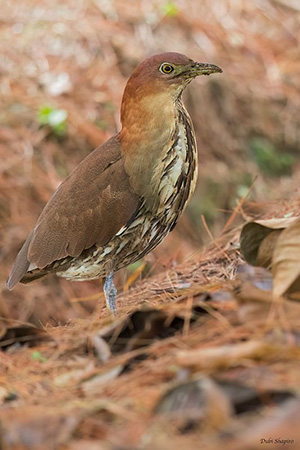
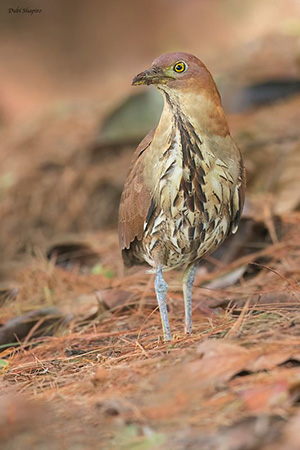
The Japanese Night Heron is a small and stocky Ardeidae, with short, decurved bill.
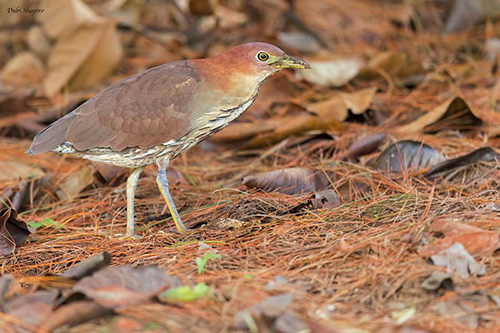
The upperparts are pale chestnut, but the upperwing is darker, with blackish flight-feathers conspicuously tipped tawny. In good light, we can see a whitish patch on the forewing. Rump, uppertail-coverts and rectrices are blackish-brown.
The underparts are pale brown from throat to belly, with black, vertical stripes usually longer on the throat. The flanks are mostly brown and slightly mottled. The underwing coverts are whitish and barred or spotted with black. They have broad white tips. The flight-feathers are black with tawny broad tips, usually duller than above.
Depending on the season, the colour of the plumage can become brighter, especially on head and upperparts.
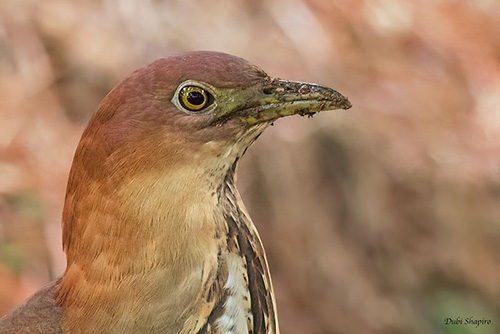
The head is chestnut with short chestnut crest. The neck sides are paler, mostly buffy-brown. Chin and throat are whitish with black vertical stripes.
The short, decurved bill has dark brown upper mandible and yellow lower mandible. Both bill and cere become greenish-black during the breeding season.
The eyes are yellow to pale orange-yellow. Lores and eyering are greenish-yellow, becoming pale blue during the breeding season.
Legs and feet are greenish-blue to yellowish.
Male and female are very similar, the female being slightly duller than male.
The juvenile resembles adult, but it has darker upperparts. Head and wings show many fine black flecks. The upperwing is paler. The crown is browner and the head is less chestnut. It usually shows a speckled pattern.
The bill is paler and the legs are darker than in adults.
RANGE:
The Japanese Night Heron occurs in Japan, South China and the Philippines.
This species breeds only in Japan in Honshu, Shikoku, and Kyusgu, and on the Izu Islands.
During the winter, it can be found in the Philippines, but also in Korea, Southern China, Taiwan and Russia. However, the main wintering range is the Philippines where it occurs on several islands.
HABITAT:
The Japanese Night Heron frequents rivers, streams and swamps in heavily forested areas, rice paddies and bamboo forests on migration, whereas during winter, it occurs in less wooded areas close to cultivated fields.
It usually uses a broad-leaved forest and a mixed forest with coniferous and broad-leaved trees as a breeding ground.
It is usually found in the low parts of the mountains, from 50 to 240 metres. However, it has been reported to 1,100 metres in Indonesia, 1,500 metres in Japan and to 1,350 metres in the Philippines (with two records at 2,400 metres on Luzon).
CALLS AND SONGS: SOUNDS BY XENO-CANTO
While feeding or at nest, the Japanese Night Heron produces slow, croaking, repetitive “bwoo bwoo bwoo” calls, especially in the early evening.
This call is probably used as contact call and can also be heard on migration.
During the breeding season, it utters its “Voo, Voo” sounds, while searching for a mate. The low-pitched hoots and croaks are used to communicate and to attract females.
BEHAVIOUR IN THE WILD:
The Japanese Night Heron has shorter and thicker bill than other Ardeidae. Usually, the herons have long bills, well-adapted for catching aquatic prey such as fish. The bill of the present species is more adapted for foraging on the ground by digging while searching for earthworms. It does not capture fish, or rarely.
The diet of this heron includes land snails (adults), freshwater crabs and scarabid beetles, insects and larvae. It is often observed catching and eating earthworms.
It feeds by walking slowly around pools and along streams, but it also forages on the dry ground on the forest floor. It is usually nocturnal or crepuscular, but it also occasionally feeds during rainy and cloudy days. It is observed solitary or in small, loose groups.
The Japanese Night Heron is monogamous. During the breeding season, impressive courtship displays are observed. The male engages in elaborate and synchronized movements accompanied by calls. We can see the birds performing wing-flapping and neck-stretching.
They usually nest in solitary pairs or in small, loose groups, not truly colonies, in areas with abundant food resources.
The nest is built by both adults on tree branches, about 7-20 metres above the ground. Both parents share all the nesting duties.
The Japanese Night Heron is migratory and moves S in September/October after breeding. It returns in early April.
It winters primarily in the Philippines, but also in the other countries of Southeast Asia including Indonesia (islands of Sulawesi and Kalimantan) and Malaysia.
It migrates alone or in breeding pair, occasionally in mixed-species flocks with other heron species. During the migration, the herons follow coastal and forested areas providing them necessary food resources and suitable resting areas.
The overall pattern of the migration is often the same, with southward movement from breeding to wintering grounds.
The Ardeidae have a slow, rather heavy and not very agile flight, but it is strong. They cover great distances with flapping flight, in migration and while moving between the feeding areas and the breeding sites or the communal roosts.
The night-herons perform a flapping flight with faster wingbeats than other heron species.
REPRODUCTION OF THIS SPECIES:
The breeding season takes place from May to July. The Japanese Night Heron nests solitary or in small, loose groups.
It nests in undisturbed forests and woodlands, usually near stream. Both adults build the nest with twigs and leaves, on tree branches in dense foliage, in order to protect the chicks from predators. The nest is placed between 7 and 20 metres above the ground.
The Japanese Night Heron sometimes breeds in small groups, not truly colonies, with the nests placed 250-500 metres apart. This species nests in broad-leaved trees, fruit trees and pines trees, depending on the location.
The female lays 3-4 dull white eggs. Both adults share the incubation during 21-25 days. They take turns to incubate the eggs, and both feed and care for the chicks. The young are altricial and require constant parental care.
They are fed by regurgitation of small aquatic prey. The chicks fledge 35-37 days after hatching, but they need some weeks more to become independent.