HABITAT:
The Hooded Pitohui frequents the rainforest, forest edges and secondary growths, and occasionally mangroves and low trees on beaches.
It is usually found in hills and lower montane forests, from 350 to 1,700 metres of elevation, occasionally up to 2,000 metres, and locally in coastal lowlands at sea-level.
CALLS AND SONGS: SOUNDS BY XENO-CANTO
The vocalizations of the Hooded Pitohui include loud and melodious or staccato whistles.
The main song is a series of 3-7 rich whistles including upslurs and downslurs of different duration, mixed with some pauses.
Individuals give a stereotyped song of 2-4 whistled notes, with the first three notes on constant pitch whereas the final note descends.
Within the flocks, the calls include soft growls during activities, a fast, dry rattle and a bell-like series of 2-3 clear ringing notes ending in higher pitch.
Several vocalizations can be heard across the range, such as loud, downslurred, rising or rapid whistles.
BEHAVIOUR IN THE WILD:
The Hooded Pitohui is often observed while foraging in family groups and mixed-species flocks.
It feeds primarily on fruits, grass seeds, insects, various invertebrates and some small vertebrates. The strong legs and sharp claws are well-adapted for foraging on the ground, whereas the stout bill is adapted for probing for insects and cracking seeds.
The fruits include figs of genus Ficus. Among the invertebrates, we can find beetles, spiders, earwigs, bugs, flies, caterpillars and ants. The Choresine beetle of family Melyridae is the source of the poison, making this bird “poisonous and toxic”.
The Hooded Pitohui feeds at all levels, from the undergrowth to the canopy. They often feed in small family groups and also join mixed-species foraging flocks. They are primarily diurnal, and they adapt their diet according to the season.
During the nesting period, the chicks are fed with berries and invertebrates.
The breeding behaviour of the Hooded Pitohui is poorly known. The breeding season begins in the late dry season, continuing into the middle of the wet season, at least. They are monogamous and breed in simple pairs, but helpers are reported at nest, mainly to assist with chick-feeding. From some observations, the young are often fed by more than two individuals. When observers approach a nest, four or five birds are defending the nest-site.
The courtship displays are unknown. But we can suggest that the strongly contrasted plumage is enhanced by adapted postures. However, as both male and female are similar in appearance, the displays are probably fairly simple.
The nest is a cup-shaped structure suspended on small branches.
The Hooded Pitohui is probably sedentary within its range.
This species has rounded wings that enable agile flight through the habitat, especially the dense understory. No significant seasonal movements are reported.
REPRODUCTION OF THIS SPECIES:
The breeding season takes place during the austral spring and summer in New Guinea, with the laying in mid-October, mid-December and mid-February. The Hooded Pitohui is monogamous and probably co-operative breeder.
The nest is a cup-shaped structure made with curly vine tendrils, and lined with fine tendrils. It is suspended from thin branches, about two metres above the ground in the low understory.
The female lays 1-2 creamy or pale pinkish eggs with dark spots and blotches, along with light grey patches.
The duration of the incubation is unknown, but both parents and helpers share this period and other duties. The chicks are fed with berries and invertebrates, and the young birds develop rapidly.
The Batrachotoxins present in both skin and feathers of adult birds possibly transfer to eggs and nest materials during the brooding, protecting them from predators and ectoparasites.
PROTECTION / THREATS / STATUS:
The Hooded Pitohui is described as locally fairly common to common.
The size of the population is unknown, but it is suspected to be stable in absence of substantial threats.
However, illegal songbird trade in Indonesia is a risk for this species, despite its toxicity. But their toxicity also protects them from hunting pressure.
The Hooded Pitohui is currently evaluated as Least Concern.
Fr: Pitohui bicolore
Ang: Hooded Pitohui
All: Zweifarbpirol
Esp: Pitohuí Bicolor
Ita: Pitoui monaco
Nd: Bergpitohui
Sd: svarthuvad pitohui
Photographer:
Dubi Shapiro
Dubi Shapiro Photo Galleries
Text by Nicole Bouglouan
Sources:
HANDBOOK OF THE BIRDS OF THE WORLD Vol 12 by Josep del Hoyo-Andrew Elliott-David Christie - Lynx Edicions - ISBN: 8496553423
DIGITAL COMMONS - The Hooded Pitohui's Poisonous Secret
California Academy of Sciences - Scientist Spotlight: Jack Dumbacher
IBCP - Bird in the Spotlight: Hooded Pitohui
Homobatrachotoxin in the Genus Pitohui: Chemical Defense in Birds?
BioDB - The most poisonous living pitohui species
Meet the Hooded Pitohui – The Only Scientifically-Confirmed Poisonous Bird in the World
World’s only toxic bird: Why the Hooded Pitohui is one bird you should fear
Wikipedia, the free encyclopaedia
Home page
Page Passeriformes Order
Hooded Pitohui
Pitohui dichrous
Passeriformes Order – Oriolidae Family
INTRODUCTION:
The Hooded Pitohui is endemic to the islands of New Guinea where it frequents the rainforest, forest edges and second grows, and occasionally mangrove forests.
The species was described by the French ornithologist Charles Lucien Bonaparte in 1850.
The Hooded Pitohui was placed in the genus Pitohui with five other species, and this genus was thought to belong to the Australasian whistler’s family, the Pachycephalidae. And the whistlers are well named because they constitute some of Australasian’s most outstanding songsters.
The vocalizations of the pitohuis are loud and melodious or staccato whistles. But following the examination of the genus in 2008, some species were considered unrelated and not falling within the whistlers.
Finally, the Hooded Pitohui and the closely related Variable Pitohui (Pitohui kirhocephalus) were both found to be related to the Old World Orioles in the family Oriolidae, which was confirmed in 2010 by a study.
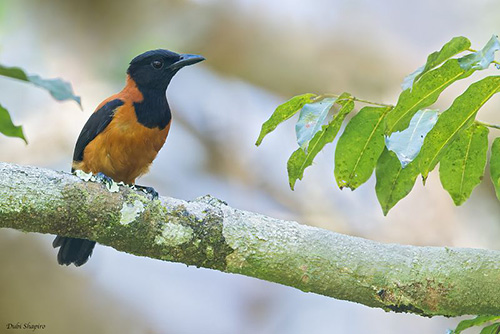
The Hooded Pitohui is a bicoloured bird with strongly contrasted black and rufous-chestnut plumage.
It feeds on fruit, often small figs (Ficus), some insects and grass seeds. It occurs from the undergrowth to the canopy, and forages at all levels of the forest.
The breeding behaviour is poorly known, but some nests have been described as a cup-shaped structure suspended on small branches. The species is thought to be a possible cooperative-breeder.
But the Hooded Pitohui is mainly known as poisonous or toxic, and it is the most toxic of all passerines tested in New Guinea. The bird stores Homobatrachotoxin, apparently as a chemical defence or antipredator adaptation, always highest in both skin and feathers.
The Hooded Pitohui is described as locally common to common within its large range, and currently, the species is not globally threatened.
THE HOODED PITOHUI, A POISONOUS BIRD…
This finding occurred in 1990, when scientists were preparing skins of the Hooded Pitohui for museum collections. One of them, Jack Dumbacher, discovered (by accident) that New Guinea birds use poisons for protection.
While working alongside local guides, Jack Dumbacher released a colourful songbird called a “pitohui” from a mist net. While doing this, he cut his hand and developed a tingling, burning sensation on the skin, but he also put the wound in his mouth to dull the pain, but that only made his tongue tingle and burn.
This encounter led him to years of research on the chemical defense in birds living on the Pacific islands.
Later, Dumbacher and other researchers identified the chemical texture and potential use of pitohui toxins. This study revealed that the pitohui possessed “batrachotoxin”, a poisonous substance also found in some species of frogs such as the “poison dart frog” from Colombia. Skin and feathers contained the highest levels of the toxins.
And finally, Dumbacher has identified this pitohui as the first poisonous bird known to science. Today, five more species of poisonous birds are identified. They use this feature as a protection against predators, and other unrelated bird species have evolved to mimic the pitohui’s plumage, exploiting its toxicity for their own protection.
The source of the bird’s poison comes from the Choresinebeetles (family Melyridae) they eat, full of the same batrachotoxin.
However, the toxicity of the Pitohui was known to the indigenous peoples of New Guinea from ancient times. Native tribes knew the bird was inedible. It has “garbage-like” taste and smell when cooked, and it is regarded as toxic by the locals.
But there are still numerous unanswered questions about this species…
Sources: California Academy of Sciences - Scientist Spotlight: Jack Dumbacher
DESCRIPTION OF THE BIRD:
Biometrics:
Length: 22-23 cm
Weight: 67-76 g
The Hooded Pitohui is a medium-sized songbird with strongly contrasted plumage.
It has a black hood including head, chin, throat and upperbreast. Upperwing and tail are also black, as are both underwing and undertail.
Mantle, back, rump, uppertail-coverts and rest of underparts are bright rufous-chestnut.
The stout bill is black.
The eyes are reddish-brown.
Legs and feet are black, with sharp claws.
Male and female are similar. When threatened, they erect their head feathers to form a crest.
The juvenile resembles adults, but flight-feathers and rectrices show brown edges, and the plumage appears slightly duller than in adults.
RANGE:
The Hooded Pitohui is endemic to New Guinea where it occurs, and extends to the nearby Yapen Island.
This species is monotypic, and molecular studies of this genus have not identified sufficient genetic divergence to validate some subspecies.