The Grey Heron, a magnificent fishing bird!
With its ash-grey and white plumage, long beak and neck, the Grey Heron always exudes elegance wherever it goes, carried by its long, slender legs.
Photographers:
Roger Ahlman
Pbase Galleries Peru and Ecuador
John Anderson
John Anderson Photo Galleries
José Luís Beamonte (videos)
Pájaros de España
Didier Buysse
Vision d’Oiseaux
Steve Garvie
RAINBIRDER Photo galleries
William Price
PBase-tereksandpiper
Ingo Waschkies
Bird Photography
Nicole Bouglouan
PHOTOGRAPHIC RAMBLE
Text by Nicole Bouglouan
Sources:
HANDBOOK OF THE BIRDS OF THE WORLD vol 1 by Josep del Hoyo-Andrew Elliot-Jordi Sargatal - Lynx Edicions - ISBN: 8487334105
THE HANDBOOK OF BIRD IDENTIFICATION FOR EUROPE AND THE WESTERN PALEARCTIC by Mark Beaman, Steve Madge - C.Helm - ISBN: 0713639601
Personal observations
Card on the site: Grey Heron – Ardea cinerea – Heron cendré
It moves slowly along the edge of the marsh, its gaze attentive to the slightest movement on the water surface or in the reeds.
VIDEO: Grey Herons near water
José Luís Beamonte
Pájaros de España
It walks quietly, the neck outstretched and the head tilted forward, the eyes fixed on the water directly in front of it.
Its tall silhouette passes between the reeds that rustle in the wind. Sometimes, it raises its head, attentive to the surroundings. But its gaze quickly returns to the water, watching for any fish that might come too close and be caught by its long, sharp beak.
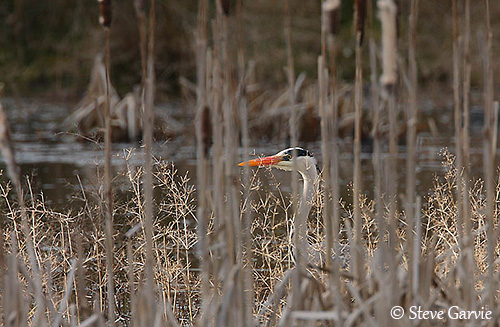
This beautiful bird frequents all kinds of shallow, fresh, salt, or brackish waters with some trees on the edges for nesting. Inland, it can be found near rivers, canals, ditches, lakes and marshes, ricefields… But deltas, estuaries, tidal mudflats and mangroves are also used along the coasts.
Actually, it adapts its behaviour depending on the season and the range.
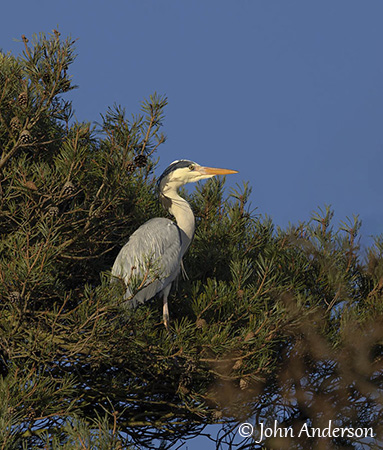
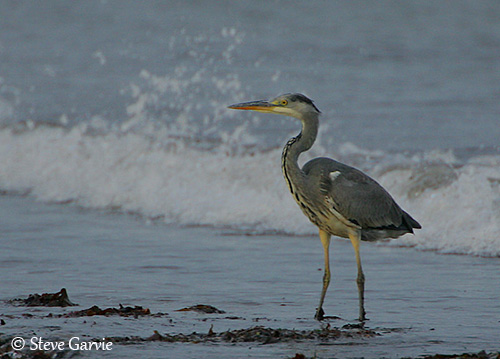
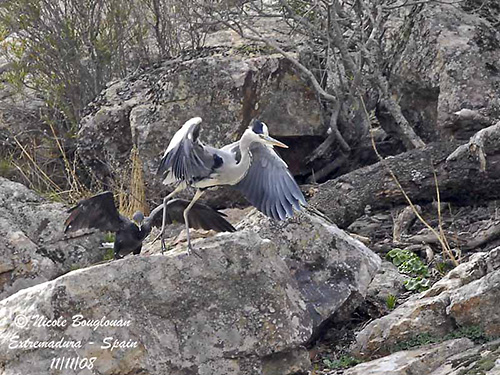
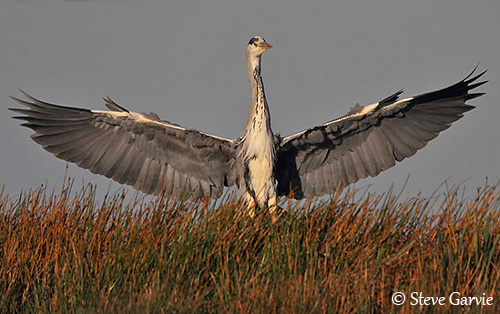
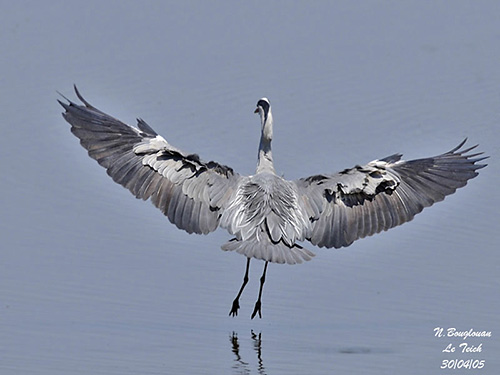
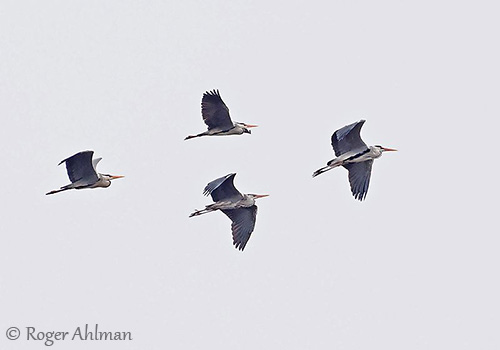
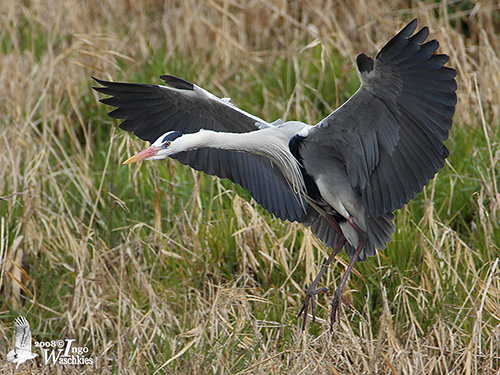
This large bird flies slowly, with its long neck retracted, typical of herons and bitterns.
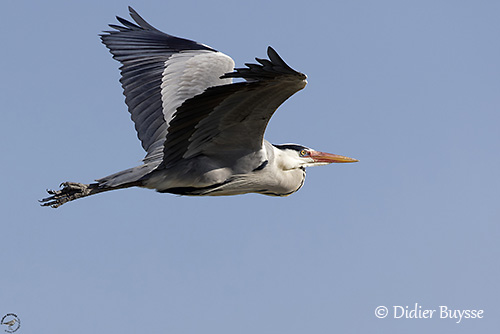
They differ from storks, cranes and spoonbills which fly with the neck extended.
The Grey Heron performs slow wing-beats and also glides over short distances. The flight is slow, rather heavy, not very agile but strong.
However, it can cover great distances with flapping-flight, both in migration and during the trips between feeding areas and breeding colonies.
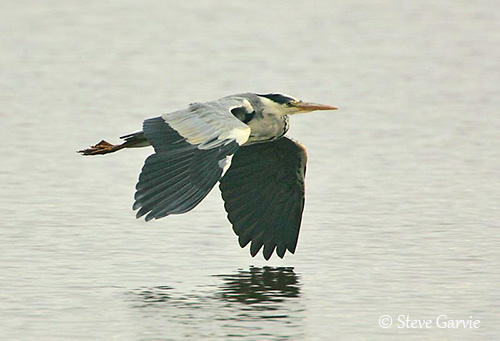
It may soar very high in the sky, but mainly in spring above the heronry where they chase each other, making aerial movements or swooping down towards the ground.
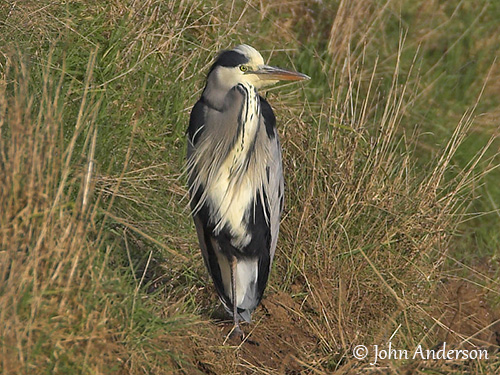
This species is mainly seen on the ground while foraging near water or standing for long periods in an upright stance, and often on a single leg.
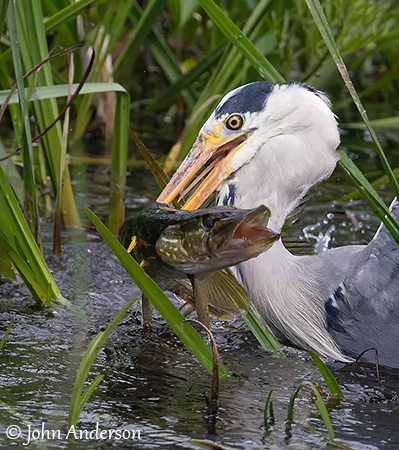
The Grey Heron feeds mainly on aquatic prey including fish, amphibians and crustaceans caught in shallow water with the long, pointed bill.
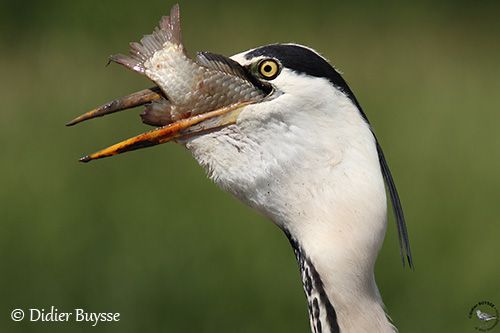
Insects are also taken just above the water surface.
But it is able to kill small vertebrates such as ducklings and even larger birds like rails, and small mammals including water voles, rats, stoats, and even young rabbits are occasionally caught.
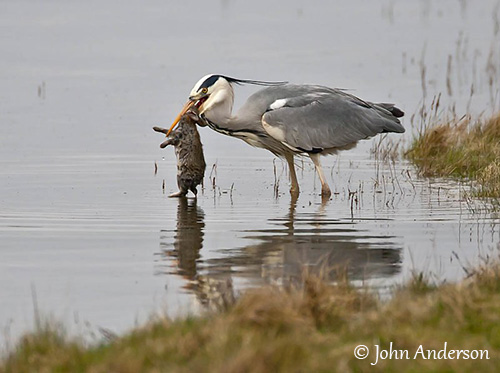
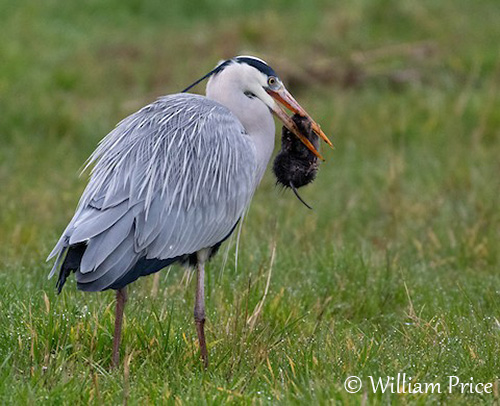
Some observations report large prey of about 680 grams, but usually, it takes prey of 100-500 grams. The food items vary in size from 1 cm long to 30 cm-long carps, and even 57 cm eels.
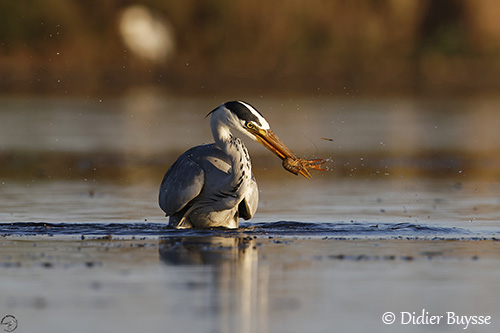
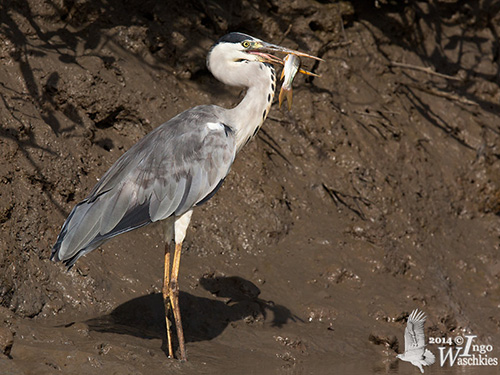
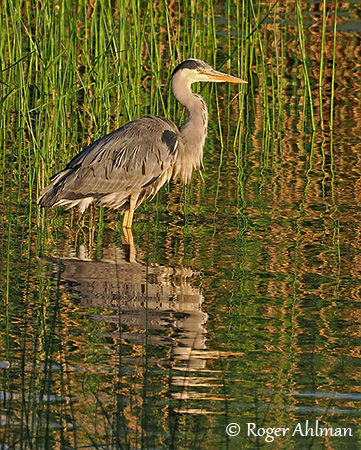
The Grey Heron usually stands motionless at the edge of the water or in shallow water, while waiting for an approaching prey. When it is close enough, the heron spears it with its long, pointed bill
VIDEO: Grey Heron fishing in shallow water
José Luís Beamonte
Pájaros de España
Two different postures are described.
The Upright posture shows the heron with neck and body erect, involving better field of vision, helping it to localize the prey.
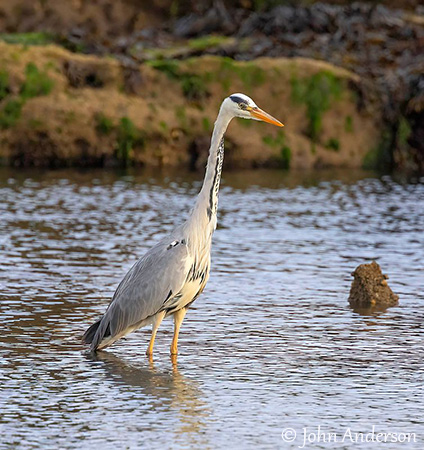
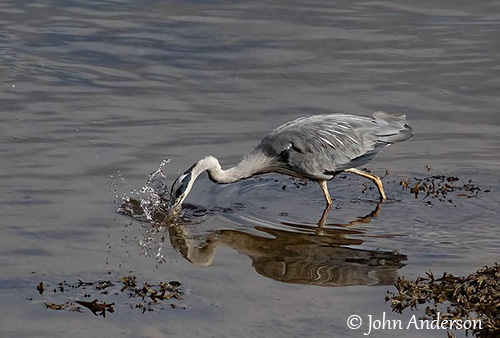
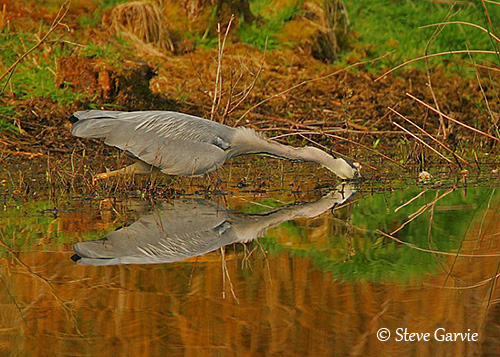
The Crouched posture shows the heron with neck and body parallel to the surface of both water and ground. This posture is more cryptic and is mainly related to the capture of a prey, and the bird can situate the bill closer to the future victim.
The large Ardea herons are real specialists with this behaviour.
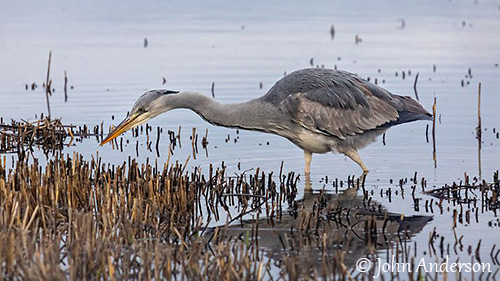
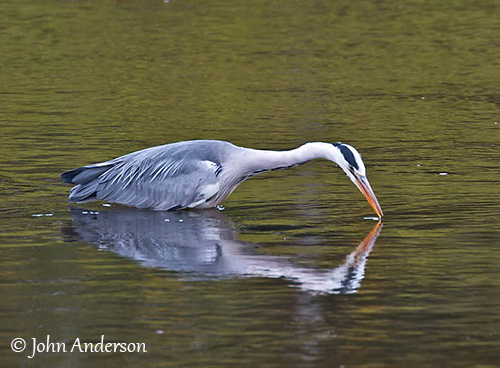
Another more active method shows the bird moving about. It walks slowly while searching for prey, both on land and in shallow water, but also on aquatic vegetation or on the branches of the trees.
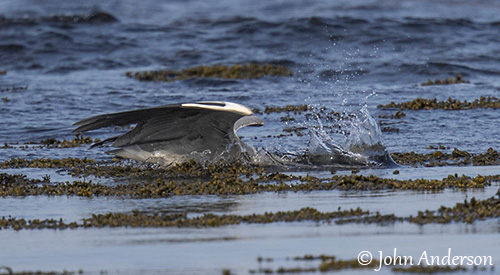
The Grey Heron catches the prey with the bill, but it sometimes impales the victim, following a slow walk with the body less upright than usual, and the neck curved in an S.
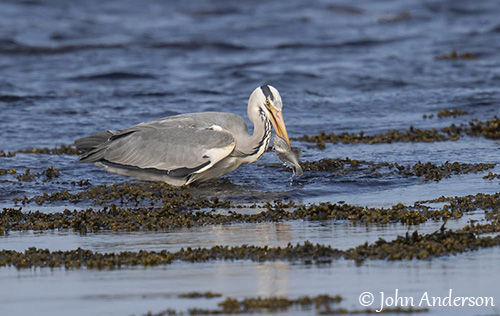
The bird then straights its neck and strikes very quickly with the bill.
It swallows the small fish head first, while largest prey are carried to the shore and beaten on the ground or killed with the bill.
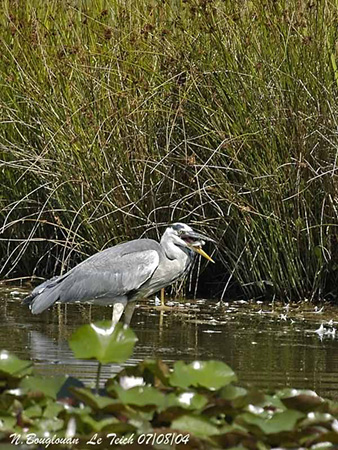
Other prey such as small mammals, birds or ducklings are held by the neck and can be drowned, suffocated or beaten on the ground or on a rock, before to be swallowed whole. It also takes amphibians, crustaceans, mollusks and arthropods.
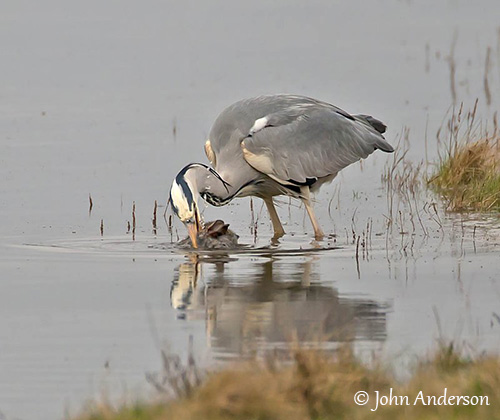
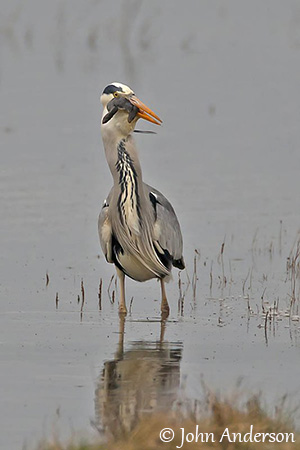
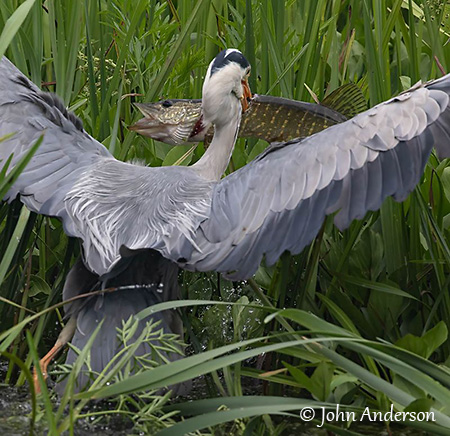
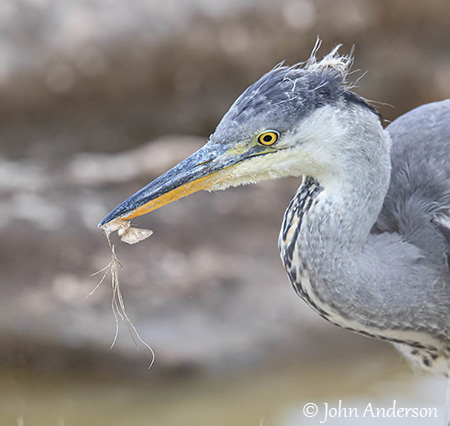
Later, the Grey heron regurgitates pellets of fur and bones. It also rejects remains of crustaceans, shelled mollusks and arthropods, such as rigid exoskeletons providing structural support and protection to these animals.
The Grey Heron hunts and feeds mainly around dawn and dusk, with the minimum levels around the middle of the day.
However, it may sometimes forage at night, especially in tidal environments.
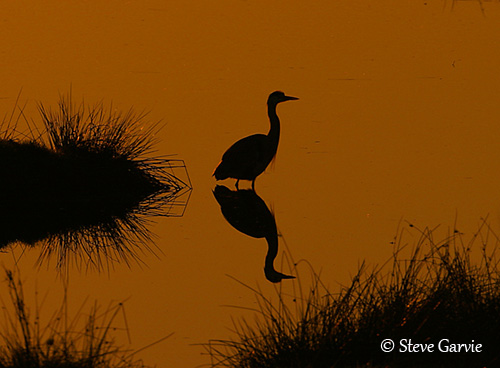
This species is very gregarious, and several birds can be seen roosting in groups in safe sites such as tall trees, small woods, reedbeds, but also on cliffs.
They nest in colonies established in good feeding areas, sometimes very extensive. The Grey Heron may wander off as much as 35-40 km away.
During the breeding season, the adults feed the chicks by regurgitation of prey adapted to the young birds. In this species, the chicks are not fed with prey of a large size suitable for adults until they are three weeks old.
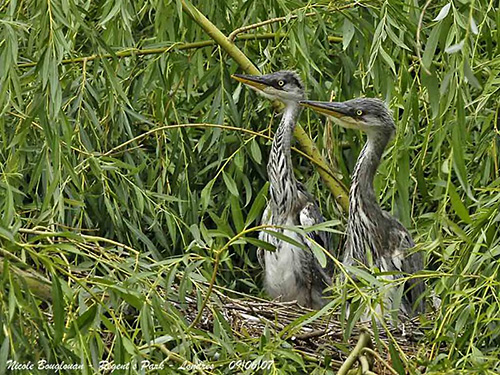
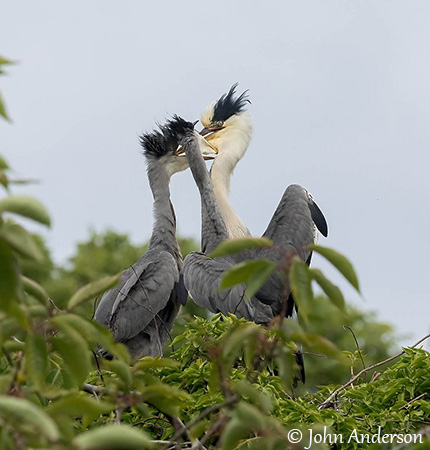
The Grey Heron has an extremely large range and some populations are decreasing whereas others are stable, increasing or have unknown trends. The species was heavily persecuted in the past in the mid-1900s. But later, due to protection, climate warming, and greater availability of good foraging sites, it became common and expanded to both the north and the south.
In 2019, the global population was estimated at 500,000–2,500,000 mature individuals.
The Grey Heron is currently evaluated as Least Concern.