PROTECTION / THREATS / STATUS:
The White-cheeked Bullfinch is a restricted range species described as scarce or locally common.
It is affected by habitat loss and fragmentation caused by deforestation for agriculture expansion, involving some decrease of the population.
The size of the population is unknown but it is declining slowly.
However, the White-cheeked Bullfinch is not globally threatened and currently evaluated as Least Concern.
Fr: Bouvreuil des Philippines
Ang: White-cheeked Bullfinch
All: Weißwangengimpel
Esp: Camachuelo Filipino
Ita: Ciuffolotto guancebianche
Nd: Filipijnse Goudvink
Sd: vitkindad domherre
Photographer:
Dubi Shapiro
Dubi Shapiro Photo Galleries
Illustration: (source: Ibis 1895)
John Gerrard Keulemans : 1842-1912
Text by Nicole Bouglouan
Sources:
HANDBOOK OF THE BIRDS OF THE WORLD Vol 15 by Josep del Hoyo-Andrew Elliot-David Christie - Lynx Edicions – ISBN: 9788496553682
A photographic guide to Birds of the Philippines by Tim Fisher and Nigel Hicks. New Holland Publishers. ISBN: 9781847738301
FINCHES AND SPARROWS by Peter Clement, Alan Harris and John Davis – Helm Identification Guides – ISBN: 0713652039
CREAGUS@Monterey Bay (Don Roberson)
Wikipedia, the free encyclopaedia
White-cheeked Bullfinch
Pyrrhula leucogenis
Passeriformes Order – Fringillidae Family
INTRODUCTION:
The White-cheeked Bullfinch is a medium-sized Fringillidae endemic to the Philippines where it frequents the mossy oak forests at high elevations.
It feeds on a variety of seeds and fruits found in its natural habitat. Depending on the season, and especially during summer, it also consumes insects.
During the breeding season, this species forms monogamous pairs. The male performs aerial displays while uttering soft calls to attract a female. They nest in coniferous forests and the cup-shaped nest is built by the female. Both parents rear and feed the young.
The White-cheeked Bullfinch is described as scarce and locally common. It is affected by degradation of the forested habitats. The population is slowly decreasing, but the species is not globally threatened at the moment.
DESCRIPTION OF THE BIRD:
Biometrics:
Length: 15-17 cm
Weight: 28-29 g
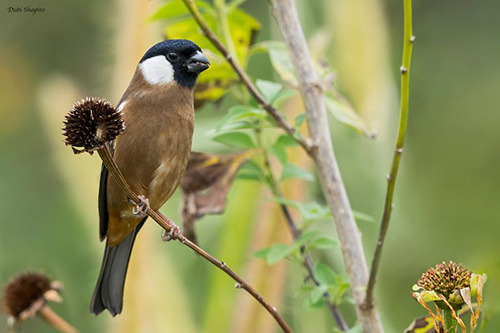
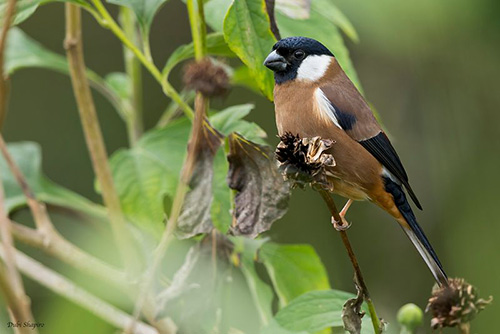
The White-cheeked Bullfinch has conspicuous white cheeks, giving the bird its name.
This plump-bodied, medium-sized bullfinch is endemic to the Philippines.
The adult male has mantle, wing-coverts and underparts warm brown except the white lower belly and the buff undertail-coverts.
On the upperwing, the brown coverts are finely tipped pale buff to whitish, forming a thin white line on closed wings. The flight feathers are black with bluish gloss. The outer edge of the upper tertial is deep crimson, well visible on closed wings and rear view of the bird. The first primary coverts are black and contrast with the white patch of the breast side.
The rump is white. The tail is black with bluish gloss.
The underparts are warm brown too, but we can see a prominent white patch on the breast sides, and a whitish-brown vertical stripe in the centre of the underparts, from the lower breast to the white lower belly. The undertail-coverts are buff. The rectrices are pale grey.
On the head, chin, upper throat, face, crown and hind crown are black and contrast strongly with the conspicuous white cheeks.
The short, thick, stubby bill is black, well-adapted for feeding seeds.
The eyes are dark brown.
Legs and feet are pinkish-horn.
The adult female shows similar plumage pattern, but she is duller overall, with paler face, mostly buffish-white.
The juvenile resembles adult but the face is buffish-white. Base of bill to forehead and around the eyes are blackish, whereas crown and nape are grey-brown. The rump is pale buff-brown and the upperparts are duller than in adults.
The underparts are dull buff-brown.
The bill is paler with yellowish-horn lower mandible.
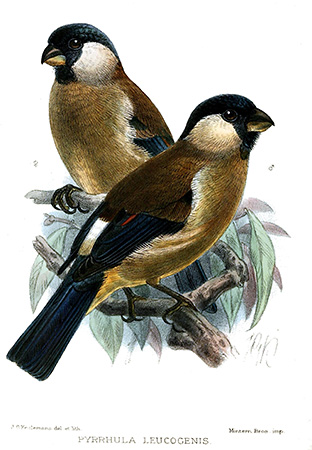
Female on the left
Male on the right
John Gerrard Keulemans
1842-1912
SUBSPECIES AND RANGE:
The White-cheeked Bullfinch has two subspecies.
P.l. leucogenis (described above) is found in N Luzon (N Philippines) in the Cordilleras and Mts Zambales.
P.l. steerei occurs in Mt Malindang, Mt Kitanglad, Mt Hilong-Hilong, Mt Apo and Mt Mayo, in Mindanao (S Philippines).
This race is slightly smaller than nominate. The bird has whiter belly, and the bill is smaller and blackish. The base of the lower mandible is horn-coloured.
HABITAT:
The White-cheeked Bullfinch is restricted to some mountains of Mindanao, Panay and Luzon. It is usually uncommon in forest canopy, edges and clearings with scattered trees. It is commoner in mossy, moist oak forests, dense coniferous forests and mixed forests where it can find seeds and berries which are its main diet.
The species is visible from 1,250 to 1,750 metres and more in high-altitude areas with dense vegetation and cooler climate.
CALLS AND SONGS: SOUNDS BY XENO-CANTO
The call of the White-cheeked Bullfinch is a clear, soft and melodious “pee-yoo”. It also produces a longer and louder “chuck-a-peeee yoooo” with an upward inflection on the third syllable and then, falling on the last one. This sound is repeated at regular intervals.
We can also hear a harsh, insect-like “zrrreeep”.
BEHAVIOUR IN THE WILD:
The White-cheeked Bullfinch feeds primarily on seeds, fruits and berries found within its natural habitat.
The seeds from pine, alder and birch trees are taken in spring, whereas berries (from rowan and juniper plants) are mainly consumed in late summer and autumn. During this period, it may also take insects providing it proteins. During the winter, this species depends on the remaining seeds and dried berries found through the habitat.
The small berries are taken in fruiting trees, and young fruits of Viburnum glaberrimum and tiny flowers and buds of Dendrocnide densiflora are also added to the diet.
It forages both in canopy and understorey. This species plays an important role in seed dispersal within its habitat.
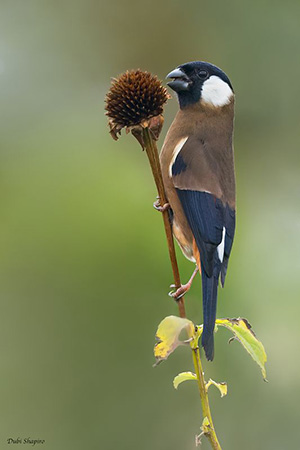
The White-cheeked Bullfinch can be seen singly, in pairs or small family groups and small flocks, but outside of breeding season, it forms larger mixed-species groups.
During the breeding season in early spring, between April and July, the males perform courtship displays during which their contrasted plumage is enhanced, in order to attract mates. During the displays, the males utter soft, melodious calls.
This species forms monogamous pairs and they strengthen the pair-bond by performing together synchronized movements.
The cup-shaped nest is built by the female, but both parents share chick-rearing and chick-feeding.
The White-cheeked Bullfinch is primarily resident, but it may perform altitudinal movements to lower areas in non-breeding season to find food resources. It usually moves over short distances and only performs minor altitudinal movements, depending on winter conditions.
Like most members of the Family Fringillidae, the White-cheeked Bullfinch performs swift and undulating flight, with bouts of flapping interspersed with glides on closed wings.
REPRODUCTION OF THIS SPECIES:
The breeding season takes place in early spring between April and July, when the food resources are abundant.
The White-cheeked Bullfinch usually breeds in coniferous forests, in areas with shrubs or small trees, often near open woodland.
The nest is built by the female, a cup-shaped structure made of twigs, grass and moss, a very welcoming and comfortable nest for the chicks. It is concealed by the foliage to protect it against intruders or predators.
The female lays 3-5 pale eggs with small markings. She incubates alone during about 12-14 days, while the male feeds her. After hatching, the chicks are fed on seeds and insects by both parents. They fledge about 17-20 days after hatching. They remain in family group until they become independent.