Fr: Ortalide de Wagler
Ang: West Mexican Chachalaca
All: Graubrustguan
Esp: Chachalaca Pechigrís
Ita: Ciacialaca del Messico Occidentale
Nd: West-Mexicaanse Chachalaca
Sd: västmexikansk chachalaca
Photographers:
Roger Ahlman
Pbase Galleries Peru and Ecuador
Jean Michel Fenerole
Photos d’Oiseaux du monde
Dubi Shapiro
Dubi Shapiro Photo Galleries
Text by Nicole Bouglouan
Sources:
HANDBOOK OF THE BIRDS OF THE WORLD Vol 2 by Josep del Hoyo-Andrew Elliot-Jordi Sargatal - Lynx Edicions - ISBN: 8487334156
A GUIDE TO THE BIRDS OF MEXICO AND NORTHERN CENTRAL AMERICA by Steve N. G. Howell, Sophie Webb - Oxford University Press - ISBN: 0198540124
THE WEST MEXICAN CHACHALACA—BEST KNOWN FOR ITS “SONG”
Dónde observar y fotografiar la chachalaca pechigrís en su hábitat natural
Wikipedia, the free encyclopaedia
West Mexican Chachalaca
Ortalis poliocephala
Galliformes Order – Cracidae Family
INTRODUCTION:
The West Mexican Chachalaca is endemic to SW Mexico where it frequents mature deciduous forests with dense foliage and vegetation.
It feeds primarily on plants, fruits and seeds, and occasionally takes small insects, especially during the breeding season. It forages mainly on the ground, but also into vegetation, shrubs and trees.
This species is very social, and flocks of 6-12 individuals are often observed. It produces loud calls used to communicate within the groups.
The West Mexican Chachalaca is monogamous. Both adults build the nest in tree, about 5 metres above the ground. They share the nesting duties, but the female alone incubates the eggs.
The West Mexican Chachalaca is described as fairly common to common throughout its range. It is affected by hunting pressure and habitat loss, but it is able to adapt to secondary forests and human-modified areas. The species is not globally threatened at the moment.
DESCRIPTION OF THE BIRD:
Biometrics:
Length: 58-68 cm
Weight: 1 male: 760 g
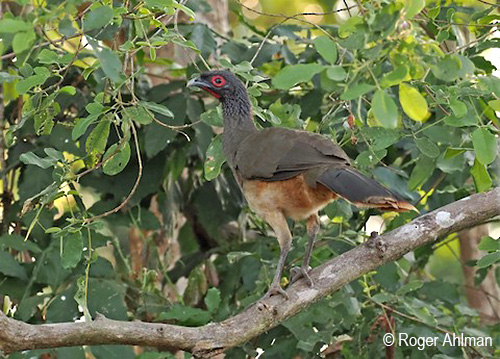
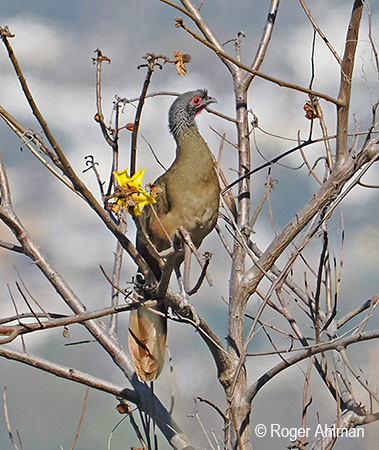
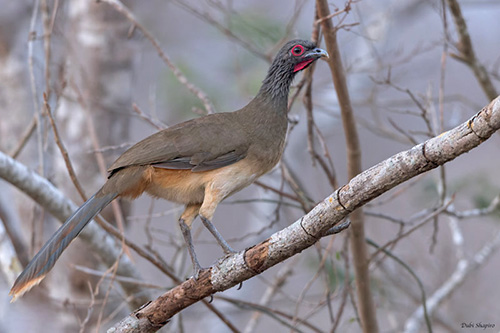
The West Mexican Chachalaca has pale grey-brown upperparts with olive sheen. The long tail is slightly greyer with broad, ochraceous-buff tips. The wings are grey-brown and strongly rounded.
On the underparts, the breast is greyish-olive. The belly is whitish with pale ochraceous-buff wash, darker on flanks and thighs. The underwing is dark grey with pale ochraceous-buff axillaries. The undertail-coverts are cinnamon. The rectrices are greyish-black with paler tips.
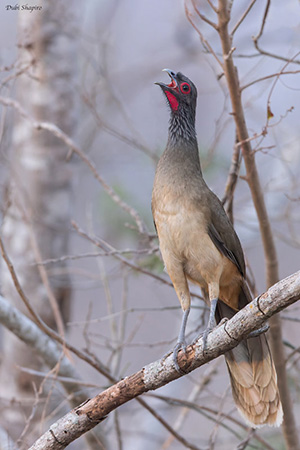
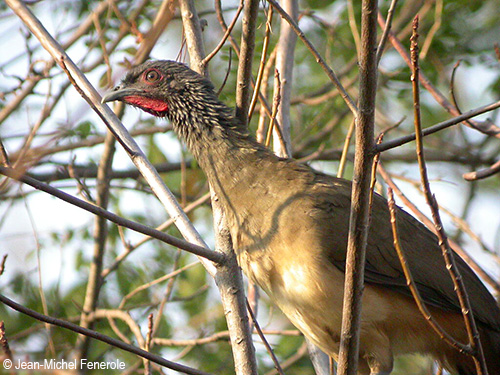
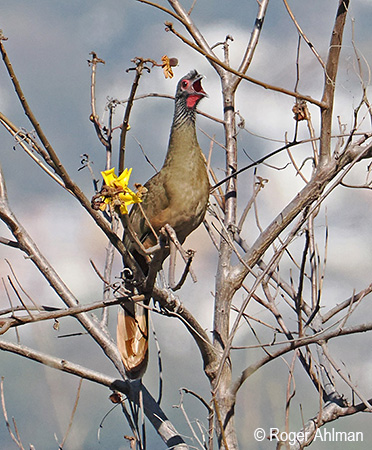
On the head, forecrown, crown, nape and neck are dull brownish-grey. A bare patch of red skin is visible at the base of the throat, becoming more conspicuous when the bird is calling.
The strong, curved bill is pale grey.
The eyes are hazel-brown, surrounded by bare, red orbital skin.
Legs and feet are ashy-grey.
Male and female have similar appearance.
The juvenile resembles adult, but the rectrices are more pointed.
RANGE:
The West Mexican Chachalaca is endemic to SW Mexico. It occurs from N Jalisco, S to SW Chiapas. It is also present inland to SW Puebla.
The species occurs generally along the Pacific coast of SW Mexico.
HABITAT:
The West Mexican Chachalaca frequents deciduous forests, thorn scrubs and second growths. It also occurs locally in pine-oak forests, and can be occasionally found in mangroves and palm plantations.
It prefers dense forests and woodlands, providing it cover and abundant food resources. It is adaptable to human-modified habitats and is able to exploit a variety of arid ecosystems such as arid scrublands.
The species is visible from sea-level to 2,400 metres of elevation.
CALLS AND SONGS: SOUNDS BY XENO-CANTO
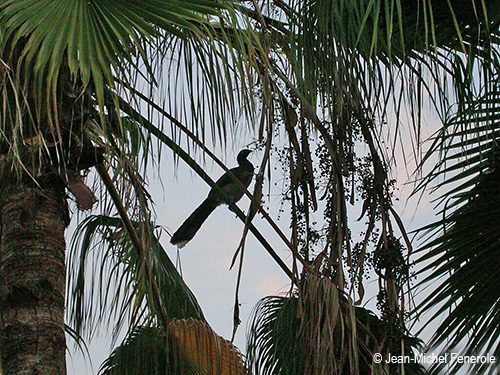
The West Mexican Chachalaca communicates within the groups with loud vocalizations, creating a strident, reverberating chorus, mainly heard at dusk (in the late afternoon) and dawn (after sunrise).
During the breeding season, male and female gives a series of loud calls, often uttered as well-co-ordinated rhythmic duets.
These calls are also used as contact between both mates while helping the chicks to find food items.
The main vocalization of this species is a collection of gruff, guttural, rhythmic chattering described as “chur-uh-uh-uhr…” but other calls such as squawks, whistles or clucking given from time to time are also heard.
While the birds are calling or singing, the bare red patch of the throat becomes more visible, but it is not protruding like in other Cracidae species.
BEHAVIOUR IN THE WILD:
The West Mexican Chachalaca feeds primarily on plant matter including leaves, seeds, flowers and fruits. These food items represent about 92% of the diet. However, it also consumes various insects such as beetles, ants and orthopterans, and small invertebrates, especially during the breeding season.
It usually forages on the ground, but it often takes the food directly off the vegetation.
The West Mexican Chachalaca is a social species, and flocks of 6-12 individuals often forage together while they communicate by loud, honking calls.
They gather where the food is abundant, often around fruiting trees. These groups are also observed at drinking sites, especially during the droughts.
The birds move into the dense vegetation, thanks to their specially adapted strong legs and feet. When foraging, they prefer running across the branches or on the ground, although being able to perform short, powerful flights.
The West Mexican Chachalaca is a monogamous species. The strong pair bonds last over several seasons.
At the beginning of the breeding season, they perform elaborate courtship displays involving synchronized movements accompanied by vocalizations. Male and female produce series of alternating calls heard through the habitat. The male may engage in subtle dance including wing-fluttering and bowing movements, in order to attract the female.
During this period, the birds can become quite aggressive, and conflicts often lead to fighting.
During the incubation, the female may occasionally leave the nest momentarily to help the male to chase away the intruders.
Both adults build a shallow platform in tree, about 1-5 metres above the ground. The copulation usually takes place on the ground. Except for the incubation performed by the female alone, both parents share the nesting duties.
The West Mexican Chachalaca is a resident species, staying in the same range all year round.
The capacity of flight is moderate and it rarely performs sustained flights. However, following a flurry of wingbeats, the bird makes long glides, and the long tail provides a good support. The short, rounded wings involve a weak, fluttering flight.
REPRODUCTION OF THIS SPECIES:
The breeding season of the West Mexican Chachalaca takes place from April to August, with peak in June-July.
The nest is a shallow platform built by both mates. It is made of twigs, leaves and grasses, creating a cup-shaped structure. It is placed in low to mid-canopy branches of trees, usually within dense forests.
The female lays 2-4 white, unmarked eggs. She incubates alone during 24 days. At hatching, the chicks are precocial. They leave the nest and can fly in few days. They are fed by both parents by regurgitation. Both adults care for the young, and later, they guide them towards food sources.
PROTECTION / THREATS / STATUS:
The West Mexican Chachalaca is described as fairly common to common within its range. Habitat loss and fragmentation, but also hunting pressure may affect this species.
The size of the population is placed in the band 50,000-500,000 mature individuals, and it is suspected to be decreasing.
But currently, the West Mexican Chachalaca is evaluated as Least Concern.