The female lays 2-3 pale brown eggs with speckles. The incubation is shared by both parents and lasts about 2-3 weeks (more information is needed). The altricial chicks are fed with insects and continuously protected by the adults. They fledge 3 weeks after hatching, but they still depend on parents until they are independent.
PROTECTION / THREATS / STATUS:
The Visayan Cuckooshrike is threatened by habitat loss caused by deforestation, logging and conversion of lowland forests to agriculture and urban development.
It is a restricted-range species, living in small, fragmented populations within its small range estimated at just 65,200 km².
The population is suspected to be decreasing due to habitat loss.
But the Visayan Cuckooshrike is not globally threatened and currently evaluated as Least Concern.
Fr: Échenilleur barré (panayensis)
Ang: Visayan Cuckooshrike
All: Visayasraupenfänger
Esp: Oruguero de las Bisayas
Nd: Panayrupsvogel
Sd: visayagråfågel
Photographer:
Dubi Shapiro
Dubi Shapiro Photo Galleries
Text by Nicole Bouglouan
Sources:
HANDBOOK OF THE BIRDS OF THE WORLD Vol 10 by Josep del Hoyo-Andrew Elliott-David Christie - Lynx Edicions - ISBN: 8487334725
L’ENCYCLOPEDIE MONDIALE DES OISEAUX - Dr Christopher M. Perrins - BORDAS - ISBN: 2040185607
Nuptial behaviour in the genus Coracina (Campephagidae)
Wikipedia, the free encyclopaedia
Visayan Cuckooshrike
Coracina panayensis
Passeriformes Order – Campephagidae Family
INTRODUCTION:
The Visayan Cuckooshrike was formerly a subspecies of the Bar-bellied Cuckooshrike (Coracina striata), from which it differs by different morphology and colour of barring plumage pattern. The vocalizations also differ.
This species was described as a distinct species in 1890 by Joseph Beal Steere, an American ornithologist, during an expedition to the Philippines.
The name “panayensis” comes from the Panay Island where the specimen was discovered. But despite the placement in the genus “Coracina” recognizing its affinities with other cuckooshrikes, the Visayan Cuckooshrike and other cuckooshrike species are not related to either the cuckoos or the shrikes. The name “cuckoo” probably derives from the grey plumage coloration of many of these species (including the cuckoo-like barring on the underparts), whereas the name “shrike” comes from the strong bill.
The Visayan Cuckooshrike is endemic to the western Visayan Islands in the Philippines. Its current range is limited to the islands of Panay and Negros.
It frequents the tropical, moist lowland forests of the island, and usually occurs in the dense canopy cover for feeding and shelter.
It feeds on insects and small invertebrates picked off leaves and branches. Fruits and berries are also part of the diet, especially when insects are less abundant.
During the breeding season, courtship displays accompanied by vocalizations are reported. They are monogamous and both adults share the nesting duties. The nest is a cup-shaped structure built in well-concealed site for protection.
The Visayan Cuckooshrike is a restricted-range species, affected by habitat loss caused by deforestation and fragmentation of the forested habitat. The population is suspected to be decreasing, but currently, the species is not globally threatened.
DESCRIPTION OF THE BIRD:
Biometrics:
Length: 26-31 cm
Weight: 108-120 g
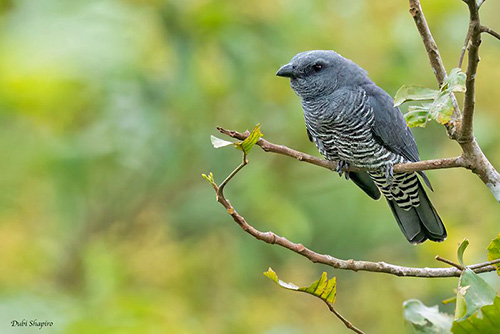
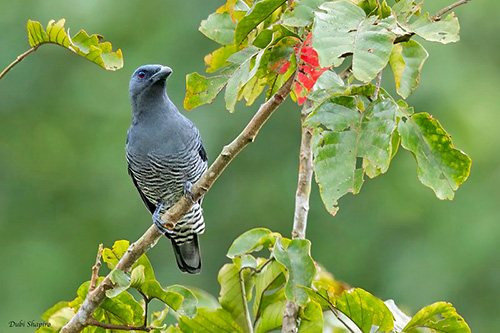
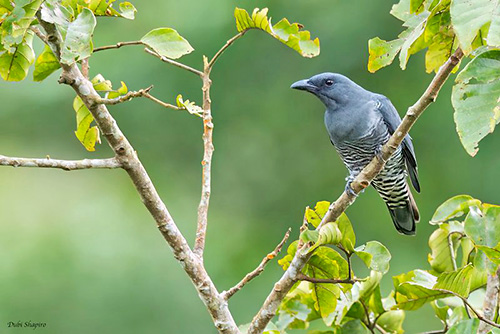
The Visayan Cuckooshrike adult male has grey upperparts with darker flight-feathers and tail. Rump and uppertail-coverts are barred black-and-white, like underwing coverts and axillaries.
On the underparts, chin, throat and upper breast are grey, while rest of underparts is barred black-and-white.
Depending on the light, the plumage may show blue hues.
The head is grey with blackish lores and fore ear-coverts.
The strong, heavy bill is black.
The eyes are red.
Legs and feet are black.
The adult female is very similar to the male, but she lacks the black markings on the face, and shows tightly barred black barring on both white throat and breast.
The juvenile is globally duller than adults. It is finely barred black, grey and buff. Wings and tail feathers are conspicuously fringed buff-white.
RANGE:
The Visayan Cuckooshrike occurs in the western Visayan Islands in the Philippines. It is also reported from islands including Panay, Negros, Masbate, Guimaras and Ticao in C Philippines.
The species is confined to these islands and it not distributed across the archipelago.
HABITAT:
The Visayan Cuckooshrike frequents forest habitats and wooded areas, mainly the tropical, moist lowland forest of the islands. It usually occurs in the dense canopy cover where it forages for insects and fruits, depending on the season.
It is mainly present at low to mid-elevation where it benefits from a warm and humid climate. It is occasionally seen up to 2,000 metres of elevation.
The species is able to adapt to altered habitats such as secondary grown forests and plantations, scrubby areas and fragmented habitats close to its main forested areas.
CALLS AND SONGS:
The vocalizations of the Visayan Cuckooshrike are used as contact and during territory maintenance, and during the courtship displays.
The bird produces melodious whistling calls heard throughout the forest. Both mates often sing together, providing harmonious duets that echo through the tree-canopy.
During the breeding season, the males give melodious song to attract females. The courtship displays are accompanied by vocalizations.
The melodic calls and songs of the Visayan Cuckooshrike blend softly with the forested habitat.
BEHAVIOUR IN THE WILD:
The Visayan Cuckooshrike feeds on insects and small invertebrates while foraging in the tree-canopy within its forested habitat. It is an arboreal species, mainly active during the day.
It moves along branches and through foliage, searching for food and gleaning insects. It occasionally makes short sallies to catch flying insects.
The main diet consists of caterpillars, mantids, dragonflies, beetles and other arthropods picked off leaves and branches. But the Visayan Cuckooshrike also consumes fruits and berries provided by numerous fruiting plants (mainly Ficus species) within its habitat. Fruits are consumed when insects are less abundant. The species adapts to food availability, depending on the season.
The Visayan Cuckooshrike may be observed singly, in pairs or small family groups moving through the tree canopy. While foraging, they also join mixed-species flocks. They communicate by calls and songs used for contact and to advertise the territory.
At the beginning of the breeding season, the birds use visual displays and body postures, also used during aggressive interactions. The male performs dynamic courtship displays and aerial displays accompanied by vocalizations. Melodious songs are given by the males to attract the females. Both mates strengthen the pair bonds by performing mutual preening.
The Visayan Cuckooshrike builds a cup-shaped nest among the dense foliage of trees and shrubs in wooded areas. They are monogamous and both adults share all the nesting duties.
The Visayan Cuckooshrike is a non-migratory species. It is considered resident of the islands where it lives.
The species is often observed in tree-canopy where its sleek body allows it to glide easily through the canopy. The species is able to fly for short distances among the tree-canopy.
Like numerous cuckooshrikes, it performs stealthy movements with short bursts of flight when needed.
REPRODUCTION OF THIS SPECIES:
The breeding season occurs probably in April-May, usually mainly in spring and early summer during the wetter months.
The Visayan Cuckooshrike builds a cup-shaped nest in the dense foliage of trees in wooded areas, but also in gardens with thick vegetation. Both adults build the nest with twigs, leaves and plant fibres to make a shallow cup.