PROTECTION / THREATS / STATUS:
The Stone Partridge has very large range where it is locally common to abundant.
It may be affected by habitat loss and degradation caused by agriculture expansion, overgrazing and human settlement. Hunting pressure in some parts of the range is generally low.
The species is present in several protected areas, and is adaptable to several types of dry habitats.
The size of the population is unknown, but it is suspected to be stable.
The Stone Partridge is currently evaluated as Least Concern.
Fr: Poulette de roche(s)
Ang: Stone Partridge
All: Felsenwachtel
Esp: Gallinita Roquera
Ita: Pernice sassicola
Nd: Rotspatrijs
Sd: stenvaktel
Photographers:
Steve Garvie
RAINBIRDER Photo galleries
William Price
PBase-tereksandpiper & Flickr William Price
Dubi Shapiro
Dubi Shapiro Photo Galleries
Ingo Waschkies
Bird Photography
Text by Nicole Bouglouan
Sources:
HANDBOOK OF THE BIRDS OF THE WORLD Vol 2 by Josep del Hoyo-Andrew Elliot-Jordi Sargatal - Lynx Edicions - ISBN: 8487334156
BIRDS OF AFRICA SOUTH OF THE SAHARA by Ian Sinclair and Peter Ryan - Princeton University Press Princeton and Oxford - ISBN: 0691118159
Arthur Grosset's Birds (Arthur Grosset)
Wikipedia, the free encyclopaedia
Stone Partridge
Ptilopachus petrosus
Galliformes Order - Odontophoridae Family
INTRODUCTION:
The Stone Partridge was formerly part of the family Phasianidae, subfamily Perdicinae. But the species is now in the family Odontophoridae that includes mainly the New World Quails.
Two species are in the genus Ptilopachus, the Stone Partridge and the Nahan’s Partridge (Ptilopachus nahani), both found in Africa. They are the only African representative of this family.
The Stone Partridge is found in Africa, in a broad band from Senegal in the west to Ethiopia in the east, where it frequents dry and rocky habitats, savannas and open forests.
It primarily feeds on seeds and grains, but also fruits and berries found on the forest floor. Insects are consumed during the rainy season.
This species is often seen in small groups. At the beginning of the breeding season, the male performs courtship displays accompanied by calls to attract females.
They nest on the ground on in rocky crevices, with the site well hidden under rocks or dense bushes and foliage. The female incubates, but both parents rear and feed the chicks.
The Stone Partridge has a very large range in which it is described as locally common to abundant, and the population is suspected to be stable, despite some hunting pressure.
DESCRIPTION OF THE BIRD:
Biometrics:
Length: 23-25 cm
Wingspan: 35-40 cm
Weight: 187-198 g
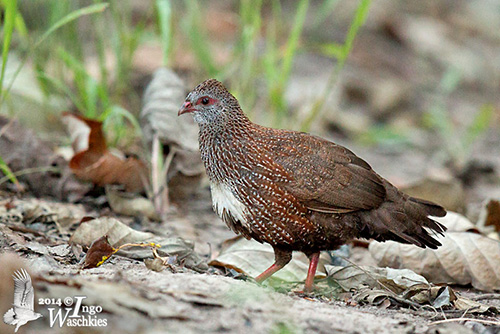
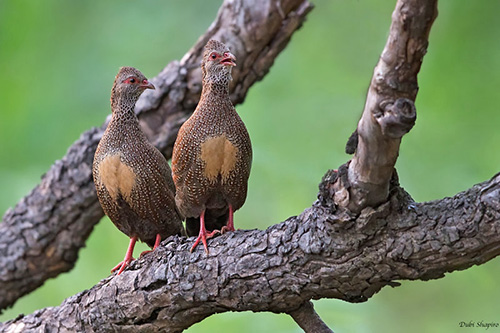
The Stone Partridge is a terrestrial species with short, rounded wings, short bill and strong legs and claws, all characteristics perfectly adapted to rocky terrain and dry environments. Its cryptic plumage provides the bird a good camouflage within its habitat.
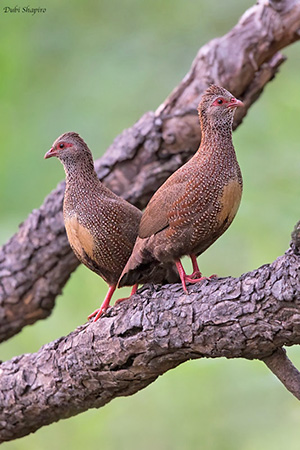
The Stone Partridge has chocolate-brown upperparts with pale greyish spotted pattern. The male may show brighter plumage coloration during the breeding season.
The underparts are paler overall, but lower breast and belly are buff in males, and flanks show broad chestnut streaks.
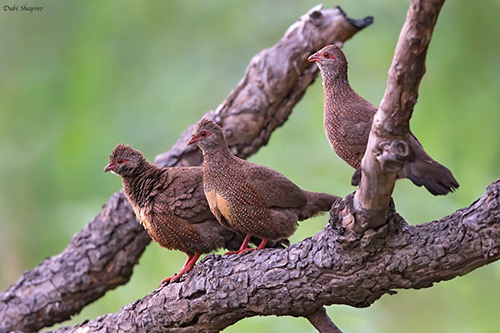
Head and neck are paler brown. The crown is darker and contrasts with the paler cheeks and the whitish eyebrow. On top of the head, the feathers are sometimes raised and form a short crest. They have broad, cream edges, involving a scaled appearance.
The short bill is reddish with greyish-yellow tip.
The eyes are brown, surrounded by bare, red orbital ring.
The strong legs and feet are dark red, the claws are black.
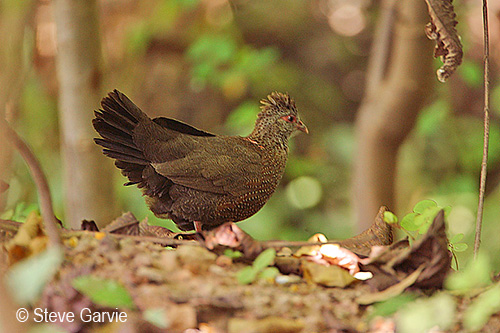
The female is very similar but slightly smaller than the male. She has very pale cream lower breast and belly.
When she raises the crown feathers, the crest is more conspicuous than in males, due to longer feathers.
The juvenile has duller plumage and lacks the mottling of mature birds. It has barred body, secondaries and tail.
SUBSPECIES AND RANGE:
The Stone Partridge may have two or four subspecies, according to the authors.
The two main subspecies are:
P.p. petrosus (described above) is found in S Mauritania and Senegal, E to SW Sudan, South Sudan and C Kenya, and SC Ethiopia.
P.p. major is found in NW Ethiopia and N Eritrea.
This race is larger (28 cm length) and paler than nominate, with broader streaks on flanks and less saturated brown tones. Its appearance is probably an adaptation to higher altitude and more arid environment in its range.
Two other subspecies are sometimes added by some authors:
P.p. brehmi, found S Chad to C Sudan.
P.p. florentiae, found in S Sudan and S Ethiopia to NE DR Congo, N Uganda and C Kenya.
These races probably represent stages of clinal variation birds living in more arid areas. They also show paler or more rufous plumage.
They are normally included within the nominate race.
HABITAT:
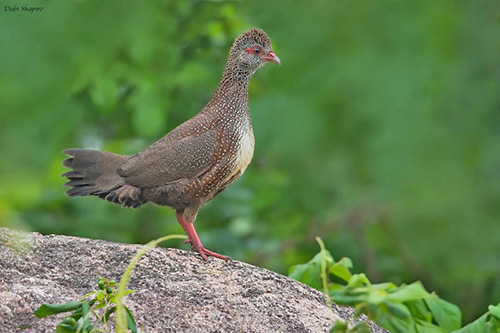
The Stone Partridge is usually found in dry, rocky areas and dry scrublands. It also frequents the rocky hillsides with dense vegetation, and can be seen near boulders in savanna habitat.
But this species is also observed in more humid forest edges and cultivated areas, adapting to other type of vegetation.
In addition, the arid to semi-arid climates and seasonal rainfalls that prevail in this type of habitat create a suitable environment adapted to the behaviour of this species.
The Stone Partridge occurs from 600 to 1,500 metres of elevation, among bare rocky ground and thorny vegetation.
CALLS AND SONGS: SOUNDS BY XENO-CANTO
The Stone Partridge generally produces quiet vocalizations including soft whistles and calls. These sounds, often given in duets or by several birds, are used as contact between mates and young birds, or as territorial signals in bushy habitats.
They call mainly at dawn and dusk, but during the rainy season, they can be heard all day long. Pairs or small groups produce soft, clucking calls while foraging or moving through the vegetal cover.
The advertising call is a repeated “weet-weet-weet” and also a more liquid “rr-weet, rr-weet, rr-weet”. The alarm calls are sharper.
But the Stone Partridge also mimics several bird calls, used in territory defence to avoid predators.
BEHAVIOUR IN THE WILD:
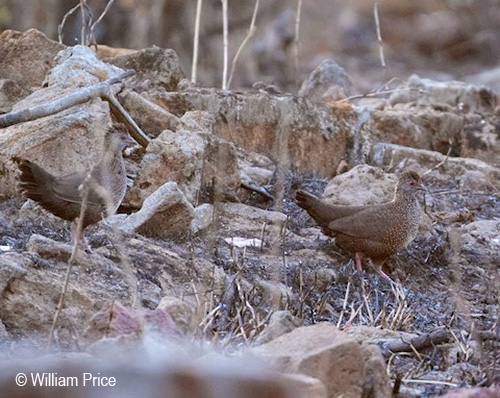
The Stone Partridge is mainly a ground-dwelling species with shy and secretive behaviour. It is usually discreet during the day, becoming active in the early morning and in the late afternoon, protected by its cryptic plumage within its rocky environment.
This species feeds primarily on seeds, grains and small fruits and berries, but it also takes leaves and buds. During the breeding season, insects (beetles, ants) and small invertebrates are also consumed.
The Stone Partridge forages on the ground, scratching the soil with the feet and pecking at the surface with the bill.
They often feed in small groups or in pairs. They roost in flocks in the thick vegetation or in rocky crevices that protect them from predators.
The Stone Partridge breeds during the rainy season, when food availability is important. The male performs courtship displays including subtle posturing, fluffing its feathers and dancing while singing to attract the females. It uses mainly its cryptic but beautiful plumage and behavioural signals to strengthen the pair-bonds. During the courtship, the male may also offer food to the female.
As a very social species, the males often display in groups, competing to attract the attention of the females.
The Stone Partridge nests in shallow scrape on the ground, protected by rocks or dense bushes, but it also use rocky outcrops.
The female incubates alone, but both parents rear and protect the chicks.
The Stone Partridge is sedentary within its large range.
This species is able to fly, but it flies only when necessary and prefers to run to escape predators. However, it can perform a fast, direct flight. But it is also able to climb easily cliff faces, and sometimes perches on low branches in trees.
As usual, it uses its cryptic plumage to blend into the rocky habitat.
REPRODUCTION OF THIS SPECIES:
The breeding season varies depending on the range. It usually occurs during the rainy season in the dry parts of the distribution, and during the dry season in wet areas, when food availability is higher.
The Stone Partridge usually nests on rocky grounds and near stones, often using natural rocky crevices that protect the family from predators. Grass and leaves are added in the nest.
But it may also use a shallow scrape lined with grass on the ground, protected by rock, tree or tuft of grass.
The female lays 4-6 pale buff eggs with speckled markings. She incubates alone during 21-23 days. The chicks are precocial and are fully-feathered at hatching. They have blackish-chestnut upperparts and dark brown underparts with black speckles. Both parents rear and protect them, guiding the young birds until they are independent.