Fr: Cormoran de Socotra
Ang: Socotra Cormorant
All: Sokotrascharbe
Esp: Cormorán de Socotra
Ita: Cormorano di Socotra
Nd: Arabische Aalscholver
Sd: sokotraskarv
Photographers:
Jean Michel Fenerole
Photos d’Oiseaux du monde
Paul Guillet
Photos d'Oiseaux
Jean-Claude Jamoulle
A la rencontre des Oiseaux
Text by Nicole Bouglouan
Sources:
HANDBOOK OF THE BIRDS OF THE WORLD vol 1 by Josep del Hoyo-Andrew Elliot-Jordi Sargatal - Lynx Edicions - ISBN: 8487334105
WELCOME TO THE ENVIRONMENT AGENCY – ABU DHABI (EAD)
Zoo Tracker – Socotra Cormorant
Ornithomedia - Le Web de l’Ornithologie
Wikipedia, the free encyclopaedia
Page family Phalacrocoracidae
Summary cards
Socotra Cormorant
Phalacrocorax nigrogularis
Suliformes Order – Phalacrocoracidae Family
INTRODUCTION:
The Socotra Cormorant is endemic to the Persian Gulf and the SE coasts of the Arabian Peninsula. The first specimen was recorded on Socotra Island, giving the bird its name.
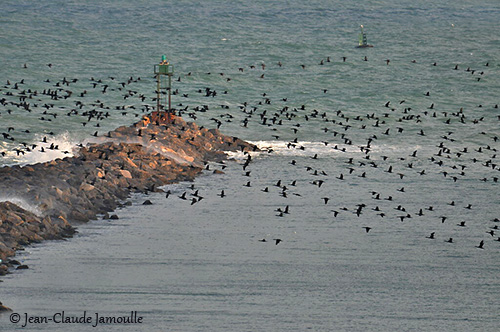
This species is highly gregarious and forms large flocks all year round, both at roost and at sea.
It feeds primarily on various small fish species, caught by pursuit-diving. It is able to reach depths of 18 metres or more. Immense feeding flocks can be seen offshore.
The Socotra Cormorant forms dense breeding colonies of several thousands of pairs. They are often established on small desert islands where they are protected from mainland predators.
The nest is a scrape on the ground, gravel or sand, or placed on slightly raised mound. Both adults feed the chicks by regurgitation.
The Socotra Cormorant has restricted range in which it is rapidly declining. The species is affected by human development and disturbance at the nesting colonies, egg and chick collection, hunting of chicks or adults and marine oil pollution.
However, thanks to conservation measures, this trend is different in the United Arab Emirates, especially in the Emirate of Abu Dhabi. From 2007-2008 to 2016-2017, the numbers of pairs rose from about 5,000 to nearly 52,000 pairs. If we add the colony established on Siniya Island (Emirate of Umm Al Quwain), which is the largest island of this region, the United Arab Emirates are home 60,000/70,000 pairs, which accounts almost half of the total population.
The Socotra Cormorant is currently listed as Vulnerable.
DESCRIPTION DE L’OISEAU:
Biometrics:
Length: 76-84 cm
Wingspan: 102-110 cm
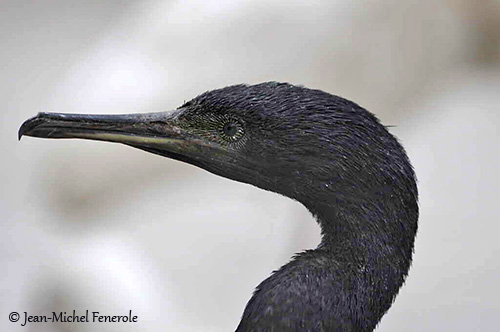
In breeding plumage, the Socotra Cormorant has more glossy black plumage. Wings and back show bronze-green tinge, whereas the rump is finely streaked whitish. Mantle, scapulars and upperwing feathers have a small black spot at tip.
The underparts are black, including the underwing. A green gloss is seen during the breeding season.
On the head, the forecrown shows a pinkish gloss, and some white plumes are visible on lores and around the green eyes.
On the neck, we can see some white flecks. The gular skin is blackish.
The long, slim bill is blackish-grey with greenish-yellow line along the basal half of the mandible.
The eyes are green.
Legs and webbed feet are black.
In non-breeding plumage, the Socotra Cormorant has entirely black plumage and lacks the gloss. The white filoplumes are lost too.
Male and female have similar appearance, but the male is slightly larger.
The chick is naked at hatching but later, it becomes entirely covered in white down.
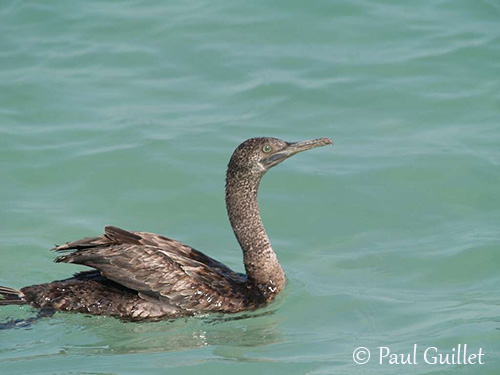
The juvenile is brownish-grey on head, neck, upperparts and thighs. Scapulars and upperwing-coverts are darker. The tail is blackish with pale shifts.
The underparts are brownish-white on throat and foreneck, and from lower foreneck to belly. Flanks are grey-brown.
On the head, facial skin, gular pouch and bill are pinkish-flesh, but more usually horn-yellow with dark culmen.
The eyes are grey, soon becoming green.
Legs and feet are grey with dull pinkish to flesh-brown tinge.
The immature has greyish brown upperparts with pale fringes to coverts. The underparts are brownish white with brownish spotting on breast and belly.
It is often mistaken for juvenile Great Cormorant.
RANGE:
The Socotra Cormorant has two sub-populations.
The norther sub-population occurs on islands off the Persian Gulf coasts of Bahrain, United Arab Emirates, Saudi Arabia and Qatar. The breeding population of Iran is not confirmed since 1972.
The much smaller southern sub-population breeds on some islands off the Arabian Sea coasts of Oman, and in the Gulf of Aden off S Yemen. It has recently been confirmed also in Socotra.
The highest breeding concentration of the species is found in the Gulf of Salwa, a narrow bay separating the peninsula of Qatar from Saudi Arabia. It is suspected representing about half of the global population of the Socotra Cormorant.
HABITAT:
The Socotra Cormorant is an exclusively marine species, breeding in colonies on rocky and sandy coasts, often on small desert islands.
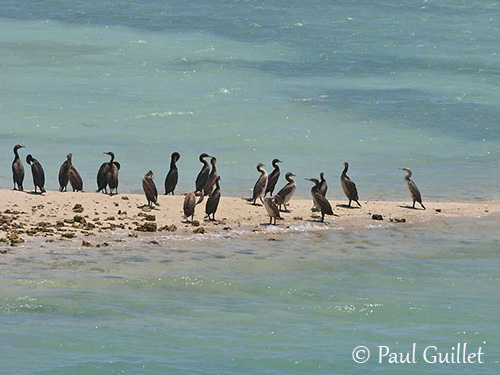
The roosting sites are usually on sandbanks, coastal cliffs and islets.
CALLS AND SONGS: SOUNDS BY XENO-CANTO
Like most of the Phalacrocoracidae, the Socotra Cormorant is usually silent outside of the breeding season.
Vocalizations are frequent at roosts, with various interactions and disputes for perches. Vocal displays can be heard at breeding colonies, associated with breeding behaviour.
Males are more vocal than females, producing croaking, groaning, barking, ticking and gargling calls. Females only produce soft hissing calls, and are usually silent.
BEHAVIOUR IN THE WILD:
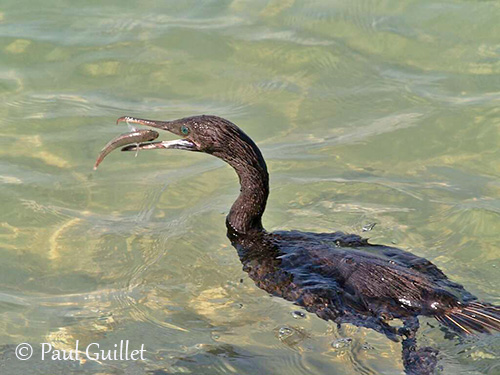
The Socotra Cormorant feeds mainly on small fish including Sailfin flying fish (family Exocoetidae), Blue Stripe Sardine (family Dorosomatidae) and anchovies.
Cormorants are surface-diving piscivorous. They feed mainly by pursuit-diving and may reach depths of 18 metres or more. Some reports suggest that they can stay submerged up to 3 minutes.
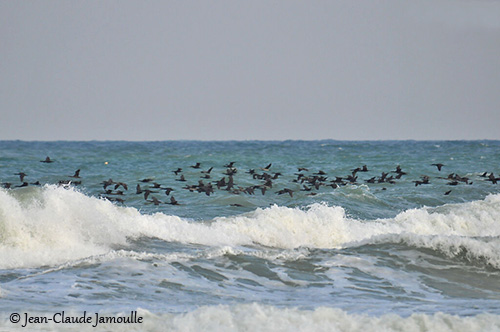
They often form large foraging flocks and are able to detect prey from the air.
Within the breeding colonies, the chicks depend completely on their parents for food. One of the adults takes off and flies across the sea for food, in order to feed the young. But if the fishing trip fails, the second parent is forced to temporally abandon the chicks to find food.
The chicks wander from the colony, begging for food at anything. Sometimes, they turn to cannibalism, grabbing an abandoned chick and swallowing it whole…
The Socotra Cormorant is a very gregarious species, forming large aggregations all year round. They roost together in tightly packed flocks, forage in groups and breed in colonies, sometimes of tens of thousands of pairs.
During the breeding season, they become more vocal. The courtship displays are accompanied by vocalizations. The birds perform head and wing movements to attract females.
The Socotra Cormorant nests in a scrape on the ground, often in shaded areas. Both adults share the nesting duties.
This species is migratory or dispersive, but more information is needed.
Some movements are related to food resources. It disperses over Persian Gulf and Arabian Sea, reaching Gulf of Aden. It is vagrant to the Red Sea coasts of E Africa N to Eritrea, and also off W India.
They usually move in very large flocks that could be interpreted as migrations.
The flight of the Phalacrocoracidae is powerful, with continuous wingbeats sometimes interspersed with occasional glides. They land on the water by fanning the tail and stretching the webbed feet before touching the surface. They run along the water surface for the take-off while flapping actively the wings. When possible, they use the wind to help both landing and take-off and usually prefer open waters.
REPRODUCTION OF THIS SPECIES:
The breeding season of the Socotra Cormorant varies, depending on the colonies. This period occurs from June to October at Indian Ocean colonies and from September to April in Gulf.
This species forms dense colonies of tens of thousands of pairs, on shores of level sand or gravel, or slightly sloping hills free from vegetation.
The female builds the nest on the ground, a scrape in gravel or sand, or sometimes on slightly raised mound. It is often built under planted trees and shaded areas, although nesting in open areas is usually preferred.
The female lays 2-4 eggs. The duration of the incubation is unknown, but it may last 25/35 days, depending on the species. The adults incubate with their webbed feet, taking turns regularly.
At hatching, the chicks are naked, and then, a white down is growing. When they are able to move, they leave the nest and form groups or creches, usually under shaded areas with trees.
The adults feed them by regurgitation, first of liquid food, and later, the young insert their head into the adult’s throat to get solid food.
From some observations, if they are abandoned by their parents, the chicks may wander from the colony, begging for food at anything. Sometimes, they turn to cannibalism, grabbing an abandoned chick and swallowing it whole.
PROTECTION / THREATS / STATUS:
The Socotra Cormorant has restricted global range in which it is suspected to be declining. These declines are caused by coastal developments, disturbances and marine pollution. Predation of eggs and chicks by large gulls has also a negative impact.
As a piscivorous species, it is also affected by several marine pollutants. Introduced predators such as Feral Cats and Red Foxes on breeding islands, eggs and chicks collection for consumption, drowning in fishing traps and storms that destroy the nests, are among the main threats.
The population was estimated at 220,000 mature individuals in 2010. It is suspected to be declining.
The Socotra Cormorant is legally protected in most range states, and several conservation actions are underway and needed. It is currently classified as Vulnerable.