Okinawa Rail
Hypotaenidia okinawae
Gruiformes Order – Rallidae Family
INTRODUCTION:
The Okinawa Rail is endemic to Okinawa Island in Japan. It is named Yanbaru Kuina in its native island.
The species was first described in 1981, based on a dead specimen found in Kunigami District, Okinawa.
It was first placed in the genus Rallus, and then moved to Gallirallus. Today, the scientific name officially adopted is Hypotaenidia okinawae, following a taxonomic update.
The Okinawa Rail is almost flightless. It is found in subtropical moist forests and adjacent areas with marshes, grasslands and cultivated land. It feeds on lizards, amphibians, snails and large insects, mainly taken from the forest floor and in shallow water. But it also takes acorn and various plant seeds.
This species nests on the ground and both adults share the nesting duties. It is monogamous and territorial.
The Okinawa Rail is classified as Endangered, due to introduced Javan mongoose, deforestation and human settlements. However, the species appears relatively common and widespread in the remaining suitable habitats.
DESCRIPTION OF THE BIRD:
Biometrics:
Length: 29-33 cm
Wingspan: 48-50 cm
Weight: 435-450 gr
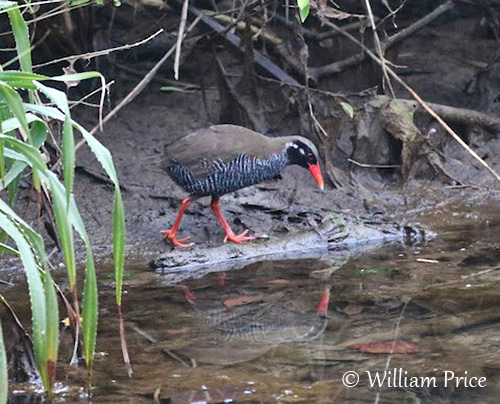
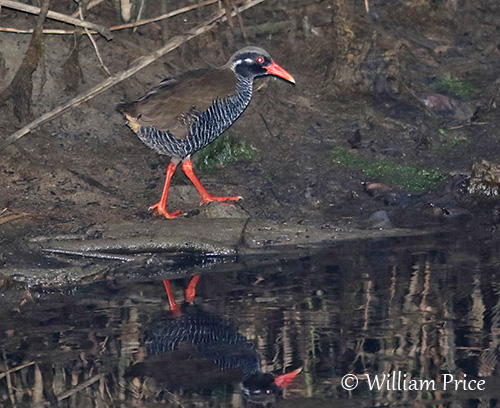
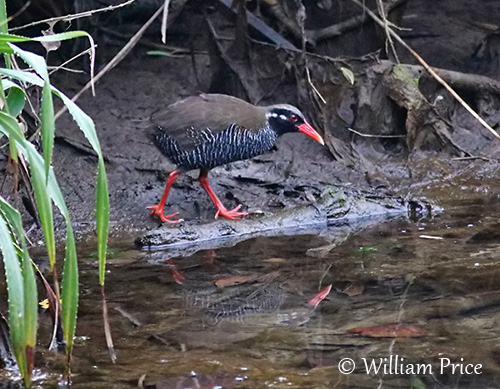
The Okinawa Rail has olive-brown upperparts, including mantle, back, wings, rump and uppertail.
The underparts are black, narrowly barred white from the breast to the pale buff vent. The undertail-coverts are dark brown with pale bars.
The rounded wings and the tail are very short, and do not allow a good flight. The bird is almost flightless.
On the head, face and chin are black. We can see a white line extending from the bill gape to the side of the neck. Forecrown, crown and hindcrown are brownish, slightly paler than the upperparts.
The stout bill is bright red with yellowish-white tip.
The crimson-coloured eyes are surrounded by narrow, reddish eyering.
The long, strong legs and feet are red with powerful claws.
Male and female have similar appearance, but the male is larger.
PROTECTION / THREATS / STATUS:
The Okinawa Rail is threatened by habitat loss caused by deforestation, logging, fragmentation and human settlements.
In addition, introduced predators such as the Javan Mongoose, and also feral dogs and cats, indigenous snakes, weasels and Large-billed Crows are possible predators.
Road kills, especially during the breeding season, also have a negative impact.
The size of the population was estimated at 1.800 birds in 1986, to 810 in 2004 and 720 in 2005.
In 2006, the numbers were estimated at 480 mature individuals, and suggested stabilised.
The Okinawa Rail is legally protected in Japan.
The species is currently classified as Endangered, with very small population within a very small range on only one island.
Fr: Râle d'Okinawa
Ang: Okinawa Rail
All: Okinawaralle
Esp: Rascón de Okinawa
Ita: Rallo di Okinawa
Nd: Okinawaral
Sd: okinawarall
Photographers:
Ken Havard
My Bird Gallery & Flickr gallery 1 & Flickr gallery 2
William Price
PBase-tereksandpiper & Flickr William Price
Text by Nicole Bouglouan
Sources:
HANDBOOK OF THE BIRDS OF THE WORLD Volume 3 by Josep del Hoyo-Andrew Elliott-Jordi Sargatal - Lynx Edicions - ISBN : 8487334202
Morpho-anatomy of the Okinawa Rail
Wikipedia, the free encyclopaedia
The chick has black down overall.
The bill has white base and tip.
The eyes are black.
Legs and feet are yellowish.
The juvenile is paler than adult, with olive-tinged upperparts and head. The underparts are mottled rather than barred.
The bill is brownish.
The eyes are brown with a shorter stripe behind.
Legs and feet are yellow-ochre.
The immature resembles adult but it has darker bill.
RANGE:
The Okinawa Rail is found in northern Okinawa in Ryukyu Islands, S Japan.
HABITAT:
The Okinawa Rail is usually present under the vegetal cover in subtropical broadleaf evergreen forest where it can find some water and dense undergrowth, especially ferns.
It can be seen along the forest edges and in small forested patches, scrub and adjacent cultivated fields where streams, pools and reservoirs are available.
But it usually prefers shady forests of Itaji evergreens and Ryukyu pines with thick undergrowth.
The species occurs from sea-level to 498 metres of elevation in the mountainous areas of the island.
CALLS AND SONGS: SOUNDS BY XENO-CANTO
The Okinawa Rail is highly vocal with a variety of loud calls, given mainly in early morning, late afternoon and evening.
The calls are given from the ground and sometimes from trees.
The calls include several sounds such as “kwi kwi kwi ki-kwee ki-kwee”, also “ki-ki-ki” and “kyip kyip kyip kyip”. We can also hear a rolling “kikirr krarr” followed by “kweee” notes resembling the calls of animals such as pigs and horses. It also produces a deep bubbling. These sounds resemble shrill screams and clattering laughter.
The pairs often call together, and from an observation, up to 12 individuals have been heard in the same area.
BEHAVIOUR IN THE WILD:
The Okinawa Rail forages primarily on the forest floor and in shallow water.
It is fond of snails, cracking open their shells on a rock, before to eat the flesh inside. Piles of broken shells can be seen at some sites.
But it also feeds on lizards, amphibians and large insects such as locusts. Some other food items are also taken from shallow water, while bathing and drinking in streams and pools.
It also takes acorn and various plant seeds.
The Okinawa Rail is mainly diurnal, and usually forages and bathes during the day. At night, it roosts in trees where it is protected from predators such as vipers.
Both legs and toes are well-adapted to this behaviour. It can grip the bark and move into the trees.
But the Okinawa Rail is a ground-nester, and at night, both nest and eggs/chicks remain on the ground without protection from predators, while the adults roost higher in trees.
Both parents care for the young, but they cannot protect their chicks from snakes or other predators. They are monogamous and territorial.
This species is sedentary, but in winter, it may wander to reach areas S of the main range.
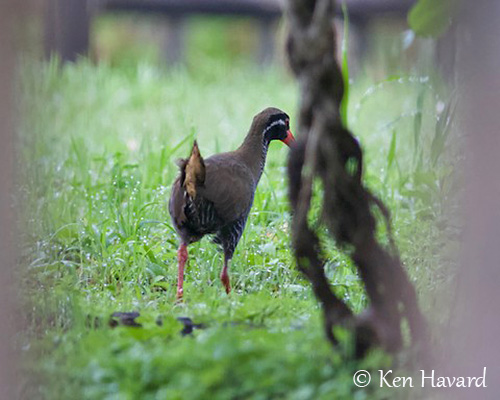
The Okinawa Rail is the only flightless bird of Japan. But it is almost, not completely, flightless. Wings and tails are very short, and the bird is not able to take off. Following the night in tree, the bird drops back in the morning in a graceless fluttering of wings.
However, even being a poor flyer, it can run rapidly. It is an athletic sprinter, and can be seen dashing or weaving through the thick undergrowth.
REPRODUCTION OF THIS SPECIES:
The breeding season takes place from March to June, with the laying from May to July.
The Okinawa Rail is monogamous and territorial, with probably permanent pair-bond.
The nest is placed on the ground. It is made of some loose leaves and grasses, making it similar to the leaf litter.
The female lays 3-5 pale, brown-speckled eggs. The incubation lasts about three weeks, shared by both adults.
At hatching, the chicks are entirely black. They are able to stumble about on their legs, soon after hatching. They become independent after two months, and develop the same plumage as adults.
Both parents care for the young but they cannot defend them against snakes, as they are left on the ground, exposed to the predators at night.