Fr: Pic élégant
Ang: Golden-cheeked Woodpecker
All: Goldwangenspecht
Esp: Carpintero Cariamarillo
Ita: Picchio guancedorate
Nd: Goudwangspecht
Sd: gulkindad hackspett
Photographers:
Roger Ahlman
Pbase Galleries Peru and Ecuador
Jean Michel Fenerole
Photos d’Oiseaux du monde
Ken Havard
My Bird Gallery & Flickr gallery 1 & Flickr gallery 2
William Price
PBase-tereksandpiper & Flickr William Price
Dubi Shapiro
Dubi Shapiro Photo Galleries
Text by Nicole Bouglouan
Sources:
HANDBOOK OF THE BIRDS OF THE WORLD Vol. 7 by Josep del Hoyo-Andrew Elliott-Jordi Sargatal – Lynx Edicions – ISBN: 8487334377
WOODPECKERS, an identification guide of the woodpeckers of the world by Winkler Hans and Christie David – Helm – ISBN: 0395720435
A GUIDE TO THE BIRDS OF MEXICO AND NORTHERN CENTRAL AMERICA by Steve N. G. Howell, Sophie Webb - Oxford University Press - ISBN: 0198540124
CREAGUS@Monterey Bay (Don Roberson)
Fatbirder - The World’s Richest Information Resource about Birds for Birders
Wikipedia, the free encyclopaedia
Golden-cheeked Woodpecker
Melanerpes chrysogenys
Piciformes Order – Picidae Family
INTRODUCTION:
The Golden-cheeked Woodpecker is endemic to W Mexico. It is resident in the Pacific lowlands. Two subspecies share this range.
It frequents tropical dry forests, but it is also observed in human-modified habitats, thus demonstrating its adaptability.
It feeds mainly on insects, fruits, seeds and small vertebrates. It forages on tree trunks by gleaning, probing and pecking for food items.
This species is highly territorial, and aggressive encounters are frequent at the beginning of the breeding season. The woodpeckers are usually monogamous. They nest in cavities excavated by both adults in tree or cactus, and share all the nesting duties.
The Golden-cheeked Woodpecker is described as relatively abundant throughout the range, and the population is suspected to be stable. The species is not globally threatened at the moment.
DESCRIPTION OF THE BIRD:
Biometrics:
Length: 19-22 cm
Weight: 55-88 g (M: 72 g – F: 64 g)
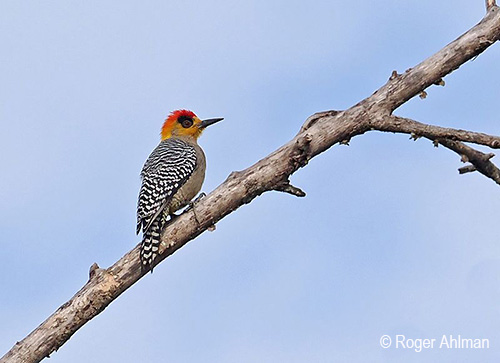
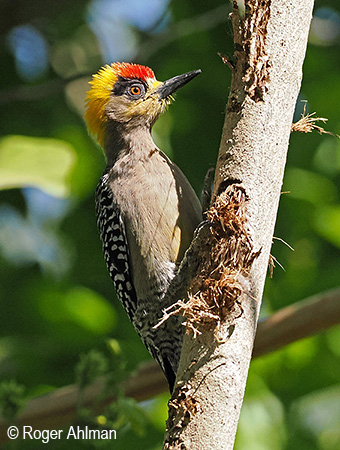
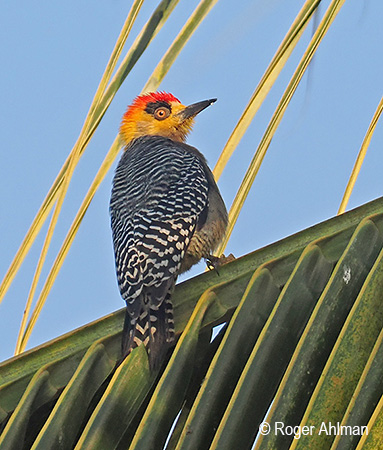
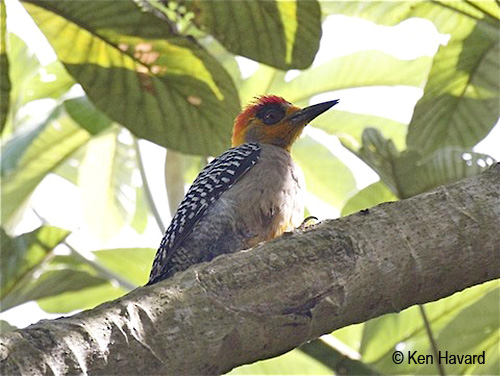
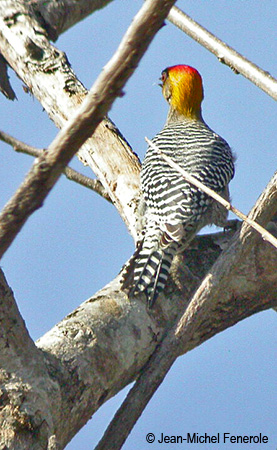
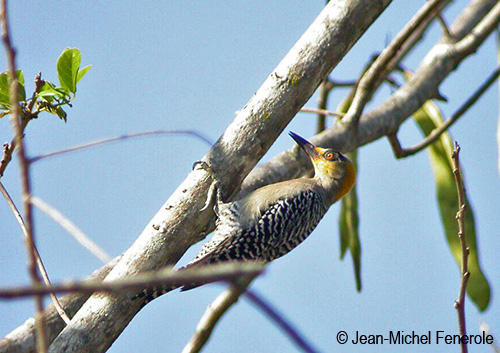
The Golden-cheeked Woodpecker adult male of nominate race has barred black and white upperparts, including on wings and tail, the latter with stiff rectrices. On the upperwing, a white stripe across primary bases is conspicuous in flight and contrasts with the dark flight feathers.
The underparts are greyish-brown to dusky grey, but the rear of the flanks and the undertail coverts are barred greyish-black and white. The vent is yellow.
On the head, the crown is red, becoming yellow-orange on the nape. Cheeks and chin are yellow. We can see a broad eyering made of black naked skin, and a broad, short, black feathered eyebrow above the eye. The forehead is whitish.
The straight bill is black with slightly chisel-shaped tip.
The eyes are deep orange or deep red.
Legs and zygodactyl feet are scaly and pale greyish with greenish tinge.
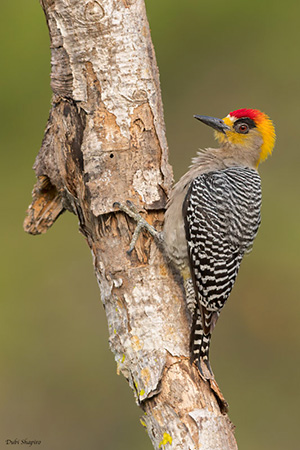
The adult female has greyish-buff crown with yellow lores and forehead. The nape is greyish-buff. The bill is slightly shorter.
The juvenile has slightly duller head plumage. The back is browner with less conspicuous barring.
The underparts are greyer with yellow wash on the breast.
The eyes are duller, mostly darker brown. The orbital skin is paler grey and more conspicuous than in adults.
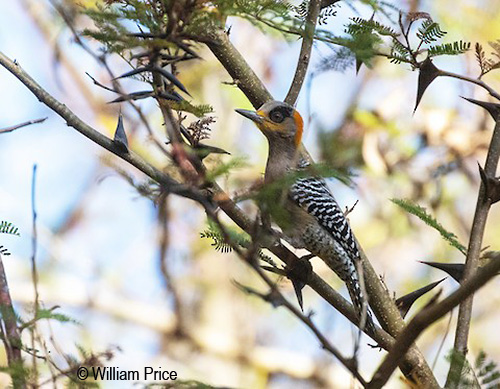
M.c. chrysogenys
Female
SUBSPECIES AND RANGE:
The Golden-cheeked Woodpecker has two subspecies.
M.c. chrysogenys (described above) occurs in NW Mexico, in the Coastal lowlands of S Sinaloa and Nayarit.
M.c. flavinuchus is found in SW Mexico, from Jalisco to SW Puebla, and Coastal lowlands of Guerrero and Oaxaca.
This one is larger than nominate. The plumage is duller overall. It has less yellow on the face but more on the nape.
On the underparts, we can see an orange or yellow patch on the belly, varying in size.
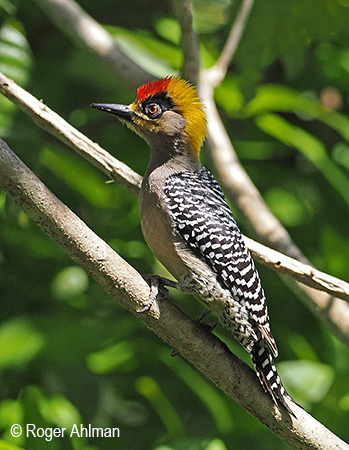
HABITAT:
The Golden-cheeked Woodpecker frequents arid to semi humid forest and forest edge. It is able to adapt to human-modified habitats such as wooded plantations of coffee and coconut palms, forest patches and cleared areas with scattered trees.
The species is found in lowlands and foothills on the Pacific slope of Mexico. It is visible from sea-level to about 1,500 metres of elevation.
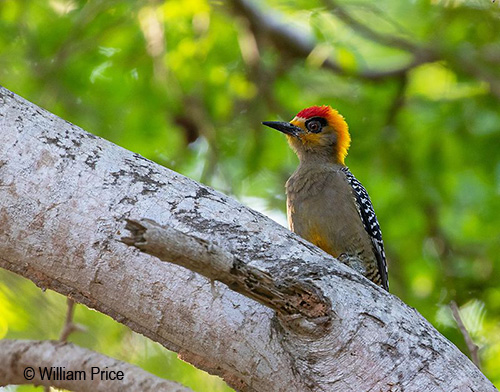
CALLS AND SONGS: SOUNDS BY XENO-CANTO
The Golden-cheeked Woodpecker produces churring calls and short series of notes, including a sharp, nasal “ki-di-dik” (sharper than the call of Gila Woodpecker).
It also produces a sneezy, loud, nasal “cheek-oo cheek oo cheek oo, keh-eh-eh-ehk”, a softer “keh-i-heh” or “kuh-uh-uh”. We can also hear a sneezy “ch’dik ch’dik” and longer, nasal, bickering series including short, rolled churrs.
During interaction of two birds, they give “wicka”-like calls.
The Golden-cheeked Woodpecker may occasionally drum, but the sound is not very strong. The bird makes 10-20 taps during about 1,2/1,8 second. This sound is generally stable, but it may slow down towards the end.
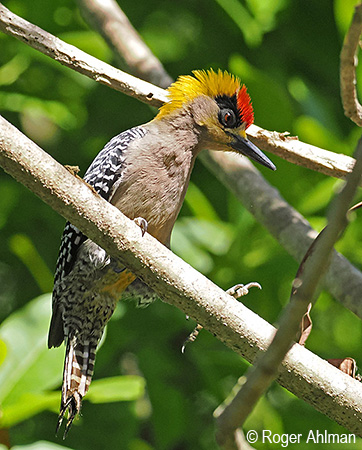
BEHAVIOUR IN THE WILD:
The Golden-cheeked Woodpecker feeds primarily on insects such as beetles (adults, pupae and larvae), ants and crickets. It also consumes several fruits and seeds. It occasionally takes small vertebrates such as lizards and geckos.
But the diet varies and may also include birds’ eggs, small animals, tree sap, carrion and human scraps.
As the bird eats various fruits swallowed whole, it is considered an important seed disperser for several tree species in tropical dry forests.
The Golden-cheeked Woodpecker searches for food on trees and cacti, foraging from middle to upper levels. It forages by pecking at tree bark, gleaning and probing for prey. It moves easily thanks to the zygodactyl feet and the stiff tail that helps to support the bird while it is climbing against a trunk.
It usually forages alone or in pairs. They often communicate by drumming with the bill, and this sound can be heard at some distance through the forest.
Like most Picidae species, the Golden-cheeked Woodpecker is highly territorial, and the territory is defended all year round. Drumming and vocal signals advertise their presence, and the conflicts usually occur close to the nest-site or the roost. Bill and feet are the main weapons, and both opponents may fall to the ground during these interactions.
But they also perform courtship displays, often fairly similar to the defence behaviour. The feathers of both crown and nape are erected, and the head is extended with the bill directed forward. The tail is spread, and the bird often drops its wings while performing swinging movements of head and body.
Aerial displays are signals only for the mate. Fluttering and gliding flights are observed, accompanied by squeaky calls.
The Golden-cheeked Woodpecker nests in cavity excavated by both mates in trees or cacti. Both adults share all the nesting duties. The woodpeckers are usually monogamous.
The Golden-cheeked Woodpecker is resident and sedentary throughout its range.
They are excellent fliers, able to cover long distances over open areas. The flight is usually undulating.
REPRODUCTION OF THIS SPECIES:
The breeding season takes place from April to July. The Golden-cheeked Woodpecker breeds in protected tropical dry forests. Both adults excavate a hole in trees of various species, although in human-modified habitats, the hole is often made in Coconut palms or cacti.
Both mates need three weeks to excavate the cavity, each working in turns of 15-30 minutes. Then, the cavity is guarded during two weeks, prior to the egg-laying. Other woodpeckers are not welcome near the nest, and the pair sleeps inside the hole at night to guard the site.
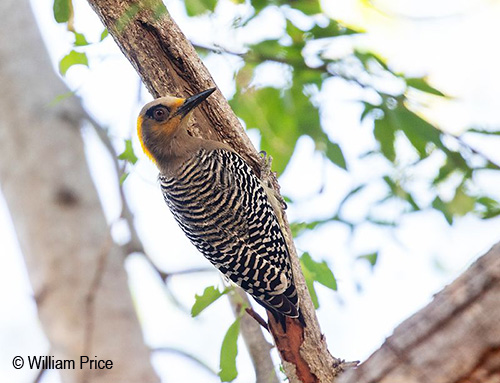
M.c. flavinuchus
Female
The female lays 1-4 white eggs, and both adults share the incubation during 14-15 days, the male mainly at night.
The chicks are altricial, hatching naked and with closed eyes. They are fed and brooded by both parents and fledge about 26-28 days after hatching. After leaving the nest, they remain in family groups and are still fed by their parents.
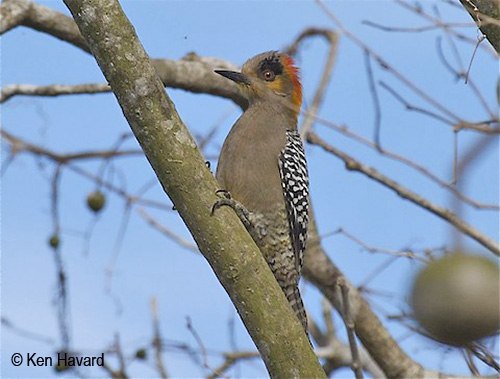
M.c. chrysogenys
Immature
PROTECTION / THREATS / STATUS:
The Golden-cheeked Woodpecker is described as relatively abundant, despite some degradation of habitat in Guerrero.
However, the species is able to adapt and can tolerate habitat modification.
The population is roughly estimated at 50,000/499,000 mature individuals, and appears to be stable.
The Golden-cheeked Woodpecker is currently evaluated as Least Concern.