PROTECTION / THREATS / STATUS:
The Geomalia is described and uncommon and local, but the secretive habits of this species make it often overlooked.
It is confined to largely inaccessible forested habitats at high elevations, often in protected areas.
However, logging may threatened the habitat of this species, but currently, the population trend is suspected to be stable.
The Geomalia is currently listed as Near Threatened.
Fr: Grive des Célèbes - Géomalie des Célèbes
Ang: Geomalia - Sulawesi Mountain Thrush
All: Sulawesi-Erddrossel
Esp: Zorzal Terrestre de Célebes
Nd: Geomalia
Sd: geomalia
Photographer:
Roger Ahlman
Pbase Galleries Peru and Ecuador
Text by Nicole Bouglouan
Sources:
HANDBOOK OF THE BIRDS OF THE WORLD Vol 10 by Josep del Hoyo-Andrew Elliott-David Christie - Lynx Edicions - ISBN: 8487334725
THRUSHES by Peter Clement and Ren Hathway – HELM - ISBN: 0713639407
A Field Guide to the Birds of South-East Asia by Craig Robson. New Holland Publishers. ISBN: 9781780090498
CREAGUS@Monterey Bay (Don Roberson)
Oriental Bird Images - Asian enigmas: Four odd 'thrushes'
Wikipedia, the free encyclopaedia
Geomalia or Sulawesi Mountain Thrush
Zoothera heinrichi
Passeriformes Order – Turdidae Family
INTRODUCTION:
The Geomalia or Sulawesi Mountain Thrush is endemic to Sulawesi in Indonesia.
This rare, terrestrial bird resembling both Turdidae and Timaliidae (babblers) was discovered in 1930 by the German explorer Gerd Heinrich in the Latimojong Mountains in C Sulawesi.
The bird was first likened to a thrush, following the first encounters with this species. However, other advices suggested that it was related to the babblers.
In 1952, Geomalia was placed in the family Turdidae in a linear taxonomy, just before Zoothera, following the first molecular study of the phylogenic position of Geomalia heinrichi. Today, Geomalia is firmly placed in the genus Zoothera after another genetic study published in 2013. It is considered as an aberrant member of the genus Zoothera.
The Geomalia frequents highland and montane forests, and is usually seen between 1,700 and 3,500 metres of elevation. It inhabits the forest floor where it walks and hops along over the vegetation. It forages on the ground, searching for large coleopterans, larvae, earthworms and small snails.
The breeding behaviour of this species is currently very poorly known.
The Geomalia is scarce, although being locally fairly common. This species may be threatened by degradation of the habitat caused by logging. However, the Geomalia is not globally threatened at the moment.
DESCRIPTION OF THE BIRD:
Biometrics:
Length: 28-30 cm
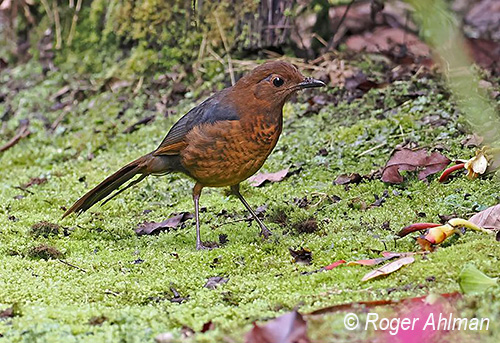
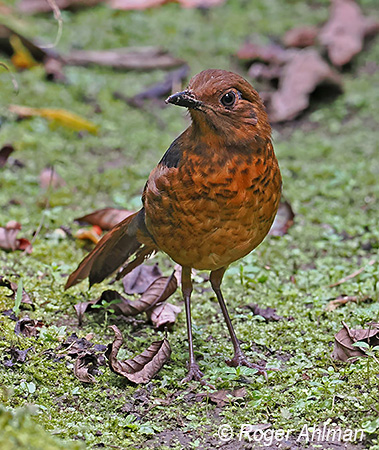
The Geomalia adult male has rich dark brown upperparts on mantle, black, wing-coverts and scapulars to rump and uppertail-coverts. The rounded wings are very short. The flight-feathers are slightly paler than coverts and scapulars, except for rusty-tinged edges to base of primaries. The long, graduated tail shows two shorter and paler brown outer rectrices, compared to central feathers.
The underparts are deep orange-brown, more rufous on the breast, whereas throat is slightly paler with brown spots. The flanks are browner, but centre of belly to undertail-coverts is paler, mostly orange-brown. On the underwing, the coverts are black with pale orange base of secondaries.
On the head, forehead to crown and hindcrown are dark brown with slightly paler nape and hindneck. The face is brown and shows pale brown streaks and speckles. Neck sides are mostly orange-brown. We can see a broad, brown malar stripe.
The bill is black to blackish-horn. The shape is atypical for a thrush, with a hooked tip on upper mandible, whereas the lower mandible tapers towards the tip.
The eyes are brown, surrounded by narrow, rufous-brown, feathered eyering. We can see a small patch of bare skin on the rear of the eye.
Legs and feet are brownish-grey.
Male and female are similar.
The juvenile has shorter bill and shorter tail than adults. The underparts are rusty-buff. We can see a dark grey blotching on the neck sides, throat sides and breast, becoming thinner on belly and flanks.
The immature is probably very similar to adults, with dark mottling on breast and upper belly.
RANGE:
The Geomalia occurs in the Latimojong Mountains in SC Sulawesi in Indonesia.
HABITAT:
The Geomalia frequents primary montane evergreen forest and rainforest with thick undergrowth, and also mossy forest and dwarf forest.
The species usually occurs between 1,700 and 3,500 metres of elevation.
CALLS AND SONGS: SOUNDS BY XENO-CANTO
The Geomalia produces thin, high-pitched whistles lasting 1 second, repeated at 0,5 second intervals. This sound is insistent but intermittent.
The song is currently unknown.
BEHAVIOUR IN THE WILD:
The Geomalia is extremely shy and secretive, making it frequently overlooked. It is usually observed alone and rarely in pairs.
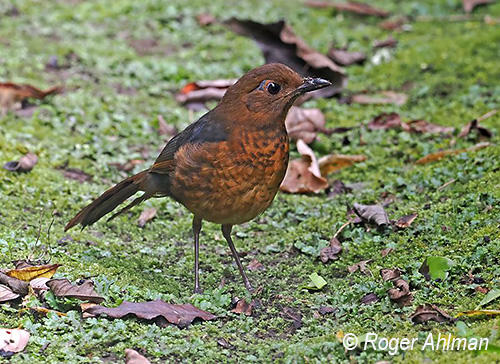
It walks and hops on the forest floor and along tracks, being rarely seen off the ground or fallen logs. It often wags and twitches its tail nervously, while the wings are held low.
It forages on the ground among the undergrowth, searching for beetles and their larvae, earthworms and small snails. It probably also takes other insect species while probing with its beak into the damp soil.
The behaviour of Geomalia during the breeding season is currently unknown.
However, as male and female have similar appearance, we can suggest that the courtship displays are simple. They are rarely seen together, even during the breeding period.
The Geomalia is a sedentary species and it does not move after breeding, but maybe over short distances while searching for food. .
This species has very short, rounded wings. The flight is weak and often only over short distances.
REPRODUCTION OF THIS SPECIES:
The breeding behaviour of the Geomalia is unknown, and more research is required.
Usually, the thrushes of genus Zoothera are monogamous and the chicks are reared by both parents which share the nesting duties.
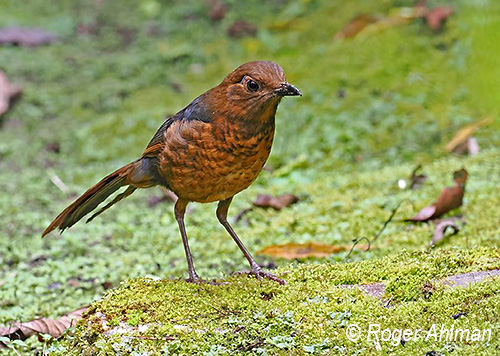
The bird displayed on these pictures is probably an immature, with dark mottling on breast and upper belly.