Fr: Cormoran couronné
Ang: Crowned Cormorant
All: Kronenscharbe
Esp: Cormorán Coronado
Ita: Cormorano coronato
Nd: Kroonaalscholver
Sd: kronskarv
Photographers:
Didier Buysse
Vision d’Oiseaux
Ken Havard
My Bird Gallery & Flickr gallery 1 & Flickr gallery 2
Patrick Ingremeau
TAMANDUA
Jean-Claude Jamoulle
A la rencontre des Oiseaux
William Price
PBase-tereksandpiper & Flickr William Price
Ingo Waschkies
Bird Photography
Text by Nicole Bouglouan
Sources:
HANDBOOK OF THE BIRDS OF THE WORLD vol 1 by Josep del Hoyo-Andrew Elliot-Jordi Sargatal - Lynx Edicions - ISBN: 8487334105
BIRDS OF AFRICA SOUTH OF THE SAHARA by Ian Sinclair and Peter Ryan - Princeton University Press Princeton and Oxford - ISBN: 0691118159
Wikipedia, the free encyclopaedia
Page family Phalacrocoracidae
Summary cards
Crowned Cormorant
Microcarbo coronatus
Suliformes Order – Phalacrocoracidae Family
INTRODUCTION:
The Crowned Cormorant is endemic to Benguela upwelling region, in the water off of Southwestern Africa. It is related to the Reed Cormorant, and was formerly considered the same species.
It is usually found along rocky ocean shorelines, offshore islands, estuaries and lagoons. It feeds mainly on small fish and squid, and hunts easily thanks to its amazing underwater agility.
This species is highly social during the breeding season, and form small colonies near the coasts in various sites, giving them easy access to food resources, especially fish. During this period, the males perform elaborate displays to attract the females.
The Crowned Cormorant is threatened by habitat destruction, oils spills and human disturbances. The species is uncommon and currently classified as Near Threatened.
DESCRIPTION OF THE BIRD:
Biometrics:
Length: 54 cm
Weight: M: 710-880 g – F: 670-780 g
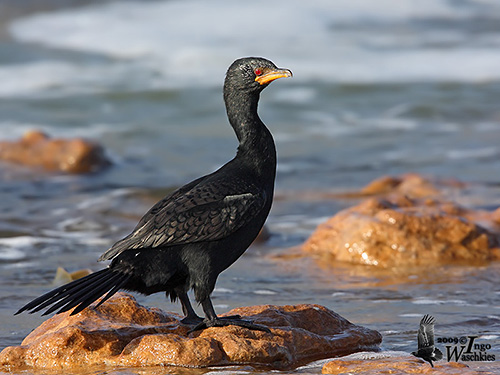
The Crowned Cormorant male in breeding plumage is notable for its dark plumage. Head, neck and most of body are shiny black.
On the upperparts, the scapulars are brownish to mid-grey, with blackish spot at tip of each feather. The wing-coverts are similar, with blackish fringe to each feather, usually broader at tip. These fringes become narrower on the greater coverts.
The underparts are shiny black.
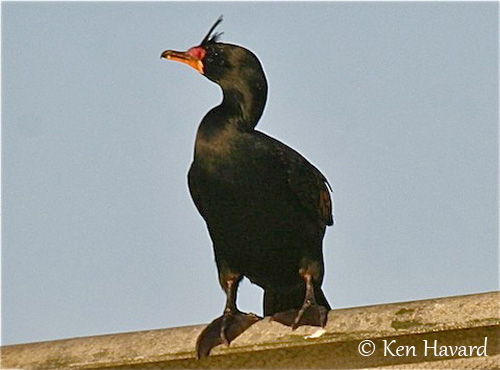
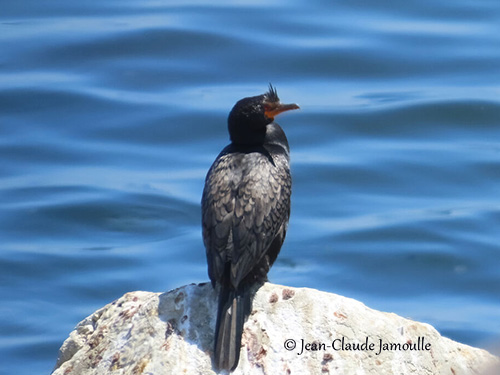
The head is black. We can see an erectile, shaggy crest on the forehead, and scattered, short, white filoplumes on both head and neck, mainly visible above and behind the eye.
The typically hooked bill is dark brown to blackish grey. Gape, base of mandible and lower ridge to mandible are orange-red with a paler yellow/whitish spot between tip and sides.
The eyes are red, surrounded by pale pink to pink-red speckled black skin, extending over the lores, whereas orbital ring and lower lores are often duller and darker.
Legs and webbed feet are black.
The plumage is duller overall in non-breeding season, including on the head, and the crest is shorter.
Male and female have similar appearance, but the male is usually larger.
The juvenile is browner than adults, with less glossy plumage. On the head, the crest is more muted.
The eyes are grey at first, but soon becoming browner/redder.
The bill is dusky brown with greyer tip.
Legs and feet are duller too.
The subadult is closer to the adult plumage, but with greyer scapulars and wing-coverts.
Head and neck are duller. The plumage looks much greyer overall.
RANGE:
The Crowned Cormorant is primarily found in the coastal regions of SW Africa, and mainly around C Namibia and SW South Africa (Cape Agulhas).
It is endemic to the west coast of Southern Africa.
HABITAT:
The Crowned Cormorant usually frequents rocky shorelines and nearby islands where it often nests in colonies on cliffs and rocky outcrops. It is rarely seen in estuaries.
It is generally found less than 10 km offshore and less than 100 metres inland.
CALLS AND SONGS: SOUNDS BY XENO-CANTO
The Crowned Cormorant is silent away from the breeding colonies, and it is often solitary. However, during the breeding season, social interactions are described. Competition for nests and food resources involve dynamic vocalizations and displays.
They communicate through various sounds including grunts and clicking sounds given in series, and we can also hear cackles and hisses at the colonies.
BEHAVIOUR IN THE WILD:
The Crowned Cormorant feeds primarily on fish and squid, but other food items such as crustaceans, molluscs and various marine invertebrates are also part of the diet.
This diet varies depending on the season, but also during the breeding period.
The Crowned Cormorant hunts in marine environment, foraging in shallow water (less than 5 metres deep), but also sometimes up to about 20 cm. It can be seen close to rocky shores, in protected bays and among kelp beds.
It hunts primarily by pursuit-diving, showing its remarkable underwater agility, often staying submerged for significant periods to find and catch their prey.
The Crowned Cormorant is an excellent swimmer thanks to the webbed feet and the streamlined body. However, this species has less preening oil on its feathers than many other seabirds, making it unable to dive deeper. They can be seen typically spreading their wings to dry their feathers after fishing periods.
At the beginning of the breeding season, the Crowned Cormorant performs elaborate courtship displays at the nest-site.
They perform bowing movements and puff their throat pouches, and then, they jerk rapidly the head backwards and forwards. This period is also marked by frequent interactions and synchronized swimming.
Highly social, this monogamous species forms small colonies of less than 30 nests. They often nest within larger colonies of seabirds, herons and egrets.
Both adults share the nesting duties.
The Crowned Cormorant is sedentary, with only some movements to N and E of the breeding range. These movements are related to food resources, not to long-distance migrations.
It may exhibit some seasonal movements, depending on prey availability and breeding conditions. But usually, the Crowned Cormorant remains within its range year-round.
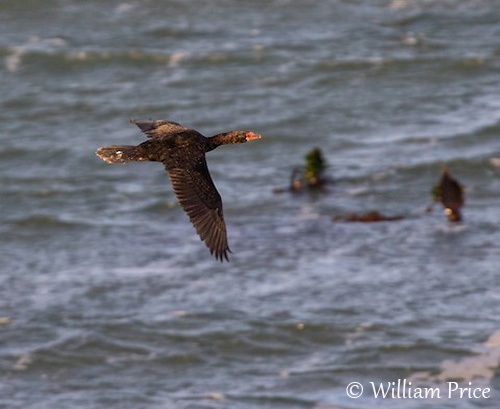
Over water, the Phalacrocoracidae species fly low over the surface, whereas over land or during longer flights, they travel at great heights. The marine species usually follow the coastline and avoid flying over land.
The flight is powerful with regular, continuous wingbeats sometimes interspersed with occasional glides. Some species can reach speeds of up to 80 km/h with help of wind or thermals.
They land on the water by fanning the tail and stretching the webbed feet before touching the surface. They run along the water surface for the take-off while flapping actively the wings.
REPRODUCTION OF THIS SPECIES:
The Crowned Cormorants forms small breeding colonies established at sites inaccessible to mammalian predators. They can be found on cliffs, in caves, on boulders, bushes, but also artificial structures such as jetties and walls, and also on the ground.
The laying occurs year-round, with peak between September and January, and slightly later in Namibia, mainly from October to March.
The nest is mainly built by the female. The structure is a platform made with sticks, dry seaweed, feathers and bones, lined with finer materials. The guano may add some pinkish tinge.
The female lays 1-5 eggs, usually 2-3 eggs. Both adults share the incubation during 21-23 days. The chicks are naked at hatching, and then, the black down is growing. They have yellow-orange skin on face and chin.
They are fed by regurgitated fish by both adults.
They are able to leave the nest at 12 days old, and they remain in the surroundings of the nest-site where they may form creches, on rocks and at sea (where they are vulnerable to predation by Cape fur seals).
They take their first flight at about 35 days old, and become fully independent 10-25 days later.

PROTECTION / THREATS / STATUS:
The Crowned Cormorant is affected by habitat destruction, human disturbances and oil spills. In addition, predation by Cape fur seals, especially of fledglings, has become important as the seals are more abundant in the Benguela ecosystem where about 70% of the global population of Cape fur seals, endemic dolphins (such as Heaviside's dolphin), and numerous whale species are present.
Several colonies are fully protected, and the disturbances are minimized by management practices.
The Crowned Cormorant has fairly restricted range in which it is relatively uncommon.
The most recent estimate was of 8700 individuals in 2012. This population is suspected to be stable.
The Crowned Cormorant is currently classified as Neat Threatened.