REPRODUCTION OF THIS SPECIES:
The breeding season takes place from March to May in Costa Rica and from January to April in Colombia.
Like most Picidae, the Cinnamon Woodpecker nests in tree hole, a cavity excavated by both mates in living or dead tree, and more generally, in soft wood. The hole is usually placed between 6 and 9 metres above the ground.
The nesting behaviour concerning clutch size, incubation, fledging period and parental care is unknown.
PROTECTION / THREATS / STATUS:
The Cinnamon Woodpecker is usually uncommon but locally fairly common. This species is more often heard than seen. It is often inconspicuous, but it plays a vital role in the rainforest ecosystem where it acts as a pest controller while hunting for insects hidden beneath the tree bark.
The species occurs in several protected areas throughout the range.
The size of the population is unknown, and roughly estimated at 50,000/499,999 mature individuals. Habitat loss in some areas involves decline of the population.
But currently, the Cinnamon Woodpecker is evaluated as Least Concern.
Fr: Pic cannelle
Ang: Cinnamon Woodpecker
All: Rotkehlspecht
Esp: Carpintero Canelo
Ita: Picchio cannella
Nd: Roodkeelspecht
Sd: rödstrupig kastanjespett
Photographers:
Roger Ahlman
Pbase Galleries Peru and Ecuador
John Anderson
John Anderson Photo Galleries
William Price
PBase-tereksandpiper & Flickr William Price
Text by Nicole Bouglouan
Sources:
HANDBOOK OF THE BIRDS OF THE WORLD Vol. 7 by Josep del Hoyo-Andrew Elliott-Jordi Sargatal – Lynx Edicions – ISBN: 8487334377
A GUIDE TO THE BIRDS OF MEXICO AND NORTHERN CENTRAL AMERICA by Steve N. G. Howell, Sophie Webb - Oxford University Press - ISBN: 0198540124
Woodpeckers of the World: The Complete Guide by Gerard Gorman – Editeur: A&C Black, 2014 – Helm Photographic Guides - ISBN: 1408147173, 9781408147177
WOODPECKERS, an identification guide of the woodpeckers of the world by Winkler Hans and Christie David – Helm – ISBN: 0395720435
A Flash of Rufous: Unveiling the Cinnamon Woodpecker
PANAMA – Birds and Wildlife Photos
Wikipedia, the free encyclopaedia
Cinnamon Woodpecker
Celeus loricatus
Piciformes Order – Picidae Family
INTRODUCTION:
The Cinnamon Woodpecker is found in Nicaragua, Costa Rica, Panamá, Colombia and Ecuador.
The woodpeckers of genus Celeus usually have a well-developed crest, a short bill and unfeathered nostrils.
The species is native to the humid lowland forest of Centre and South America. It frequents the upper levels of the forest, especially the canopy. It feeds primarily on ants and termites, but fruits are also part of its diet.
Like most Picidae species, it nests in a hole excavated by both adults in soft wood. The breeding behaviour is poorly known.
The Cinnamon Woodpecker is described as uncommon to locally fairly common. It occurs in several protected areas, and currently, the species is not globally threatened.
DESCRIPTION OF THE BIRD:
Biometrics:
Length: 19-23 cm
Weight: 74-83 g
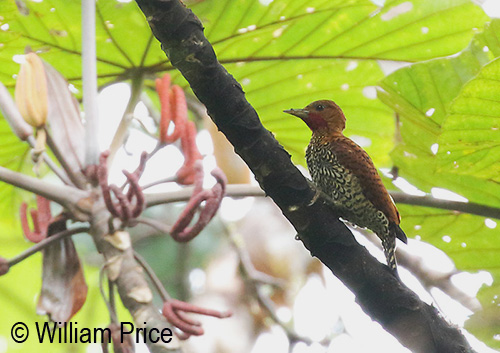
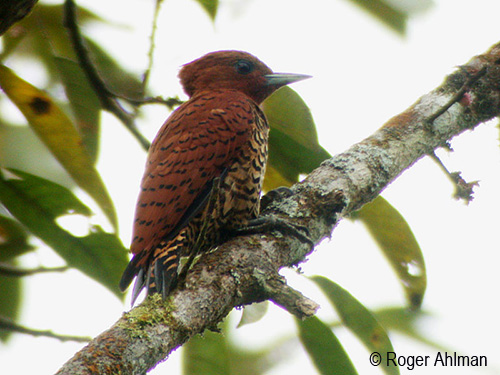
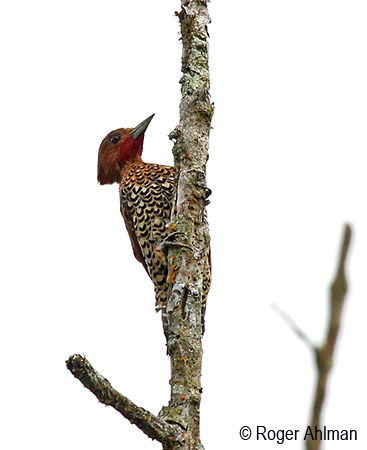
The Cinnamon Woodpecker adult male has dark rufous-cinnamon upperparts with narrow black bars. On the upperwing, both wing-coverts and tertials are similar to the upperparts, whereas the flight-feathers are blackish with broad rufous bars. The rump is paler. The uppertail is black with broad buff/whitish bars.
On the underparts, the upper breast is pale rufous with black edges and tips to feathers. Rest of underparts is paler buff with conspicuous black crescent markings on the breast, while flanks and belly to undertail-coverts show black scale-like pattern. The underwing is rufous with black bars on the flight-feathers.
The head is rufous with a slightly shaggy, pointed crest. The crown is streaked with black whereas the feathers of chin, throat and malar area are tipped with red. This reddish patch on the lower cheek is only present on males.
The relatively short, almost pointed bill is ivory/pale-yellowish. The slightly curved culmen becomes narrower across the nostrils.
The eyes are dark red.
Legs and feet are grey.
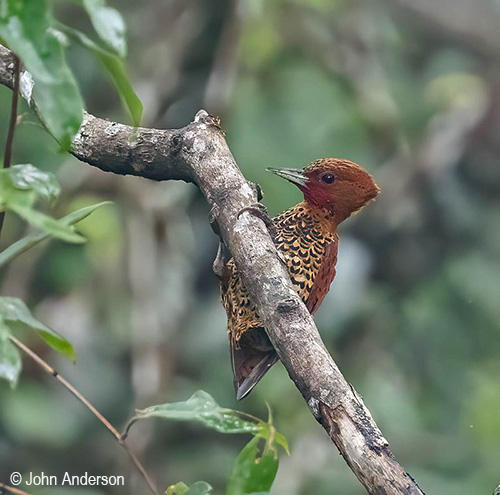
The adult female has uniformly rufous head, and lacks the red feathers on lower cheeks and throat.
The juvenile resembles adult, but the throat shows dusky mottling and the underparts are less regularly marked.
The young male shows some red on the face.
SUBSPECIES AND RANGE:
The Cinnamon Woodpecker occurs from Nicaragua, S along the Caribbean slope of Costa Rica and Panamá, to the Pacific slope of Colombia and NW Ecuador.
Four subspecies share this wide range.
C.l. loricatus (described above) is found in W Colombia (Chocó) to SW Ecuador (S to Gayas).
C.l. diversus occurs in SE Nicaragua, S to W Panamá.
This one is the largest. The throat shows more red and less black, and the plumage has a stronger cinnamon colour than nominate. The black bars of the upperparts are narrow, whereas the markings of the underparts are more widely spaced. The bill is yellowish.
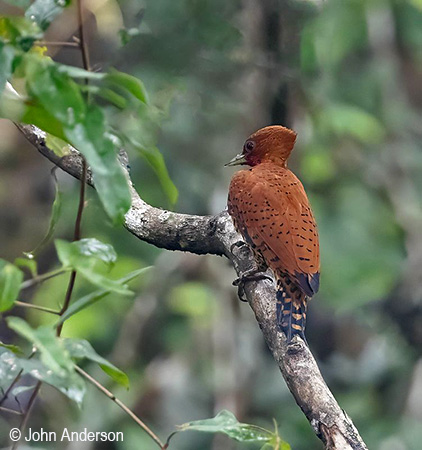
C.l. mentalis is found in Panamá and NW Colombia.
It is smaller than the previous, with paler underparts and less barring on the body plumage.
C.l. innotatus occurs in N Colombia (Córdoba to N Santander).
This race resembles previous, but it is paler, less marked and almost unbarred on the upperparts. The underparts are uniformly coloured, with only some spots on the breast. The crown may be unstreaked.
HABITAT:
The Cinnamon Woodpecker frequents humid and wet forests, and is rarely seen in drier areas. However, it occasionally visits the forest edges near clearings and other semi-open areas.
It usually frequents the middle levels and the tree canopy, often by flying easily through the dense foliage.
It may also range at higher elevations in the foothills, from sea-level to 760 metres in Costa Rica and Panamá, up to 1,500 metres in Colombia, and to 800 metres in Ecuador.
CALLS AND SONGS: SOUNDS BY XENO-CANTO
The call of the Cinnamon Woodpecker is very helpful to identify the species among the foliage. This call is a series of loud, breathy whistles, descending in pitch and amplitude.
It is described as a loud, far-carrying “wheeét-wheeét-wheet-it” sometimes preceded by a “chuweeo”.
When the bird id agitated, it produces sharp, descending, rolling chatter, and we can also hear some other sounds such as a hard “chikikikiit”, a squeaky “tititit-too” and “chweé-titit”.
The drumming of the Cinnamon Woodpecker is rather slow and short, but it is the main sign of its presence.
BEHAVIOUR IN THE WILD:
The Cinnamon Woodpecker feeds primarily on ants and termites, found in bark crevices. It uses its strong bill to catch insects hidden under the bark. However, it also locates ants living in plants, and it knows how to exploit this food.
But it also feeds on fruit, especially bananas.
The South American woodpeckers of genus Celeus frequently roost in fruit trees. When the fruit crop is abundant, they often ignore the invertebrates for short periods. They are able to cling to a slender twig to reach the fruit.
This species forages alone or in pairs, and occasionally joins mixed-species foraging flocks. It forages near or in the tree canopy where it moves easily through the dense foliage, although it can also forage and feed lower in more open areas.
It feeds by pecking and gleaning.
The breeding behaviour of this species is poorly known. Nothing is known concerning the courtship displays, but we can suggest that the bright rufous crest is erected and the red patch of the male is exposed. But more information is needed.
Both mates excavate a hole in soft wood or dead tree, and both adults probably share most of the nesting duties.
The Cinnamon Woodpecker is resident in the range.
The woodpeckers are usually good fliers, performing undulating flight, and most of them are sedentary in their range.