Fr: Ninoxe de Cebu
Ang: Cebu Boobook - Cebu Hawk-Owl
All: Cebukauz
Esp: Nínox de Cebú
Nd: Cebuboeboekuil
Sd: cebuspökuggla
Photographer:
Dubi Shapiro
Dubi Shapiro Photo Galleries
Text by Nicole Bouglouan
Sources:
HANDBOOK OF THE BIRDS OF THE WORLD Vol 5 by Josep del Hoyo-Andrew Elliott-Jordi Sargatal - Lynx Edicions - ISBN: 8487334253
OWLS OF THE WORLD – By Claus König, Friedhelm Weick and Jan-Hendrik Becking - IBSN 978-0-7136-6548-2
Owls of the World - A Photographic Guide: Second Edition – By Heimo Mikkola – Editeur: A&C Black, 2014 – ISBN: 147290592X, 9781472905925
Cebu Hawk-Owl. Endangered species of Cebu Island
Cebu Hawk-Owl moves off endangered list; threat remains
Ornithomedia - Le Web de l’Ornithologie
Habitat selection and conservation status of the endemic Ninox hawk-owl on Cebu, Philippines
The Cebu Boobook: A Beacon of Biodiversity Conservation
Wikipedia, the free encyclopaedia
Cebu Boobook
Ninox rumseyi
Strigiformes Order – Strigidae Family
INTRODUCTION:
The Cebu Boobook is endemic to the Island of Cebu in the Philippines, one of the largest islands located between Mindanao to the south and Luzon to the north.
It was considered extinct in 1888, but was rediscovered in 1998 in three forest patches.
This Strigidae was formerly a subspecies of the Philippines Hawk-owl, but it was reclassified in 2012, as voice, plumage and other differences suggested a new placement as a unique and separate species.
The Cebu Boobook frequents the dense lowland forests of Cebu Island. It favours areas with dense foliage used for roosting, but also providing good hunting opportunities. However, the species is occasionally seen in degraded secondary forests and in the vicinity of human settlements.
It typically feeds on various insect species and small vertebrates such as rodents and birds, but fruits and seeds are also taken when insects are less available, especially during the wet season.
At the beginning of the breeding season, courtship displays accompanied by vocalizations are reported. This species nests in natural cavities in large trees within its forested habitat. Both adults share the nesting duties.
The Cebu Boobook is a restricted-range species. It is affected by habitat loss caused by deforestation, involving population decline. The species is currently listed as Vulnerable.
DESCRIPTION OF THE BIRD:
Biometrics:
Length: 23-25 cm
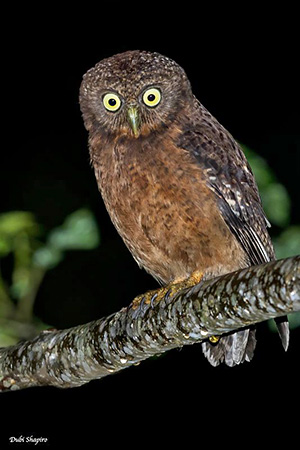
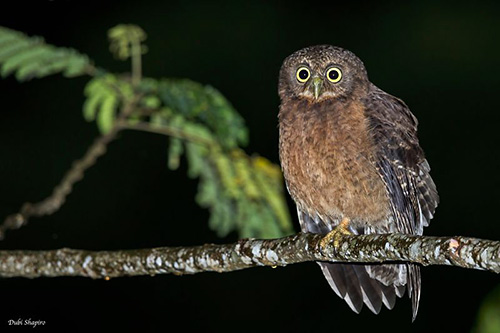
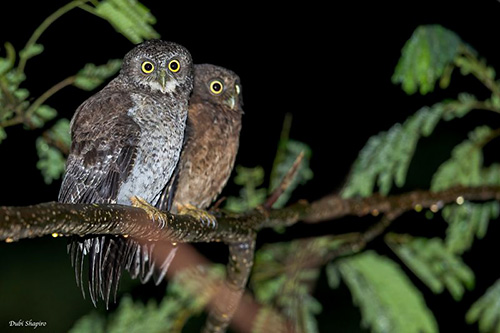
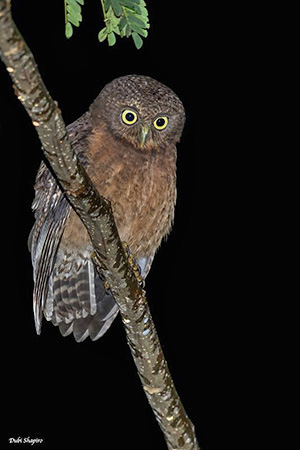
The Cebu Boobook has chocolate-brown upperparts with scattered white spots across the wing feathers. The dark brown upperparts show dense, narrow buff/tawny-buff bars, often weaker on lower mantle. The tail is dark brownish and narrowly barred buffy.
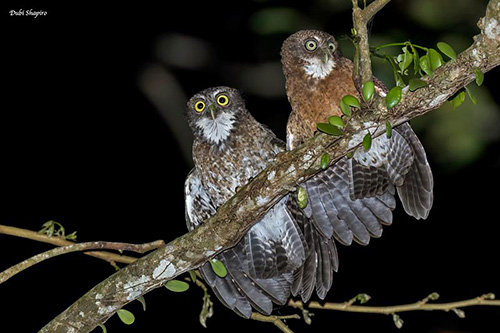
On the upperwing, the white outer scapulars show narrow dark brown edges and a warm buff colour between the white and the brown feathers. The upperwing-coverts are brown too, but greater and some outer median coverts are more strongly marked with pale buff or white bars. Both flight-feathers and tertials are dark, dull brown. Narrow wingbars on outer webs are formed by buff markings.
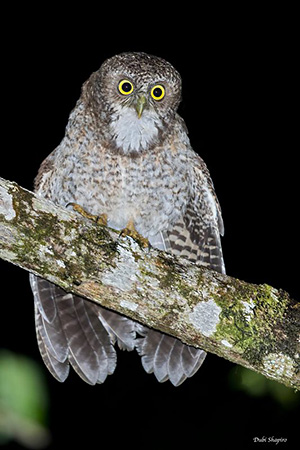
On the underparts, the area from breast to flanks and belly is pinkish-buff or rusty-brown, with weak and irregular dark brownish barring and also some whitish streaks, or rather uniform with some dark speckles, with high individual variability. Vent and undertail-coverts are white or pale buff with some dull brown speckles. On the undertail, the rectrices are dark grey-brown with pale bars. On the underwing, the feathers are greyish with paler barring becoming weaker towards the feather tips.
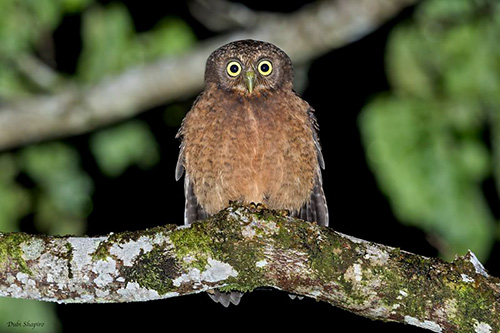
The head is rounded and without ear-tufts but only short filamentous extensions on the ear-coverts. The head is mostly dark brown but the face is duller with indistinct paler spots. On the crown, a barred/spotted pattern is made by rows of buffy speckles. Head sides and neck sides are similar but with weaker streaks.
Head and neck seen in frontal view form a hood contrasting with the conspicuous white throat patch, sometimes concealed in some postures.
The superciliary stripes are white, usually conspicuous, but sometimes indistinct.
The hooked bill is dull olive, but yellower along the culmen and at tip.
The eyes are yellow, from lemon-yellow to olive-yellow.
The tarsi are half-feathered. Legs and feet are ochre-yellow. The claws are black.
Male and female are similar.
The juvenile has paler brown plumage. The eyes are typically duller.
RANGE:
The Cebu Boobook is endemic to Cebu Island in the Philippines. The species is not reported from other islands or regions.
HABITAT:
The Cebu Boobook frequents various types of forests, but mainly dense, lowland forests. It roosts and forages from interior and edge of forests, sometimes near clearings and farms, or degraded secondary forests and even near human settlements.
The remaining forests, especially in the central highlands, are the last refuge for the Cebu Boobook.
CALLS AND SONGS: SOUNDS BY XENO-CANTO
The call of the Cebu Boobook has a unique pattern, a series of “hoot” notes used as contact at dusk. Vocalizations are used between mates during courtship displays, and for territory defence.
The song varies in rhythm and note type, although gruff staccato chucks and plaintive short down slurs are mainly uttered.
We can also hear metallic, abrupt, tree-frog like notes, sometimes given in rapid series. Other sounds include a low, clear, abrupt “duit” sometimes given twice, and hoarse screeches lasting less than 1 second.
The Cebu Boobook also performs duets starting with several low “djuk” and “gwick” notes, and then moving into “djuk, kyeur-gwick, djuk, kyeur-gwick…” fading out after 30 seconds and starting again after a short pause.
Long series of “kyeur” notes separated by short pauses are also given.
BEHAVIOUR IN THE WILD:
The Cebu Boobook feeds primarily on various insects such as cicadas, mantises, moths, stick-insects and crickets.
But it also takes small invertebrates including birds such as sunbirds, flowerpeckers, tits and flycatchers, and snakes, lizards, geckos, frogs and toads.
Fruits and seeds are also consumed during the wet seasons, when insects are less available.
The Cebu Boobook forages at dusk and night. Like numerous hawk-owls, it uses perch-and-pounce techniques, and makes short sallies from elevated perches, to catch the prey in flight or on foliage or ground.
It forages within the forest or at the edges and near clearings and cultivated fields, indicating that the species has adapted to its fragmented habitat. The complex pattern of its plumage mimics the forest environment and allows it to approach the prey.
At the beginning of the breeding season, the Cebu Boobook performs elaborate courtship displays and physical displays accompanied by vocalizations. During the displays, the male remains perched while calling and flaunting its feathers to enhance the plumage pattern, in order to attract the female’s attention.
The Cebu Boobook maintains a breeding territory of about ten hectares or more. The nest is in natural cavity in large tree within the forested habitat. Both parents share the nesting duties.
The Cebu Boobook is probably sedentary, and does not move after breeding.
Like numerous Strigidae species, the nocturnal Cebu Boobook performs silent flight thanks to the soft flight-feathers. It is an agile flier and flies through the trees without touching the branches.
REPRODUCTION OF THIS SPECIES:
Eggs of the Cebu Boobook are found in early May, in the latter part of the dry season. We can suggest that this period aligns with the onset of the wet season in Cebu.
The species nests in tree-cavity, usually in older, larger trees. The nesting site is chosen based on safety from predators, and near the hunting areas. The cavity can be modified or not by the owls.
The female lays 2-3 eggs, incubated by the female during 28-33 days. During this period, she is fed by the male which provides food to its mate.
The chicks are fed by both parents with insects and small vertebrates. The young fledge about five weeks after hatching, but they remain dependent on the adults for several weeks.
PROTECTION / THREATS / STATUS:
The Cebu Boobook is threatened by habitat loss caused by deforestation. Illegal logging and agriculture expansion are the main threats. But the species is adaptable to other habitats, and occurs near clearings and farms.
In 2011, the size of the population was roughly estimated at 250-999 mature individuals, and it is suspected to be similar and stable.
Recent studies indicate that forest cover loss has slowed in recent years, causing only negligible declines. Continual conservation actions are necessary to support the recovery of the population.
The Cebu Boobook is currently listed as Vulnerable.