Fr: Coryllis de Camiguin
Ang: Camiguin Hanging-Parrot
All: Camiguinpapageichen
Esp: Lorículo de Camiguin
Ita: Pappagallo acrobata di Camiguin
Nd: Camiguinvleermuisparkiet
Sd: camiguinhängpapegoja
Photographer:
Dubi Shapiro
Dubi Shapiro Photo Galleries
Text by Nicole Bouglouan
Sources:
HANDBOOK OF THE BIRDS OF THE WORLD vol 4 by Josep del Hoyo-Andrew Elliott-Jordi Sargatal - Lynx Edicions - ISBN: 8487334229
PARROTS OF THE WORLD – An Identification Guide – by Joseph M. Forshaw – Princeton University Press – ISBN 0691092516
A new hanging parrot from Camiguin Island, Philippines
Camiguin Hanging-Parrot: a new species from a small Philippine Island
Weebly - Camiguin Hanging-Parrot
A New Species of Hanging-Parrot (Aves: Psittacidae: Loriculus) from Camiguin Island, Philippines
Wikipedia, the free encyclopaedia
Camiguin Hanging-Parrot
Loriculus camiguinensis
Psittaciformes Order – Psittaculidae Family
INTRODUCTION:
The Camiguin Hanging-Parrot is a new species endemic to the Island of Camiguin, a small oceanic island off the northern coasts of Mindanao in S Philippines.
It was described in 2006, giving it a separate identity because it exhibits no sexual dimorphism. It was formerly a subspecies of the Philippine Hanging-Parrot, but it is now recognized as a distinct species.
The Camiguin Hanging-Parrot frequents the tree canopy in upland forests. It feeds on nectar, seeds, fruit, berries, blossoms and small insects.
Like most Psittaciformes, it nests in tree cavities. Male and female have similar appearance, a unique fact in the genus Loriculus.
The Camiguin Hanging-Parrot is threatened by habitat destruction, but it is able to adapt and can be found in suburban areas. This species is also heavily affected by illegal pet trade.
The species is currently considered as Threatened, but more research is still needed to determine the population status, especially molecular-genetic analysis.
DESCRIPTION OF THE BIRD:
Biometrics:
Length: 12-14 cm
Weight: 32-40 g
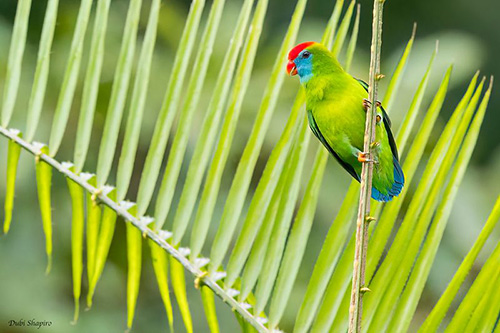
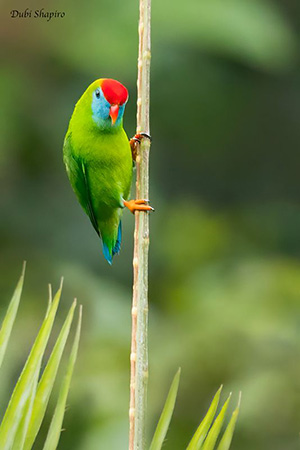
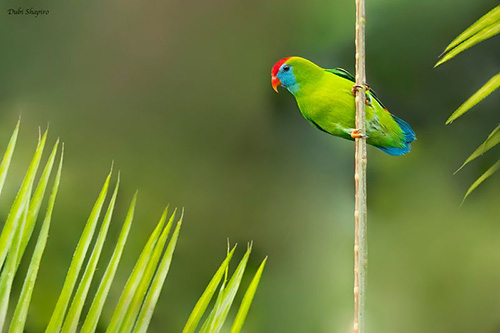
The Camiguin Hanging-Parrot has yellowish-green plumage overall with some brightly-coloured body parts.
On the green upperparts, both rump and uppertail-coverts are bright red. On the yellowish-green upperwing, the greater and some median coverts show duskier centres. The dusky primaries have much green on the outer web, whereas secondaries and tertials are similar but mostly dusky green. On the tail, the green rectrices show some pale blue on tips and in the centre of the tail.
The underparts are uniformly yellowish-green, except the pale blue underside of the tail. Some pale blue areas are visible on the inner thighs and on the rear of the flanks.
On the head, crown and forehead are red, but the face is pale blue.
The short, stout, hooked bill is orange-red.
The eyes are dark greyish/brownish.
Legs and feet are yellowish-horn.
Male and female are similar.
The juvenile resembles adults, but the bright colours of the head are duller, reduced or absent.
The head is almost entirely green with only reduced blue on the cheeks, and little or no red on top of head.
A pale blue mutant form has the green plumage replaced by pale blue, as other coloured areas are paler.
This bird could be the result of inbreeding depression to which the declining population is exposed.
RANGE:
The Camiguin Hanging-Parrot is found only on the island of Camiguin, in Camiguin Sur, where it remains throughout the year. It does not migrate.
Camiguin Island is a pear-shaped island of volcanic origin, of 238 km² in area. It is found about 10 km off the north coast of Mindanao, in S Philippines.
HABITAT:
The Camiguin Hanging-Parrot frequents dense and humid tropical lowland and montane forests.
It can be seen from forest floor to mid-canopy levels, where a large variety of fruiting trees provide the bird good food resources.
But this species is able to adapt to other types of habitats such as secondary growth forests and agricultural fields with good tree cover, allowing it to find fairly suitable habitat, despite deforestation. It can be observed along the forest edge, between 300 and 1,350 metres of elevation.
CALLS AND SONGS: SOUNDS BY XENO-CANTO
The Camiguin Hanging-Parrot is known for its high-pitched, rapidly repeated “tziit-tziit-tziit”.
High-pitched series of complex calls and whistles are used to communicate with the mate and the other birds of a group. They are used to maintain the social bonds within the group, also as signal when a predator is detected and while foraging, and to maintain the territory.
These complex vocal signals enhance the social behaviour of this species.
BEHAVIOUR IN THE WILD:
The Camiguin Hanging-Parrot feeds primarily on fruit, nectar and flowers provided by the flora of Camiguin Island. But seeds, especially those of wild bananas, berries and flowering blossoms are also part of the diet.
The main fruits are mangoes, papayas and figs. Proteins are given by small insects and caterpillars, usually taken mainly during the breeding season.
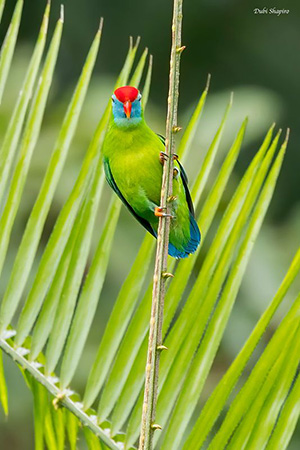
This species is often seen singly, in pairs or small family groups, and sometimes in flocks. They are observed perched in trees and bushes while searching for food.
Their green plumage helps them hide among the vegetation. They are known as shy birds, usually detected when they produce their high-pitched calls.
The Camiguin Hanging-Parrot has a unique behaviour giving it its name “hanging-parrot”. The bird usually sleeps upside down, like bats. This behaviour is believed to provide protection against intruders or predators, helping it to blend in with the habitat.
During the breeding season, courtship displays are performed by males. The elaborate aerial displays are accompanied by calls and songs, in order to attract females.
Food availability and suitable nesting habitat influence the breeding patterns of the species. They nest in tree holes, often in dead tree-ferns. Both adults share the nesting duties, and especially chick-rearing.
The Camiguin Hanging-Parrot is a very social species. They form small flocks in which the bonds are built through mutual preening and playful interactions.
This species is not migratory. It is found exclusively on Camiguin Island to which it is endemic. It remains on the island throughout the year.
The Camiguin Hanging-Parrot only performs short local movements within the island when searching for food, not considered as seasonal migrations.
The flight is probably swift and dashing like in other Loriculus species, and often high in the air. It is usually undulating.
REPRODUCTION OF THIS SPECIES:
The Camiguin Hanging-Parrot breeds mainly in September/November.
This species nests in tree-cavities. The nest is built with twigs and leaves, with a soft lining. Such nest provides comfort and safe environment for the chicks. They nest high in tree-canopy of forest, or in concealed site such as tree-hole.
The female lays 2-4 eggs. She incubates during about three weeks, while the male feeds her. Both parents care for the chicks and feed them by regurgitation of a mixture of fruits, seeds and nectar.
The young fledge between 4 and 6 weeks after hatching. They remain under parental care until they become independent.
PROTECTION / THREATS / STATUS:
The Camiguin Hanging-Parrot is a restricted-range species, threatened by habitat destruction caused by deforestation and other logging activities. It is also affected by capture for the cagebird market.
In addition, the appearance of a wild blue mutation also indicates a critical limit of the population.
The species perhaps has to be classified as Threatened already, but more research is needed to determine the true population status.
