Fr: Pic fauve
Ang: Ashy Woodpecker
All: Celebesspecht
Esp: Picatroncos de Célebes
Nd: Sulawesispecht
Sd: askspett
Photographers:
Roger Ahlman
Pbase Galleries Peru and Ecuador
Ingo Waschkies
Bird Photography
Text by Nicole Bouglouan
Sources:
HANDBOOK OF THE BIRDS OF THE WORLD Vol. 7 by Josep del Hoyo-Andrew Elliott-Jordi Sargatal – Lynx Edicions – ISBN: 8487334377
L’ENCYCLOPEDIE MONDIALE DES OISEAUX - Dr Christopher M. Perrins - BORDAS - ISBN: 2040185607
Woodpeckers of the World: The Complete Guide by Gerard Gorman – Editeur: A&C Black, 2014 – Helm Photographic Guides - ISBN: 1408147173, 9781408147177
WOODPECKERS, an identification guide of the woodpeckers of the world by Winkler Hans and Christie David – Helm – ISBN: 0395720435
Fatbirder - The World’s Richest Information Resource about Birds for Birders
Wikipedia, the free encyclopaedia
Ashy Woodpecker
Mulleripicus fulvus
Piciformes Order – Picidae Family
INTRODUCTION:
The Ashy Woodpecker is endemic to Sulawesi and other surrounding islands in Indonesia. Two subspecies share this wide range.
It frequents mainly closed forests, both tropical moist lowland and montane forests. The species occurs from sea-level up to 2,200 metres of elevation. It feeds on termites and caterpillars and other arthropods. It forages in trees, often on trunks and sometimes on the ground.
Like most Picidae species, the Ashy Woodpecker, mainly the male, excavates a nest-hole in dead tree or dead part of a living tree. The breeding behaviour is poorly known, but drumming activity is common during the breeding season.
The Ashy Woodpecker has very large range in which it is not uncommon. However, it is affected by habitat loss involving some decline of the population. But currently, the species is not globally threatened.
DESCRIPTION OF THE GENUS MULLERIPICUS:
The four Mulleripicus species are medium-sized to large woodpeckers. The head is rather small, whereas the neck is long and thin.
The bills of these four species are long, slightly curved and only slightly chisel-shaped, making them different from the bills of other Picidae showing specialized features for excavating the tree-holes.
The tongue is an important tool for woodpeckers, especially those which probe deeply. The birds can protrude and retract easily their tongue and control the movements of the tip.
The nostrils are fully covered by feathers. This feature is manly found in ground-foraging species and in those which rarely excavate. The Ashy Woodpecker is known for feeding on trees, but also into termite nests on the ground.
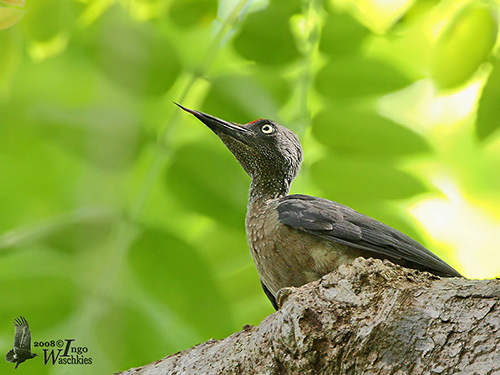
Another difference is in the long, stiff tail bent forwards towards the tip. The feet show a fourth toe shorter than or as long as the front toes, and it is about twice the length of the first toe.
Due to their large size and some anatomical similarities, the woodpeckers of the genus Mulleripicus are close to those of the genus Dryocopus.
See here the Great Slaty Woodpecker - Mulleripicus pulverulentus
DESCRIPTION OF THE BIRD:
Biometrics:
Length: 40 cm
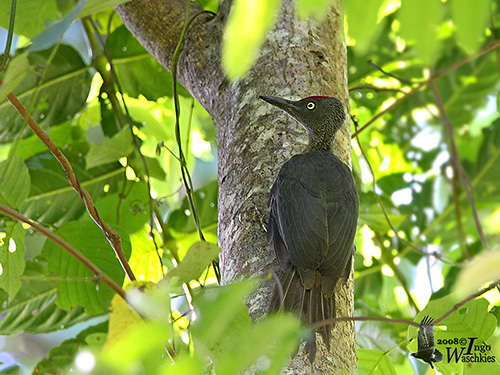
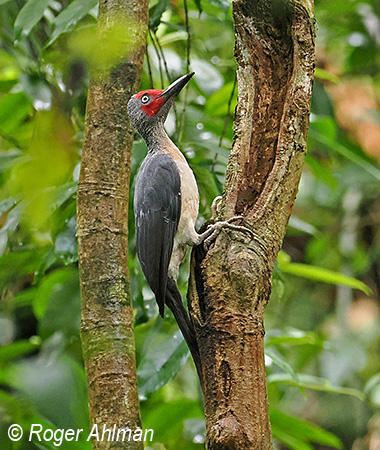
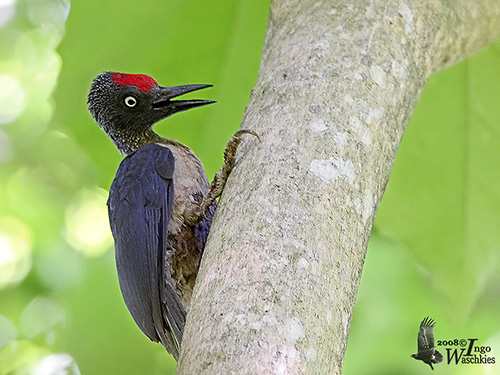
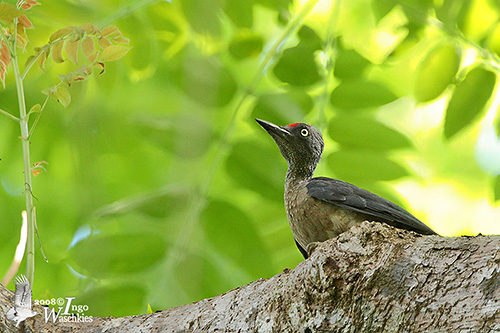
The Ashy Woodpecker adult male has dark grey-brown to blackish-grey upperparts and uppertail, with slightly paler uppertail-coverts where some pale spots or shaft streaks can be seen. The upperwing shows a darker shade.
The underparts are buff to pale yellowish-brown, greyer on the breast, and washed yellowish-grey on the flanks.
The foraging activities against the tree-trunks often involve dark reddish or ochre shades on the breast feathers.
The underwing is pale brownish-grey to darker grey. The undertail is pale brown/grey with yellow tinge.
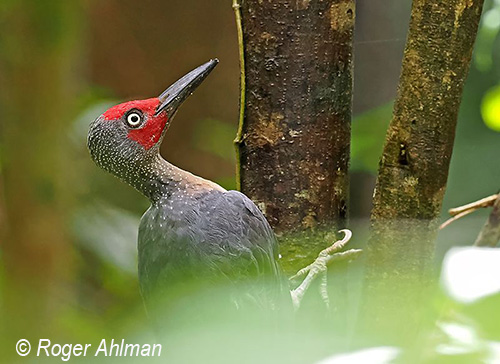
On the head, forehead, lores, cheeks and malar area are red to central crown and front ear-coverts, although being often more restricted at the rear. Some dark feathers can be seen forming a dark line on the lores.
Rear of the head and hindneck are dark grey. Chin, throat and foreneck are pale greyish-buff with very fine whitish spotting.
The black bill is long, slightly chisel-shaped. The culmen is curved and narrow across the nostrils.
The eyes are pale yellow, surrounded by grey orbital skin.
Legs and feet are greenish-grey or tinged bluish.
The adult female has similar appearance, except on the head where the red colour is replaced by dark grey.
The immature resembles adult but it is duller and more spotted. It has some red on the face, mainly on centre of forehead, but less than adult, and red on female even less.
SUBSPECIES AND RANGE:
The Ashy Woodpecker has two subspecies, both confined to Sulawesi and the surrounding islands.
Mulleripicus fulvus fulvus (described above) occurs in northern Sulawesi including the islands of Manterawu and Lembeh, and archipelagos of Togian and Banggai.
Mulleripicus fulvus wallacei is found in southern Sulawesi including Muna Island and Butung Island, and probably Togian Islands.
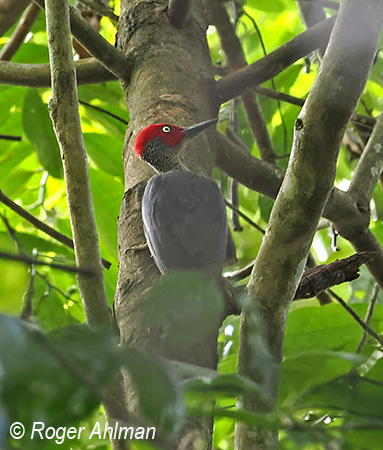
This race is slightly longer winged and longer tailed than nominate. The bill is shorter and the plumage is slightly paler.
The main difference is the red coloration of the head, brighter than nominate and far more extensive, reaching to upper nape and rear of ear-coverts.
HABITAT:
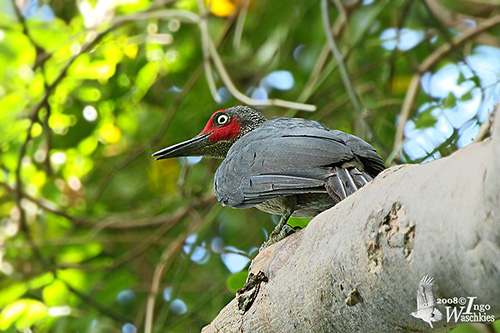
The Ashy Woodpecker favours closed forests, but it also frequents forest patches in savannah and secondary forests. However, the species occurs rarely close to human settlements.
It can be seen from lowlands up to 2,200 metres of elevation.
CALLS AND SONGS: SOUNDS BY XENO-CANTO
The Ashy Woodpecker produces a rapid laughing described as “hew-hew-hew-hew-hew-hew” and a muffled, not loud “tuk tuk tuk”.
They drum strongly during the breeding season.
BEHAVIOUR IN THE WILD:
The Ashy Woodpecker often forages in pairs or small family groups of up to 5 birds.
It feeds primarily on termites (Isoptera), caterpillars, other insects and arthropods, usually taken on tree-trunks. It also consumes ants (Formicidae) obtained from the terrestrial nests of these insects, using gleaning, probing and tongue action.
In the same way, it may also break into termite nests on the ground. The nostrils are protected by feathers that prevent dirt entering them.
The Ashy Woodpecker and the Great Slaty Woodpecker are both large ant-eating and termite-eating woodpeckers.
The breeding behaviour of the Ashy Woodpecker is poorly known. Active drumming and vocal signals are used to advertise the territory.
The courtship displays are unknown, but we can suggest that the red patch on the head of the male is enhanced by adapted postures and movements. The red feathers are erected, the head is extended, and the bill is directed forwards, while the tail is spread and the wings dropped.
This behaviour is used both in courtship and aggressive displays.
This species nests in excavated tree-hole, and most of this work is done by the male. The species is monogamous.
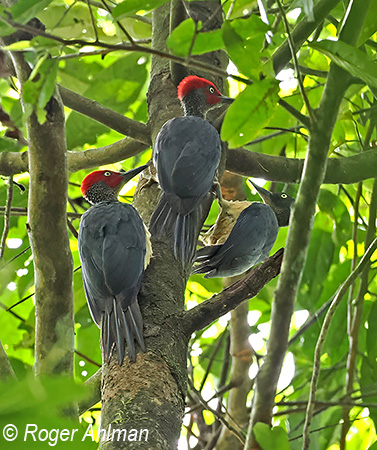
Mulleripicus fulvus wallacei
Female in the background
The Ashy Woodpecker is probably resident within its range.
Woodpeckers are good fliers and the flight is usually undulating.
REPRODUCTION OF THIS SPECIES:
From some observations, the nesting period takes place from March to August. Like most Picidae species, the Ashy Woodpecker nests in excavated hole in dead tree or in dead part of a live tree. The male does about 75% of this work.
A pair was observed during the nest excavation. This work was carried out daily during the cooler hours of the morning.
The hole was 12 metres above the ground, with the entrance facing away from the morning sun. The pair may start several new holes before a final selection is made.
The female lays 2-3 eggs. The male incubates at night. Incubation, brooding and feeding of chicks are shared by both parents.
No more information.
PROTECTION / THREATS / STATUS:
The Ashy Woodpecker is described as not uncommon within its large range, and the species is currently considered secure, as long as the habitat is protected and conserved.
The population trend appears to be decreasing, affected by habitat loss. But this decline is slow and the species is not globally threatened at the moment.
The Ashy Woodpecker is currently evaluated as Least Concern.