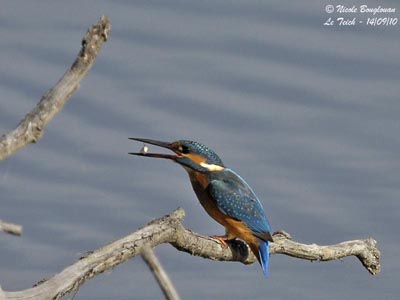
Text and photographs by Nicole Bouglouan, from personal observation in wild.
Thank you to Michel Belaud for his analysis of this stunning observation.
Thank you too to my friends ornithologists for their help about the bird's age, not so easy to make clear!
Sources:
HANDBOOK OF THE BIRDS OF THE WORLD Vol 6 by Josep del Hoyo-Andrew Elliott-Jordi Sargatal - Lynx Edicions, 2001 - ISBN: 848733430X
Martins-pêcheurs, martins-chasseurs, guêpiers et rolliers par Hilary Fry et Kathie Fry – Vigot – ISBN : 2711412679
Animal Diversity Web (University of Michigan Museum of Zoology)
Sungei Buloh Wetlands Reserve (Michael Mastaller)
Summary Observations - Reports
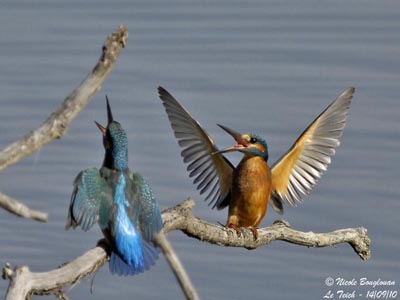
Intimidation displays between two Common Kingfishers
Alcedo atthis
The Common Kingfisher is one of our most beautiful birds with its bright orange and azure-blue plumage.
This well-known species is amazing to observe when fishing by fast dives from a perch, returning to the same branch with the prey in the bill, or hovering above the water, watching for small fishes under the surface.
But this nice bird is really superb during the courtship displays. When the breeding season starts, this solitary nester defends strongly the territory by calling while flying and chasing away the intruders.
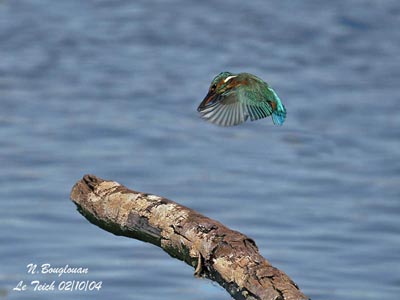
The displays occur on exposed perch where the birds perform different movements in order to enhance the bright colours of the plumage.
Courtship feeding by the male is observed before the copulation.
However, the resident birds may remain in pair through the autumn, but male and female have separate territories of about one kilometre apart, until the next spring.
I recently observed an amazing behaviour within the first half of September, when the breeding season is already finished and all the young are independent.
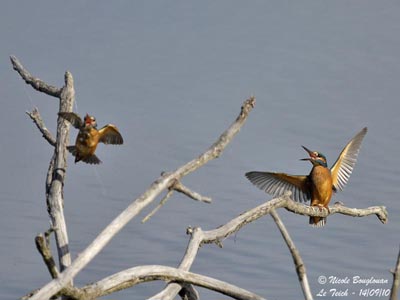
This sequence occurs on dead branches above the water in lagoon. The male is fishing alone and suddenly, it becomes more attentive. It reaches the top of the branch and looks around over the water.
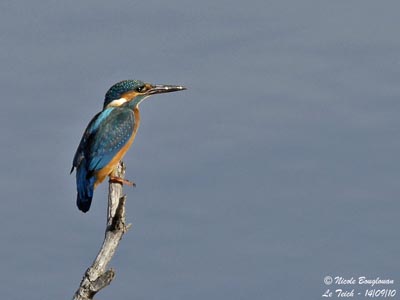
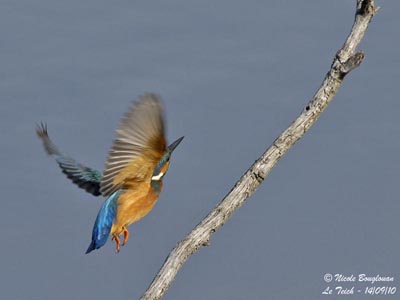
Changing of perch again, it spreads the wings while calling loudly, several harsh “kritritrit” often repeated.
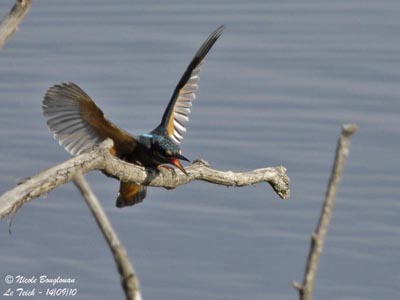
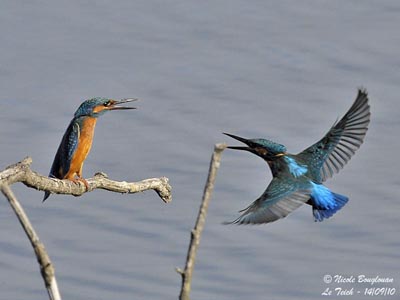
At this moment, another kingfisher, a female with orange lower mandible, joins it on the perch. Both birds call loudly, with wide movements of their open wings.
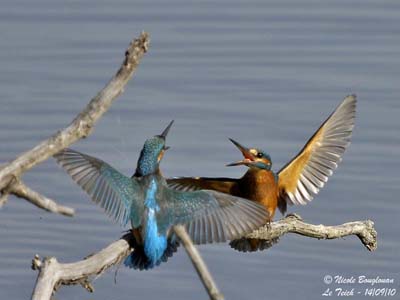
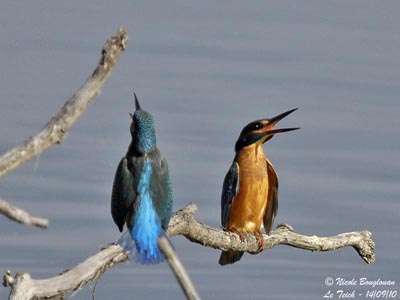
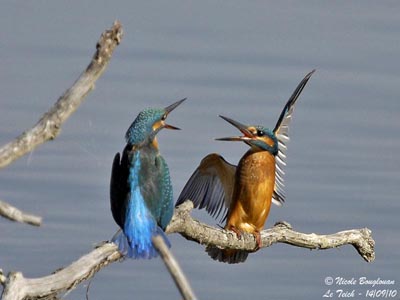
Then, there are several sequences during which both birds raise the head with the open bill upwards. The male is facing the female with the wings widely spread, exposing the bright orange underparts, while the female drops her slightly open wings.
It is clear that these displays are mainly managed by the female. Every time she turns the head towards the male, this one spreads widely its wings. Both birds are face to face with open bill but silent. As soon as the female turns the head on the opposite side and leaves the male’s look, it droops its wings.
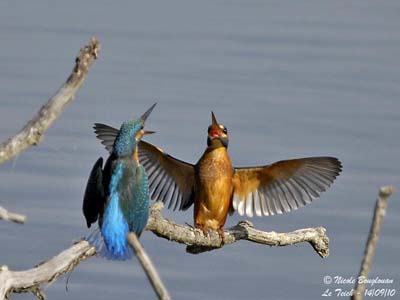
At the end of each sequence, the birds remain briefly motionless close to each other with drooped wings and open bill.
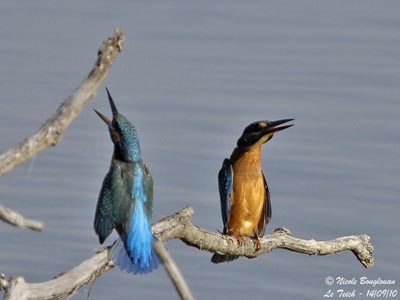
After four similar displays, the female leaves the perch and reaches another branch two metres behind the male, but she returns immediately close to him, and both gives loud calls together before to take off and fly away.
This type of displays can be repeated during several hours and is probably a good way to strengthen the pair-bonds which may last more than one season in this species.
Apparently, these displays have not been observed yet, at least so complete and complex. They are different from the spring displays prior to copulation which are aimed at procreating, whereas these autumn displays are mainly used to strengthen the pair-bonds. But only the birds could answer…
I am very fortunate to have been able to observe this superb behaviour between two amazing birds. To be at the right place and at the right moment is not easy, but sometimes, that happens!
Another interpretation of this behaviour.
These birds could be two juveniles of the year, "young" adults or even adults competing for a feeding territory and a fishing perch. The first bird performs intimidation display in front of the second, in order to defend a very specialized feeding area, restricted to water with rich food sources, especially fish. Both birds are testing their ability to defend this place.
This analysis could appear more correct than mine.
Let me know what you think about this behaviour.