Fr: Caracara austral
All : Falklandkarakara
Esp : Caracara Austral
Ital: Caracara di Forster
Nd: Falklandcaracara
Photographers:
John Anderson
John Anderson Photo Galleries
Otto Plantema
Trips around the world
Nicole Bouglouan
Photographic ramble & My pictures on IBC
Text by Nicole Bouglouan
Sources :
HANDBOOK OF THE BIRDS OF THE WORLD Vol 2 by Josep del Hoyo-Andrew Elliot-Jordi Sargatal - Lynx Edicions - ISBN: 8487334156
Wikipedia (Wikipedia, The Free Encyclopedia)
Distribution and Abundance of the Striated Caracara in the Falkland Islands - 2006
Striated Caracara
Phalcoboenus australis
Falconiforme Order – Falconidae Family
INTRODUCTION:
The Striated Caracara is known as the Falkland Island’s « flying devil », and also named “Johnny Rook” in these islands.
Considered as one of the most intelligent of the birds of prey, the Striated Caracara is primarily a scavenger, but unfortunately, it also attacks new-born lambs and has been heavily persecuted by farmers, involving today its protection by law.
The Striated Caracara is the largest of Phalcoboenus genus, and differs from the other species by the rufous thighs.
DESCRIPTION OF THE BIRD:
Biometrics:
Length: 53-65 cm
Wingspan: 116-125 cm
Weight: 1180 g
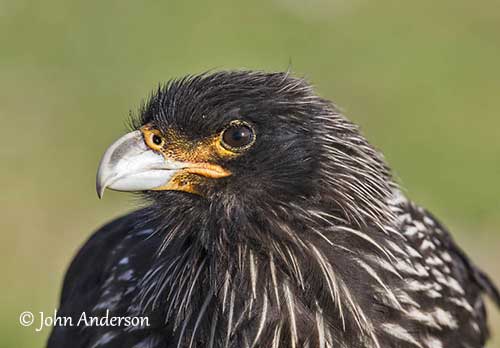
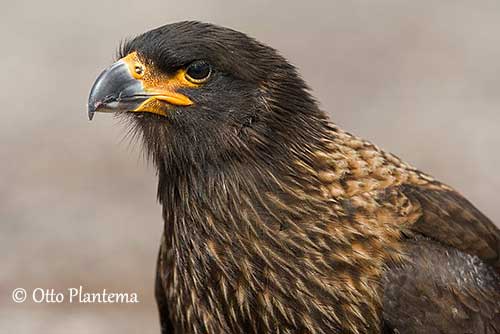
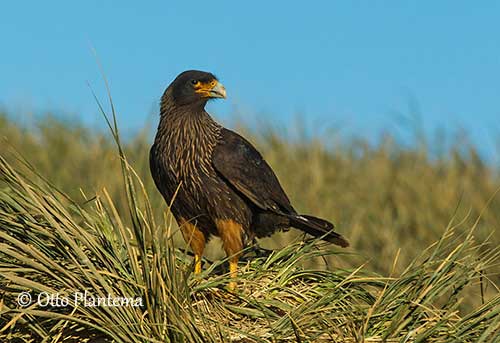
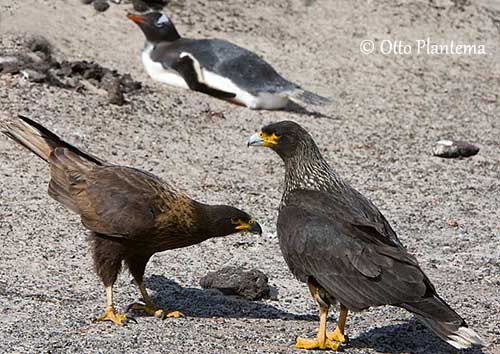
Both adults are similar in appearance. They have black to brownish-black upperparts.
The upper back, neck and breast show creamy-white or pale buff streaking. The dark tail has broad, white terminal band.
The underwing-coverts and the thighs are rufous. We can see a white patch at primary’s bases. The undertail is brownish-black.
On the head, the facial skin is yellowish-orange. The hooked bill is grey with orange-yellow cere. The eyes are dark brown. Legs and feet are orange-yellow.
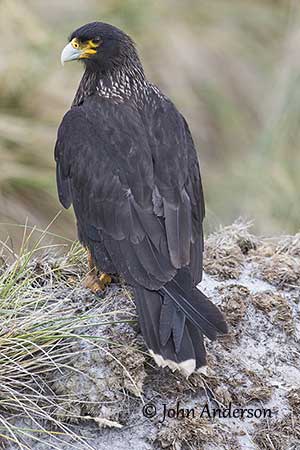
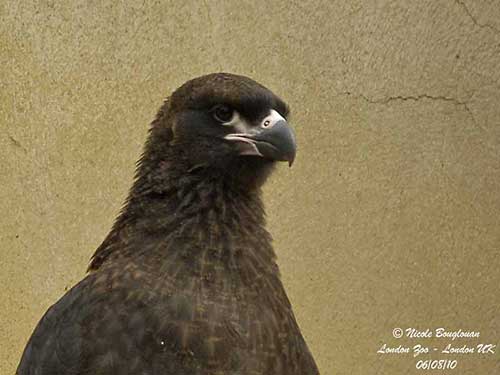
The juvenile has blackish-brown plumage overall. The streaking increases gradually and it needs at least five years to reach the adult plumage.
The facial skin, legs and feet are pale pinkish-grey. The bill is dark grey.
RANGE:
The Striated Caracara is found on the islets off extreme South America and on isolated islands of Argentina and Chile, Staten (Isla de los Estados), Navarino and Cape Horn, and Falkland Islands. We can notice its irregular presence on S and E coasts of Isla Grande on Tierra del Fuego.
HABITAT:
The Striated Caracara frequents the open lowlands and this bird if often seen along the rocky coasts, from tidal zones and probably to the coastal mountains where it may occur at higher elevations.
This species lives only on islands, among seals and seabirds.
CALLS AND SONGS: SOUNDS BY XENO-CANTO
The Striated Caracara, as all the Phalcoboenus species, gives loud calls. These slightly raucous sounds are used for proclaiming a territory or in defence behaviour.
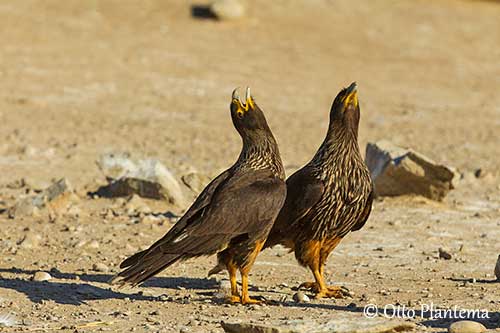
While calling, it throws the head back, sometimes touching the upper back.
When disturbed, they give grumbles, and make short clicks at nest.
BEHAVIOUR IN THE WILD:
The Striated Caracara is a scavenger, feeding primarily on carrion, dead seabirds in their breeding colonies, but also penguin’s carcasses.
When the seabirds are absent from the colonies, the Striated Caracara scratches for insects and other invertebrates along the tidal areas. It also moves the stones to search for food.
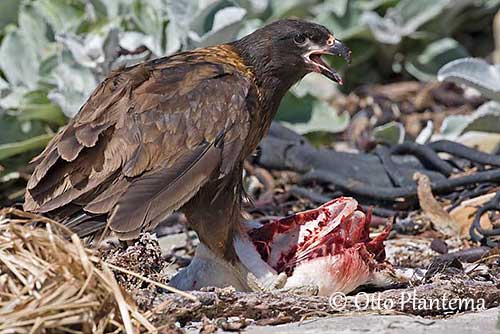
This raptor is not known for killing healthy young animals. It is attracted to adjacent settlements by dead sheep during winter, involving conflict with farmers. It may attack weak or stranded animal.
However, this opportunistic bird is able to dig up with the claws small seabirds from their burrows during the day, but also to hunt them on the wing at night when they go out. It also takes eggs and chicks of the larger seabirds on the rocky coasts, and chicks of Spheniscidae.
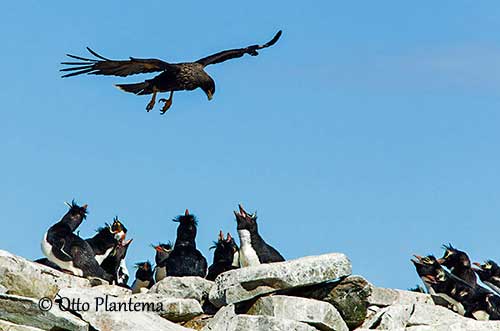
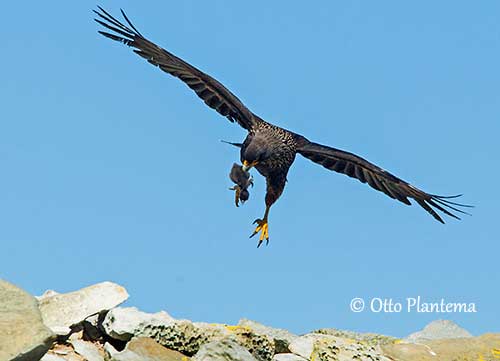
The Striated Caracaras hunt in groups of up to 50 birds, and raid the newborn lambs in pastures. For these actions, the species has been persecuted over the years. In addition, they can steal objects around the habitations on islands, and mainly red objects.
During these actions, quarrels occur between them, and they fight, facing each other, hitting them with legs and talons while calling loudly.
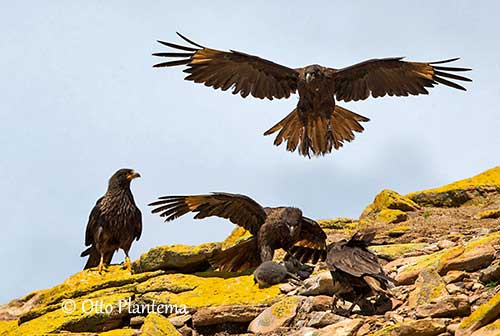
The Striated Caracara often becomes aggressive towards intruders, even humans entering its territory. It attacks by flying at the intruders, with both bill and talons hold towards them.
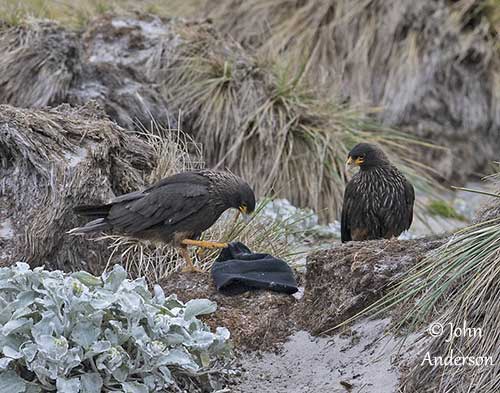
Photographer's comment about the following picture:
Checking if my hat is edible. The male had just taken it off my head and the female attacked my head, felt like getting hit by a hammer. The bird gashed my ear quite badly luckily no eye damage.
They also ran at me and were close to attacking me again until using my camera as a defense I withdrew from their territory.
During the breeding season, both mates perform some displays, and especially the “head-throwing” display in front of each other.
The Striated Caracara is territorial, uttering loud, raucous advertising calls.
This species is not migratory, but can perform seasonal movements up into coastal mountains.
It is winter visitor on N Navarino Island, and S and E of Tierra del Fuego.
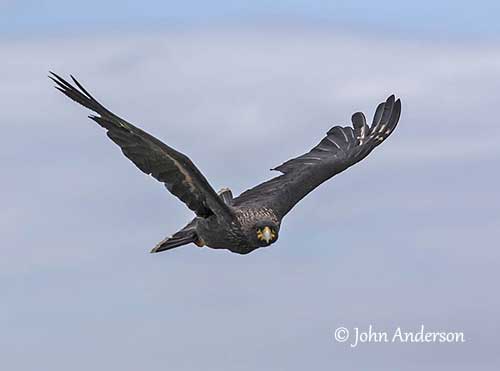
The Striated Caracara performs powerful, fast flight with steady and rapid wing-beats.
REPRODUCTION OF THIS SPECIES:
The breeding season takes place during the austral summer, from December to late February.
The Striated Caracara nests on rock ledges or under tussock of grass. The nest is made with twigs and dried grasses, and lined with wool if available.
This species is loosely colonial, with neighbouring pairs invisible from each nest. They nest sometimes less than ten metres apart when the nest-sites are limited.
Within the colonies, the birds are individual breeders.
The female usually lays 1-4 eggs. The chicks hatch during the seabirds’ nesting season, providing abundant and constant food sources for the young.
The nest is defended by both adults by chasing the intruders.
Once they have fledged, the young gather into flocks and wander through the islands. At this moment, they can be seen close to human habitations after to be chased away from the nest-site by their parents. They are fearless and attack campsites while searching for food.
PROTECTION / THREATS / STATUS:
The Striated Caracara has been heavily persecuted for its ability to kill new-born lambs, but now, the species is protected by law. The very restricted habitat makes this bird the rarest raptor of the world.
The population is estimated at about 1,000/2,499 mature individuals, equating to 1,500/4,000 individuals.
It is currently considered Near Threatened, but the breeding population is suspected to be increasing with the conservation legislation and the protection of the major sites.