Fr: Gallinule poule-d'eau
Ang: Common Moorhen
All: Teichhuhn
Esp: Gallereta Común
Ital: Sciabica
Nd: Waterhoentje
Russe: Камышница
Sd: Rörhöna
Photographers:
Alfredo Colón
Puerto Rico Wildlife
Nicole Bouglouan
PHOTOGRAPHIC RAMBLE
Text by Nicole Bouglouan
Sources:
HANDBOOK OF THE BIRDS OF THE WORLD Volume 3 by Josep del Hoyo-Andrew Elliott-Jordi Sargatal - Lynx Edicions - ISBN : 8487334202
THE HANDBOOK OF BIRD IDENTIFICATION FOR EUROPE AND THE WESTERN PALEARCTIC by Mark Beaman, Steve Madge - C.Helm - ISBN: 0713639601
THE COMPLETE BOOK OF BRITISH BIRDS – Written by “Royal Society for the Protection of Birds” experts - Préface de Magnus Magnusson - Michael Cady- Rob Hume Editors - ISBN: 0749509112
Avibase (Lepage Denis)
BirdLife International
Wikipedia, the free encyclopaedia
Biodiversity Explorer – The Web of Life in Southern Africa
Common Moorhen
Gallinula chloropus
Gruiforme Order – Rallidae Family
INTRODUCTION:
The Common Moorhen and the Common Gallinule were formerly the same species, but the latter is now a full species named Gallinula galeata.
Some morphological and behavioural differences confirm this new taxonomy, and this page reflects this recent change.
DESCRIPTION OF THE BIRD:
Biometrics:
Length: 30-38 cm
Wingspan: 50-55 cm
Weight: 271-339 g
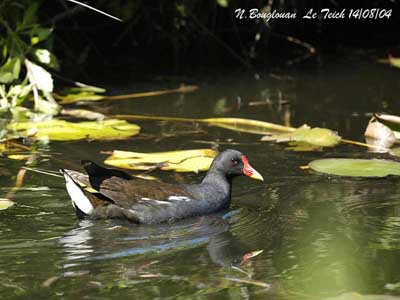
The Common Moorhen has slate-black plumage. Upperparts are brownish. We can see a white stripe on flanks and white lateral undertail coverts.
The pointed bill is red with yellow tip, and extends upwards in red frontal plate.
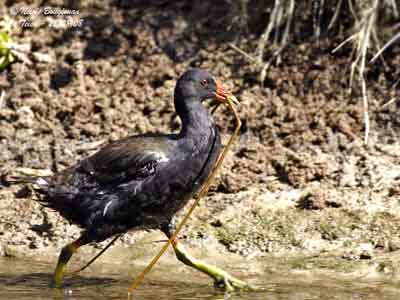
The eyes are dark red. Legs and long feet are bright yellow-green or yellow, with red-orange upper half of tibia.
Both sexes are similar, with male slightly larger than female.
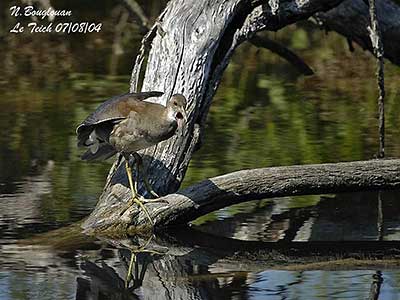
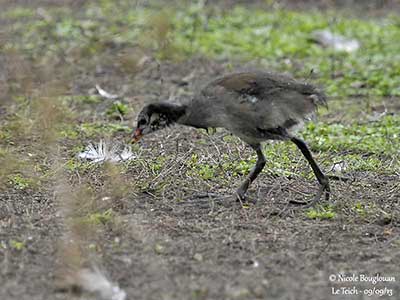
The juvenile is brownish with paler throat and belly. It has dull whitish-buff stripe on flanks. Bill and legs are dusky.
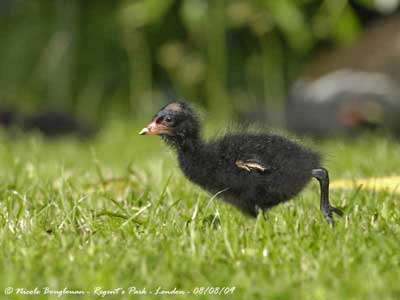
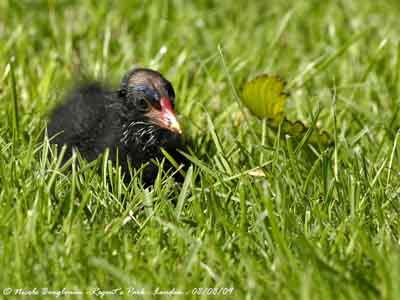
The chicks are covered in black down, and have red bill with black tip.
The Old World birds have mostly elliptic shield, whereas the New World birds have top almost squared and widest near the top.
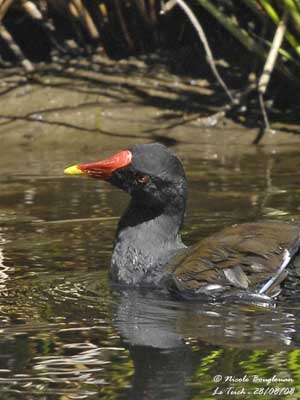
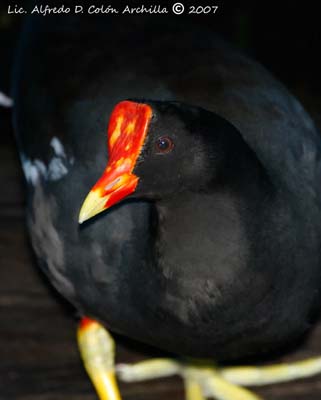
New World
SUBSPECIES AND RANGE:
The Common Moorhen has five recognized subspecies which differ in size, colours of upperparts and size and shape of the shield.
G. c. chloropus occurs in Europe, N Africa, Azores, Madeira, Canaries and Cape Verde Islands E through W, C & S Asia to Japan, S to Sri Lanka and C Malay Peninsula. The N populations winter S to Mediterranean region, sub-Saharan Africa and S Asia.
G. c. meridionalis is found in sub-Saharan Africa, São Tomé and Príncipe, and St Helena. This race is smaller than nominate, with slaty blue-grey upperwing-coverts, but it lacks olive tinge.
G. c. pyrrhorrhoa occurs on Comoro Islands, Madagascar, Reunion and Mauritius. This one has buff undertail-coverts.
G. c. orientalis occurs in Seychelles, Andaman Islands, S Peninsular Malaysia, Greater Sundas and W Lesser Sundas to Philippines and Palau Islands. This race resembles “meridionalis” but with relatively large frontal shield.
G. c. guami is found Northern Mariana Islands and Guam. This one resembles nominate but it is darker.
HABITAT:
The Common Moorhen frequents freshwater or brackish wetlands with fringing vegetation and brushy cover. It is found near ponds, slow rivers, marshes and lakes, and also in parks in urban areas.
CALLS AND SONGS: SOUNDS BY XENO-CANTO
The Common Moorhen utters a variety of sharp calls. We can frequently hear a low, rolling “krrruck”, a sudden short “chuck”, and a sharp “kik” or “kittick”. It gives a repeated fast clucking “krek-krek-krek-krek” often in flight, and mainly at night during spring.
When they fight, the birds utter short clocking chatter.

BEHAVIOUR IN THE WILD:
The Common Moorhen is a familiar waterside bird. It swims, or walks along the shore, and runs for cover.
This species is omnivorous, and feeds on seeds, grass, rootlets and soft parts of aquatic plants taken by diving. They also eat snails, worms, crayfish, grasshoppers, insects, algae, tadpoles and berries.
It feeds by picking food from the surface, or from aquatic emergent vegetation. It dips the head, dabbles and may sometimes dives for food. It takes molluscs and seeds from the underside of the floating leaves.
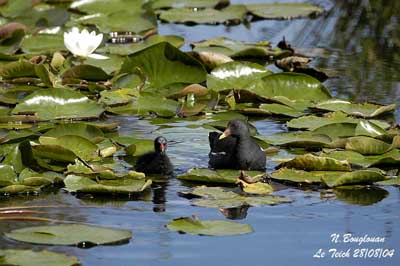
It uses its long toes for walking on the floating vegetation and in soft mud. It does not have webbed feet, but it swims very well. While swimming, it bobs its head back and forth. The Common Moorhen is active by day and at night.
It swallows sand and gravels to grind the vegetal food.
During the courtship displays, the male brings water weeds to the female. It also fans out its tail, in order to display the white undertail-coverts. They are monogamous and territorial. The pair-bonds may last for several following years.
They build several nests, and once the chicks leave the main nest, they are used for sleeping at night.

The Common Moorhen is migratory and dispersive depending on the range. The main southwards migrations occur between September and December, and they return between March and May. Both British and French populations are resident.
This species has fast, strong, direct flight and is able to migrate over long distances.
REPRODUCTION OF THIS SPECIES:
The breeding season varies according to the range.
The Common Moorhen’s nest is a wide shallow cup made with dead vegetation (stems of cattails), well rimmed and lined with grass and leaves. The nest is located in shallow water, but anchored with stems to the emergent vegetation.
Sometimes, the nest may be located on the ground, in a low shrub, or on floating vegetation.
This species often breeds in urban waters, and the nest is usually lined with paper, string, plastic and all debris found in the vicinity.
Both adults build the nest. A sloping runway allows reaching or leaving the nest. They may nest in small colonies sometimes.


The female lays 6 to 10 buffy-white to whitish eggs, spotted with brown. The incubation lasts about 18 to 21 days, shared by both parents. The incubation starts with the first egg laid, and up to four days often separate the first from the last egg hatched.
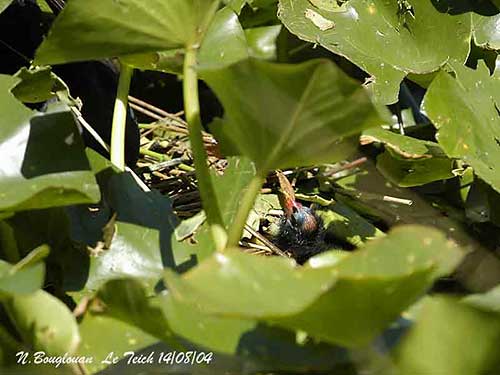
The chicks are precocial, and fed by both adults. But the young leave the nest very soon, within 2-3 days, and are able to feed themselves within a few days of birth. They fledge about 5-7 weeks after hatching.
This species may produce up to 3 or even 4 broods per season at 20-30 days interval, reusing the same nests.

PROTECTION / THREATS / STATUS:
The Common Moorhen is common and widespread, in spite of habitat loss in some parts of its range. The nest can be lost by flooding.
The European breeding population is estimated to number more than 900,000 pairs, and this population was stable between 1970 and 1990. In spite of declines in some countries, the numbers are stable in Europe and the French population has increased.
The Common Moorhen is currently evaluated as Secure.