African Darter
Anhinga rufa
Suliformes Order - Anhingidae Family
BIOMETRICS :
Length: 81-97 cm ; Wingspan: 115-128 cm ; Weight: 1050-1350 g
LONGEVITY: up to 16 years
DESCRIPTION:
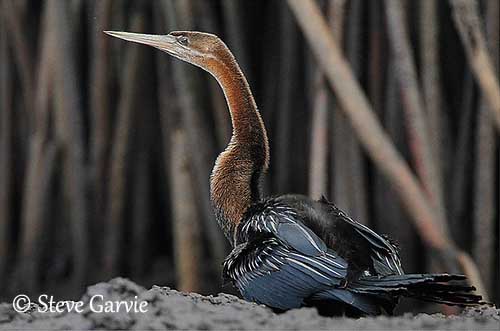
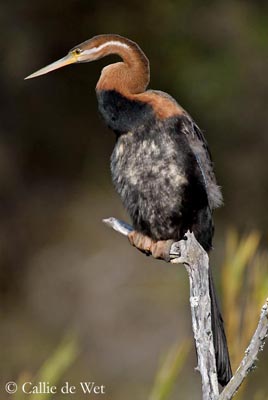
African Darter male has crown and back of the neck black and chestnut. Rest of the neck is chestnut, with conspicuous white stripe from the sides of the face to mid-neck. Its plumage is glossy black, streaked with white and silver on wings and mantle, and prominently on elongated black scapulars’ feathers. It has long black tail, held fanned when resting. Legs and webbed feet are brown.
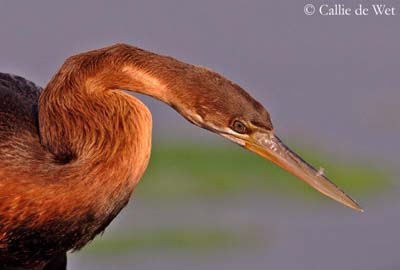
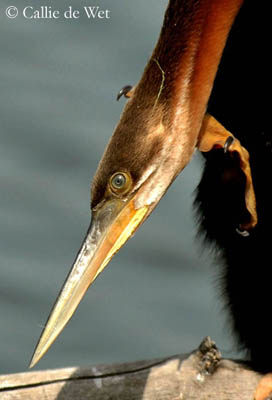
Eyes are golden. Long sharp pointed bill is horn-brown. Chin and throat are whitish. Male has generally larger bill than female.
Female and immature are paler than male, mostly buffy-brown. Female has brown crown and upper neck. She has less distinct white stripe on the neck sides.
Chicks are covered with white down.
African Darter is also named “snake bird”, because it swims very low, with only head and neck above the water.
VOICE: SOUNDS BY XENO-CANTO
African Darter is mainly silent, but at nest, it utters a harsh croak.
HABITAT:
African Darter frequents fresh and brackish waters, fringed with vegetation, especially near mangroves.
RANGE:
African Darter lives in Sub-Saharan Africa and Middle East. It performs local migrations according to the rainfalls.
BEHAVIOUR:
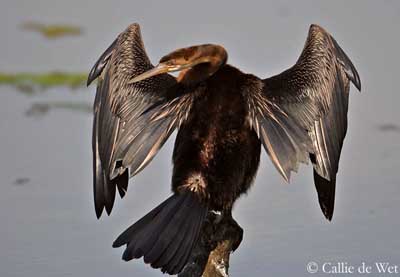
African Darter is often seen perched on bare branches or stumps above the water. If alarmed, it drops vertically into the water. It needs to dry its plumage after fishing with wings outstretched.
African Darter dives for long periods, to search for aquatic preys. It swims with the body under water, allowing ambushing prey items. It propels itself with its webbed feet. It spears the fish in flank, and brings it to the surface, where it tosses it into the air, catches it with the bill and swallows it head first.
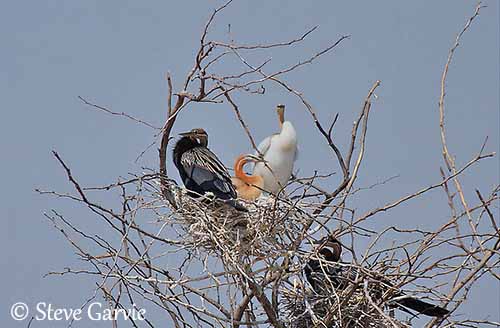
African Darter nests and roosts with other species, such as Egrets, Herons and Cormorants.
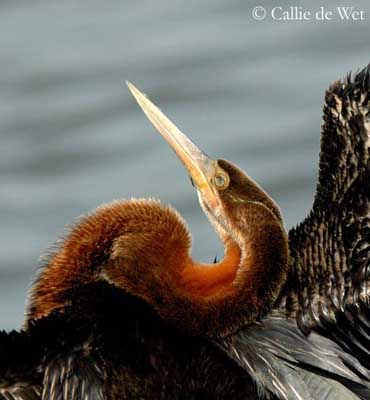
African Darter seems to be seasonally monogamous. Courtship displays may include wing-waving, snap-bowing or twig-grasping and also sky-pointing, neck-waving or bowing, and wings-lifting. Copulation occurs at nest site.
African Darters are highly territorial. They may gather in flocks of up to 100 birds, and some interactions are common between males.
FLIGHT:
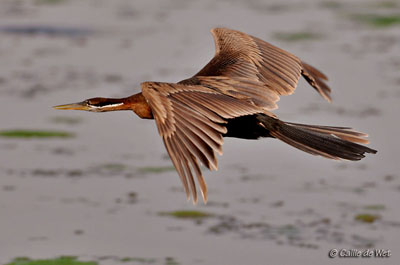
African Darter flies with long tail slightly fanned and neck partially held forwards. It performs wing beats and short glides, and frequently, it soars high in the sky, often above the colony.
REPRODUCTION:
African Darter nests in mixed colonies. Breeding season is prolonged and variable, according to the rainfalls. Nest is located in trees, reeds or bushes, over water. It is made with sticks and reeds, and lined with fine materials. Male brings twigs to female, and she builds the nest.
Female lays 3 to 5 pale green eggs. Incubation lasts about 25 to 30 days, by both parents, with eggs placed on the top of the large webbed feet. Chicks hatch altricial, and covered with white down in two days. Both parents feed and brood them.
Young fledge at about 5 weeks, and they are fed two weeks more by their parents. They reach their sexual maturity at two years.
DIET:
African Darter feeds mainly on fish, but they also prey amphibians, reptiles and invertebrates.
PROTECTION / THREATS / STATUS:
African Darter eggs are collected by humans. They have predators such as crocodiles, ravens, raptors, crows and eagles.
Fr: Anhinga d’Afrique
All : Schlangenhalsvogel
Esp : Anhinga Africana
Ital : Aninga africana
Nd : Afrikaanse Slangenhalsvogel
Sd : Afrikansk ormhalsfagel
Photographers:
Callie de Wet
GALLERY
Steve Garvie
RAINBIRDER Photo galleries
Text by Nicole Bouglouan
Sources:
HANDBOOK OF THE BIRDS OF THE WORLD vol 1 by Josep del Hoyo-Andrew Elliot-Jordi Sargatal - Lynx Edicions - ISBN: 8487334105
BIRDS OF AFRICA SOUTH OF THE SAHARA by Ian Sinclair and Peter Ryan - Princeton University Press Princeton and Oxford - ISBN: 0691118159
Wikipedia (Wikipedia, The Free Encyclopedia)
BirdLife International (BirdLife International)
Biodiversity Explorer – The Web of Life in Southern Africa